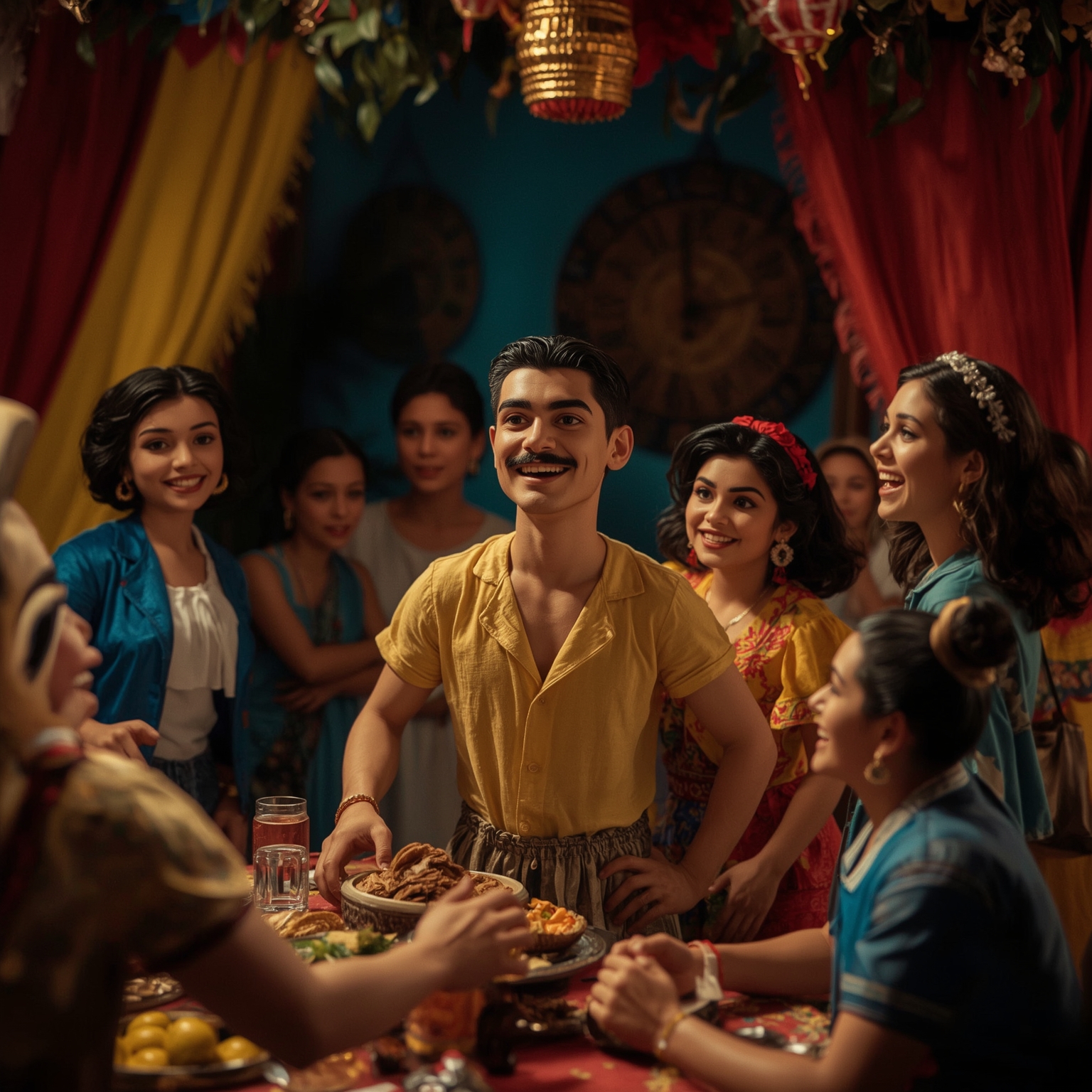
Picture, for a moment, what might happen if George Cukor’s iconic 1939 film *The Women*—a witty dramedy chronicling the entanglements and betrayals of affluent New York society—were completely reimagined. Instead of being rooted in Manhattan’s golden-era high society, envision this version unfolding as a modern Spanish-language telenovela, not in the United States, but situated in the vibrant, layered cultural landscape of Ecuador. Now go further: instead of Hollywood’s most luminous stars of the era such as Joan Crawford and Norma Shearer delivering melodramatic performances, imagine those characters crafted entirely through the tactile surrealism of stop-motion animation and directed with the flamboyant intensity and emotional verve of Pedro Almodóvar. Such a project would not simply offer camp entertainment; it would be a subversive work of art, one that deliberately normalizes queer identity and unapologetically weaves together themes of colonial history, exploitative capitalism, and the lingering consequences of both. That, in essence, captures the spirit of Adult Swim’s imaginative stop-motion series *Women Wearing Shoulder Pads*.
When I sat down with the series’ creator, Gonzalo Cordova, along with Cinema Fantasma’s founders, Arturo and Roy Ambriz, they expressed that their overarching ambition was far more profound than playful absurdity. To them, *Women Wearing Shoulder Pads* provided a rare chance to explore the nuances and contradictions of Latin American identity in its full complexity. While undeniably humorous and sometimes exaggerated to the point of surrealism, they wanted the series to feel like a deliberate reflection of life as it can be experienced across South America. Part of that authenticity involves language itself. For the first time in Adult Swim’s catalog, nearly the entire show is presented in Spanish—a bold creative choice, but also a deeply meaningful one. “If we told this story in English, it would ring false,” Cordova explained. “It would feel like an unnecessary concession to mainstream marketability. As an artist, I see it as my responsibility to resist those forces. The studio’s role is to challenge me back, and it’s within that tension that truly dynamic work can emerge.”
At its narrative core, *Women Wearing Shoulder Pads* centers on the magnetic yet ruthless Marioneta Negocios, portrayed by Pepa Pallarés. Born in Spain but now residing in Ecuador’s capital city, Quito, Marioneta thrives as a cunning entrepreneur whose ambitions consistently override loyalty or morality. In Quito, the humble cuy—guinea pig in Ecuadorian Spanish—is cherished as a culinary delicacy intertwined with cultural heritage. Marioneta, however, flippantly dismisses this outlook and instead positions the animal as a domesticated pet. She recognizes that undermining the cuy’s culinary value could cripple the empire of her longtime rival, the formidable meat magnate Doña Quispe (Laura Torres). This calculated scheme, however, comes at a significant personal cost. Her intermittent lover, Espada (Kerygma Flores)—a daring woman who stages ritualistic cuy fights in packed stadiums—is directly endangered by Marioneta’s plans. Yet, in Marioneta’s eyes, the destruction of others is incidental; her personal desires, opportunism, and conquest remain the only priorities. The interpersonal entanglements become both a parody of melodramatic tropes and a vehicle for political allegory.
Each episode is infused with irreverent absurdities reminiscent of Adult Swim’s most audacious programming choices. Characters burst into sudden musical performances without warning. Quito, a city of cobbled streets and mountainous backdrops, becomes the stage for bizarre spectacles—such as Nina striding across town atop a gargantuan guinea pig saddled like a horse. To further complicate boundaries between the animated world and tangible reality, certain sequences suddenly cut away to live-action shots of human performers. And yet, despite its farcical energy, the series carries a cinematic flourish and ringing cultural specificity that distinguish it from anything Adult Swim has attempted before in the stop-motion sphere.
For Cordova, the duality of irreverence and authenticity was crucial; *Women Wearing Shoulder Pads* had to be outrageous but also unapologetically Latin American. That conviction sparked tremendous excitement in the Ambriz brothers, who, although usually drawn toward the fantastical and supernatural, understood the distinct challenge of animating a show grounded in real social and political textures. Roy Ambriz candidly explained, “Too often, Hispanic lives are depicted exclusively through the gaze of outsiders—people disconnected from what it means to live in Latin America. Frequently, details vanish or are misrepresented. Gonzalo’s vision spoke to us because it countered that, making Latin culture visible without distortion.”
Cordova’s personal admiration for Spanish auteur Pedro Almodóvar shaped much of the show’s tone. As a lifelong devotee of the director’s films, he aspired not to parody but rather to channel a heightened homage to Almodóvar’s flamboyant visual storytelling and penchant for complex female characters. For Cordova, comedy meant exaggeration—dialing every dramatic element just beyond equilibrium to see how tensions would mutate. That principle guided not only comedic structure but also character design: virtually every central figure in the show is female and queer by default. “Even when Almodóvar populated his movies with ostensibly heterosexual characters,” Cordova noted, “those stories still radiated queerness. We wanted to take that innate energy, amplify it, and push it to its logical extreme. In a romantic melodrama stripped of patriarchal centrality, the only remaining pathway is to let queerness define every relationship.”
Interestingly, Cordova often emphasizes that the series’ most audacious ‘joke’ may not lie in its storyline, but rather in its enormous technical magnitude. Early in development, he considered staging the narrative with puppeted marionettes, leaning into their inherent awkwardness as a comedic device. But animation offered a far broader canvas for experimentation—especially for ambitious camera angles or complex visual metaphors. “I’ve worked in live-action before, and I would dream about impossible shots—like mounting the camera on the ceiling and following the characters beneath. But this was the first time that my imagination wasn’t constrained. Stop-motion allowed those impossible visions to materialize,” he reflected. Marionettes, limited in physical expression, would have underscored a single gag about stiffness, possibly undermining the dramatic richness he envisioned.
The Ambriz brothers expanded on the craft, clarifying that in stop-motion filmmaking, fluid camera movement remains among the artform’s greatest trials. Lighting, too, represents a formidable challenge, particularly when Cordova requested dramatic lighting schemes heavy with shadows and emotional contrast. Many complicated sequences ended up requiring Cinema Fantasma’s team to produce individually tailored, handcrafted frames, far beyond the efficiency of recycling sets or motions. Arturo Ambriz stated, “Gonzalo always insisted that cinematography had to be conceptual—it wasn’t enough to stage movement. Every shot had to embody visual intention, whether through nuanced lighting or character choreography. In a typical stop-motion project, you might rely on three core sets, a handful of puppets, a limited selection of props. On this show, though, almost every frame was uniquely built. That ambition became the ethos.”
This commitment to detail crescendos spectacularly in the show’s first-season finale, which frames a temporary closing chapter in Marioneta’s ongoing saga. However, Cordova admits that what lies ahead remains tantalizingly open-ended. He envisions exploring this storytelling universe through new characters and fresh vantage points. Familiar figures might reemerge, but the forward momentum lies in constructing each season as semi-standalone—a serial storyworld that resists full anthology structure yet ensures variety and novelty. “It’s called *Women Wearing Shoulder Pads* for a reason,” Cordova observed. “Every season, we need to deeply honor that title by introducing new women, presenting their stories, and weaving each one into the broader tapestry. Returning elements will remain, but each cycle must be satisfying on its own.”
Audiences eager to experience this collision of satire, cultural specificity, and visual inventiveness can tune into the next episode of *Women Wearing Shoulder Pads* airing this Sunday on Adult Swim. For those preferring to immerse in the saga uninterrupted, the entire season will debut as a feature-length special on HBO Max on September 29th—an opportunity to witness in one sitting the full measure of this bold, culturally resonant, and uniquely absurd piece of animation.
Sourse: https://www.theverge.com/tv/777484/women-wearing-shoulder-pads-interview