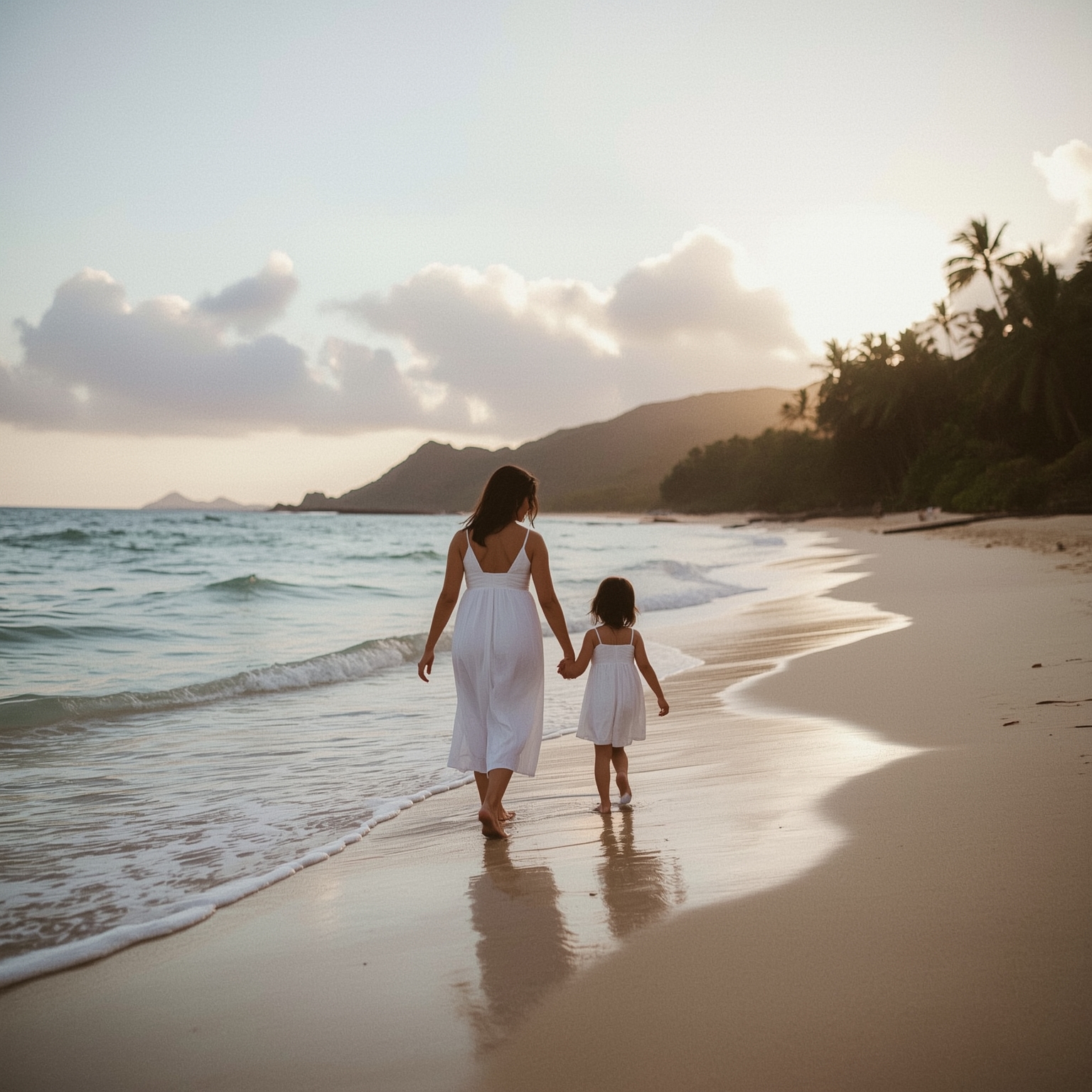
Eighteen months ago, I made the life-altering decision to dismantle the stability I had established in Michigan and transport my entire existence across the Pacific Ocean to the Hawaiian Islands. This choice was not impulsive; rather, it was the culmination of deep reflection and an acknowledgment of the multiple factors pressing on both my heart and my reasoning. Above all, nearly four-fifths of the motivation came from an unwavering dedication to my daughter’s well-being and ensuring that she, despite the difficulties of a divided household, was surrounded by love, support, and opportunity. Another portion of the reasoning—though smaller—was fueled by my personal longing to escape the harsh monotony of Michigan winters and to reconnect with my long-neglected identity as an island-raised woman. Finally, the remaining share stemmed from honoring the life plan that had existed before my divorce, one that involved planting our family’s roots in Hawaii.
Support was not merely a preference but a necessity. When my marriage began to unravel, I felt an ever-growing anxiety about whether I would remain connected to the people who had once been my extended family. My greatest fear was that divorce would sever not only my bond with my ex-husband but also with his mother, a woman who had become my sole maternal figure. Thankfully, our post-divorce civility softened that blow, and the continuation of these family ties remained one of the smoother aspects of this transition. On the other hand, one of the most disorienting and painful challenges was facing the stark emptiness where the future we had planned once stood. Divorce had dismantled that shared vision, but one element survived intact: his unexpected yearlong military deployment overseas. The unfolding reality forced me to accept that my daughter and I would need more support than I could possibly provide alone in Michigan.
I had not lived near my own biological family for a decade, and while I briefly considered moving back to Idaho to live nearer to them, the idea felt like both a personal regression and an emotional defeat. Boise had transformed in ways that made it even less appealing—its soaring cost of living only compounded my sense that this was no longer a place where I belonged. Having once left that city because I felt alien and out of place, returning there seemed to violate the forward-looking spirit that had carried me before. Ultimately, this left only one viable choice: Hawaii. There, my daughter would not only connect with her Polynesian heritage but also immerse herself in the traditions, rhythms, and family networks that were unique to her identity. For me, the allure of a climate that matched my memories of sun-soaked vitality also whispered promises of renewal.
After six months of meticulous preparation—tying countless loose ends, arranging logistics, and trying to prepare emotionally for the upheaval—it was time to board the plane. Friends and acquaintances continually asked if I felt excited. In truth, excitement hardly captured my feelings; I was suspended in a surreal state, weighed down by the realization of all I was leaving behind. My daughter, who in less than two years had already lived in three different homes, was on the verge of yet another transition. Unlike the earlier ones, this move would not pass unnoticed; she had blossomed in kindergarten, forged cherished friendships, and now understood the meaning of departure. With the momentum irreversible, I forced myself onward, repeating the mantra that eventually everything would settle into place.
My daughter traveled ahead of me to Hawaii, arriving before I could welcome her there, a separation that pained me deeply. Her father sent photographs, and although I treasured them, I hated the distance at that pivotal moment. Yet, to my astonishment and relief, she adjusted seamlessly; within mere days she was snorkeling in the luminous ocean waters, laughing with cousins whose names she still stumbled over, and receiving open-hearted embraces from relatives who welcomed her with unquestioning warmth. Her joy was palpable, and in witnessing her thriving, my own heavy heart felt lighter.
My adjustment, by contrast, was far more difficult. In the aftermath of divorce, I had been painstakingly constructing a new identity, yet the move fractured that fragile progress. To his family, I was still defined primarily in relation to him, continually introduced not as myself but as his former spouse. Many relatives, who had not seen me in years, included me in their gatherings with kindness, yet their conversations were laced with histories and shared jokes of which I knew nothing. Despite their generosity, I often felt like both a guest and an outsider—respected, perhaps, but never fully at ease. Living in their home amplified the sense of displacement, for the walls were not truly mine, and I often quieted my presence to maintain harmony. In chasing the vision of a supportive village, I had inadvertently left behind the people who knew, loved, and truly saw me, exchanging familiarity for a dream that, at times, felt unbearably lonely.
Gradually, however, subtle shifts began to offer me relief. Our landlord entered our lives in steady, understated ways—allowing my daughter to spend precious mornings with her dog, arriving with food when we least expected it, and inviting us to beaches that began to feel like sanctuaries. With her, I no longer bore the weight of being identified as merely someone else’s former wife. I was seen as myself, independent of divorce, separate from my past. This was a quiet but profound reprieve.
Meanwhile, my daughter flourished. She embraced her culture with zeal, learning snippets of language, dancing hula with unselfconscious grace, and proudly requesting to dress as the Hawaiian state fish for Halloween. Her Hawaiian relatives lavished her with attention and affirmation, fortifying her developing sense of identity and belonging. I will never forget the image of her during her first hula performance—bare feet grounding her, face glowing with confidence, body alive with rhythm. In that instant, I knew she would be all right.
Every few weeks, something happens—an unexpected moment, an embrace of community, a burst of her laughter—that reminds me why we came. I know in my soul that I will never regret making this move for her sake, even if I remain unclear whether it was equally best for me. Over the past year, I have endured nights of doubt, questioning whether I made a staggeringly wrong choice, yet I have also discovered veins of resilience and pieces of stability where I least expected them. My mother-in-law and her circle introduced me to communal rituals, his extended family folded me into their celebrations, new friends lifted me when exhaustion struck, and my landlord quietly transformed into kin.
Life here is far from effortless. There are days when survival feels held together by nothing more than duct tape and sheer determination. I labor relentlessly to keep a roof overhead and balance the invisible emotional burdens I carry alone. And yet, this messy, imperfect existence has taught me invaluable lessons: the necessity of releasing rigid expectations, the courage required to ask for help, and the growth that emerges only when one sits with discomfort rather than fleeing from it.
Although I do not always feel fully at home, Hawaii is slowly becoming the ground where I am reconstructing a new version of myself. What I have built here is imperfect and incomplete, but it is nonetheless real. The journey has been tangled, disorienting, and humbling, but the root that matters most—my daughter—has grown strong and sure in this place. She is thriving in a way no other environment could have allowed. And for that reason, despite the loneliness, the struggles, and the many uncertainties, I know the leap was worth taking. Our life here is messy, complicated, and a constant work in progress—but it is precisely where we belong.
Sourse: https://www.businessinsider.com/moved-from-michigan-to-hawaii-raise-daughter-with-ex-2025-9