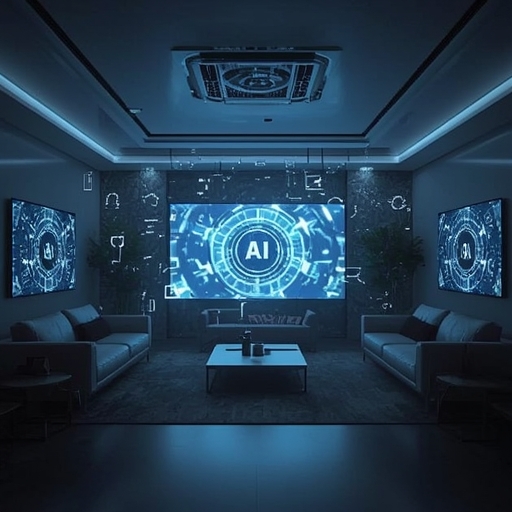
Each January, the Consumer Electronics Show turns into an extravagant showcase where television manufacturers compete to dazzle audiences with brighter displays, higher resolutions, and a growing array of features labeled as “intelligent.” Yet underneath the spectacle of luminous panels and sleek designs, an unsettling question persists: have these companies taken their fixation with artificial intelligence too far? \n\nOnce upon a time, the evolution of television revolved around tangible improvements—sharper picture clarity, truer color accuracy, and enhanced sound fidelity. Today, however, the race for differentiation increasingly depends on embedding AI into every conceivable aspect of the user experience. Remote controls are replaced with voice assistants that attempt to predict our desires; algorithms monitor our viewing habits to tailor recommendations with uncanny precision; and background sensors promise to adapt brightness, contrast, and tone based on our emotional state or the lighting in the room. These innovations are certainly fascinating in their ambition, but they also provoke skepticism about whether such complexity genuinely improves how we watch or merely satisfies an industry’s impulse to appear perpetually futuristic. \n\nThe challenge rests not in the existence of artificial intelligence itself—after all, automation and smart optimization can enhance convenience—but in the sheer pervasiveness and opacity of these systems. For instance, when every screen begins learning about its viewer, storing behavioral data, and customizing outputs, the line between helpful personalization and intrusive surveillance becomes dangerously thin. Consumers might appreciate a set that dims intuitively or curates content efficiently, yet few fully understand what information these devices collect or how it circulates through interconnected networks. Transparency remains vague, user consent often perfunctory, and the supposed intelligence occasionally overestimates its own necessity, offering recommendations or performance adjustments that add frustration instead of delight.\n\nMoreover, there is an aesthetic and experiential cost to relentless innovation. A truly extraordinary television remains, at its core, a medium for visual storytelling—a conduit between creator and audience. When menus, automated adjustments, and incessant software updates interrupt this experience, the simplicity that once defined the magic of home cinema risks fading away. It is easy to forget that most viewers are drawn to immersion and emotional resonance, not to constant reminders that their devices are “thinking” for them. In the rush to evolve, manufacturers may be prioritizing technological flourish over artistic fidelity. \n\nThis tension—between progress and practicality, intelligence and excess—mirrors a broader conflict spreading across the technology sector. Artificial intelligence, marketed as a universal remedy, promises to make everything smarter but often introduces new complications. The question for television designers should therefore shift from “How advanced can we make it?” to “How meaningfully does this serve the viewer?” Genuine innovation ought to deepen viewer connection, reduce friction, and honor the essence of storytelling rather than overwhelm it with unnecessary layers of algorithmic control. \n\nAt CES 2024, the gleaming exhibits of AI-driven televisions may symbolize both triumph and caution. They testify to human creativity and engineering brilliance, yet they also invite reflection on what audiences truly value in visual entertainment. Perhaps the “smartest” screen is not the one most adept at anticipating our every command, but the one that simply recedes into the background—faithfully, beautifully, and unobtrusively presenting the stories we love.
Sourse: https://www.theverge.com/column/858463/tv-too-much-ai


