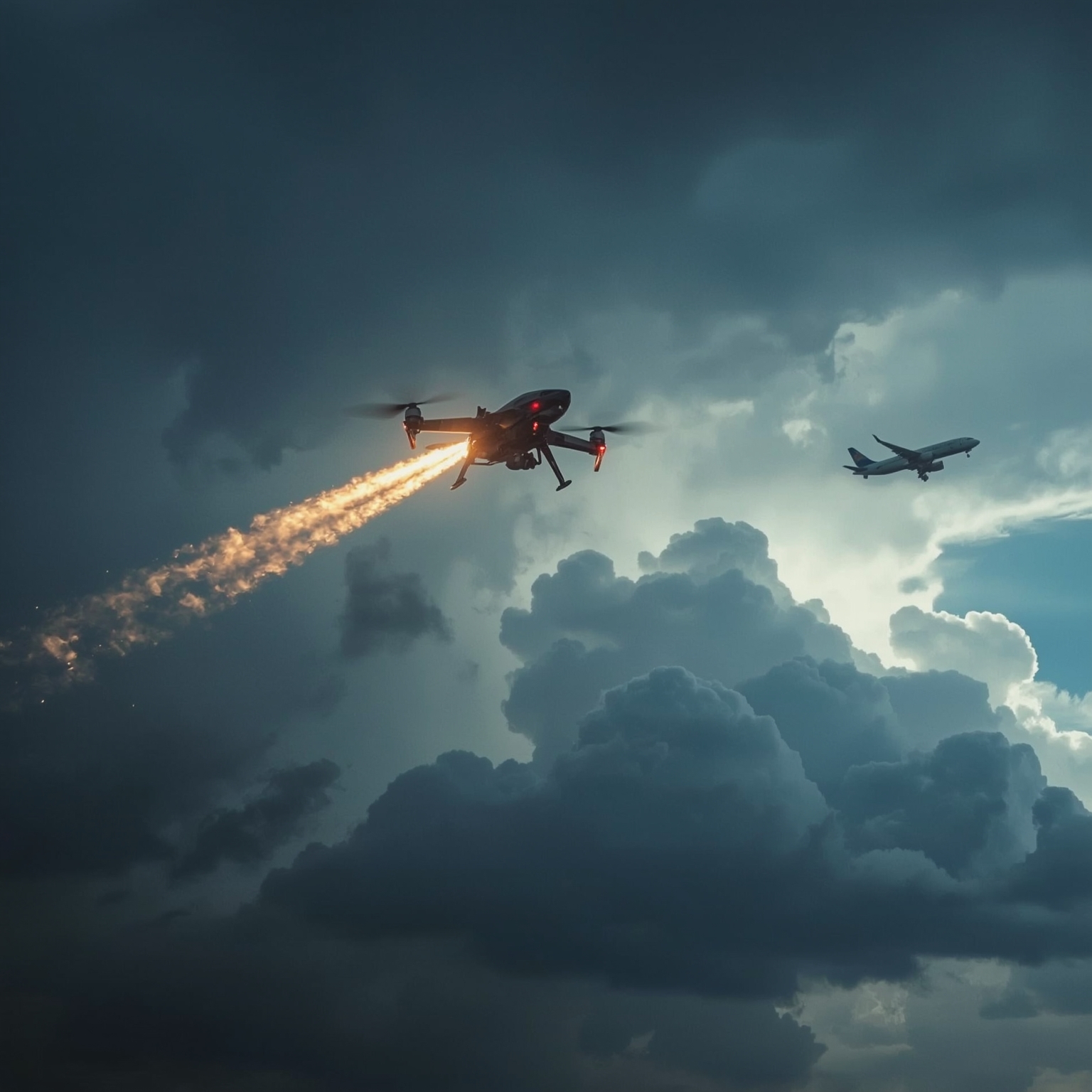
Rainmaker Technology’s proposal to utilize compact, unmanned aircraft equipped with cloud‑seeding flares has ignited significant controversy within the aviation community. The initiative, which the startup argues could enable safer and more efficient weather‑modification research, has encountered strong opposition from the Air Line Pilots Association (ALPA). The union, representing thousands of commercial aviators, has formally petitioned the Federal Aviation Administration (FAA) to withhold approval unless Rainmaker demonstrates adherence to far more stringent safety protocols than those currently presented in its public filings. Their position underscores an unease within the industry: the balance between embracing experimental innovations in atmospheric science and preserving uncompromising safety in increasingly crowded skies.
The FAA’s review of Rainmaker’s request carries broader implications than the fate of one startup. How the agency responds will not only determine the company’s ability to move forward with its drone‑based seeding system, but will also likely establish an early precedent for how regulators approach emerging fields of weather modification using unmanned aerial systems. In essence, Rainmaker’s ambitions rest on the agency’s willingness to accept that operational safeguards for drones carrying potentially hazardous materials can provide an aviation safety standard comparable to conventional restrictions.
From ALPA’s perspective, Rainmaker’s petition falls short of this threshold. The union has characterized the company’s application as failing to demonstrate an “equivalent level of safety” and warned of the potential for “extreme safety risks.” In their analysis, the introduction of drones carrying combustible flares into complex airspace where commercial jetliners routinely operate introduces risks that the petitioner has not sufficiently mitigated. Their skepticism is heightened by the absence, in publicly available filings, of specific operational data such as intended flight corridors, altitude bands, and detailed modeling of what might happen if flare components were to fall from the sky.
Augustus Doricko, the company’s chief executive, responded forcefully to these criticisms, stressing that ALPA’s conclusions were derived exclusively from reviewing the public summary rather than the more comprehensive set of technical documents submitted confidentially to the FAA. Those non‑public materials, Doricko asserts, contain data on safety measures, flight coordination procedures, and hazard mitigation plans that directly address the concerns raised by the pilots’ union. From his perspective, ALPA’s objections rest on incomplete information and therefore fail to capture the nuance of Rainmaker’s engineering and safety strategy.
At the core of the regulatory discussion is Rainmaker’s request for an exemption to rules that categorically prohibit small drones from transporting hazardous materials. Filed in July, the request remains under FAA consideration. Rather than granting an immediate ruling, the agency has issued a follow‑up request for explicit clarifications concerning operational specifics and detailed safety assurances. Central to the proposal is Rainmaker’s intent to equip its quadcopter platform, named Elijah, with two types of flares: a burn‑in‑place design and another that ejects casings. The purpose of both is to disperse silver iodide particles in the upper atmosphere to induce precipitation. Elijah is capable of ascending to altitudes of 15,000 feet above sea level, a region overlapping with controlled airspace that commercial aircraft traverse on a daily basis. As per existing air traffic rules, any such drone operations would necessitate prior authorization and coordination with Air Traffic Control.
In its petition, Rainmaker has stated that operations will be confined mainly to Class G, or uncontrolled, airspace unless specific clearance is granted. ALPA, however, has countered that the lack of clarity in the filing leaves questions about where precisely the flights will occur and at what altitudes. Doricko, aiming to dispel these concerns, remarked that the company’s classified submissions already illustrate the parameters: ceiling limits of 15,000 feet, and flight zones strictly pre‑approved as safe by aviation authorities. These constraints, he argues, effectively neutralize the possibility of interference with high‑altitude commercial traffic. ALPA, when asked for further comment by TechCrunch, did not issue a response.
Beyond airspace conflicts, the pilots’ union has also voiced apprehension about the flares themselves. Concerns include the possibility of debris falling from ejectable casings, the fire hazards associated with igniting flares, and inadequate environmental analyses regarding the chemicals involved. They note, for example, that Rainmaker’s petition omits trajectory modeling that would estimate where and how discarded materials might descend. Doricko, in rebuttal, highlighted that extensive studies conducted by environmental regulators—ranging from the Environmental Protection Agency to state natural resource departments—have evaluated cloud‑seeding practices for over seven decades without identifying adverse ecological consequences. According to him, ALPA’s focus on these factors overlooks the scientific consensus about the relative safety of silver iodide dispersal.
Sam Kim, the company’s aviation regulatory manager, sought to strike a conciliatory tone, explaining that Rainmaker holds the pilots’ union in high regard and wishes to deepen collaborative understanding. Nevertheless, he contended that the union’s latest objection reveals a fundamental misinterpretation of why the startup sought an exemption in the first place. The intent, Kim clarified, is not to conduct large‑scale operational weather modification with flares but rather to use them as part of limited, research‑oriented missions within strictly defined environments. In other words, flares play a temporary role in research validation and are not the cornerstone of Rainmaker’s long‑term plans.
Doricko elaborated by placing the potential environmental footprint into perspective. A typical cloud‑seeding mission conducted by Rainmaker disperses approximately 50 to 100 grams of silver iodide, and even less when utilizing flares. By contrast, he noted, a single hour of conventional airline operation results in the emission of kilograms of pollutants such as unburned hydrocarbons, sulfur oxides, and carbon‑based soot—substances with arguably far greater environmental impact than Rainmaker’s targeted experiments. The company’s future strategy, he added, centers on transitioning away from flares entirely, instead employing a proprietary aerosol dispersion mechanism designed to release only silver iodide without ancillary materials.
Doricko also emphasized that ALPA’s critiques do not fully appreciate the company’s extensive concept of operations (CONOP), which, he insisted, integrates multiple safeguards. These include coordination with regional air traffic controllers, deployment of experienced and licensed pilots to oversee operations, installation of collision‑avoidance technologies, as well as visual and electronic observers to track airspace activity in real time. Furthermore, flights are deliberately conducted over rural landscapes and private lands, with landowner partnerships ensuring minimal risk to populated regions.
Cloud‑seeding itself is far from a novel concept. Since the 1950s, states and private agencies across the western United States have commissioned pilot‑flown aircraft to release particulate agents into the atmosphere. Ski resorts employ these methods to sustain snowfall across slopes, while irrigation and water management districts utilize them to bolster reservoir levels by increasing the mountain snowpack during winter months. The practice relies principally on silver iodide crystals, which serve as nuclei around which super‑cooled water vapor freezes, subsequently forming ice crystals. These crystals expand quickly under favorable conditions, making them more likely to survive atmospheric evaporation processes and descend as rain or snow.
Rainmaker’s innovation lies in shifting this established meteorological technique from manned aircraft to drones, avoiding the risks of putting pilots directly into hazardous weather systems. The company argues that unmanned platforms, when operated under rigorous procedural oversight, constrained altitudes, and over sparsely populated areas, can ultimately represent a safer alternative. The ultimate decision, however, rests squarely with the FAA. Should the agency conclude that Rainmaker’s multifaceted mitigations are sufficient, the ruling will mark an important signal of openness toward integrating drone‑based systems into the future of weather‑modification science. Conversely, a rejection may reinforce existing conservatism, compelling startups to demonstrate even more stringent safety assurances before innovation can expand into shared skies.
The trajectory of Rainmaker’s endeavor thus remains uncertain, pending the FAA’s determination. What is clear, however, is that the agency’s eventual ruling will articulate the balance regulators intend to strike between fostering pioneering scientific approaches and safeguarding the integrity of national airspace.
Sourse: https://techcrunch.com/2025/09/13/pilot-union-urges-faa-to-reject-rainmakers-drone-cloud-seeding-plan/