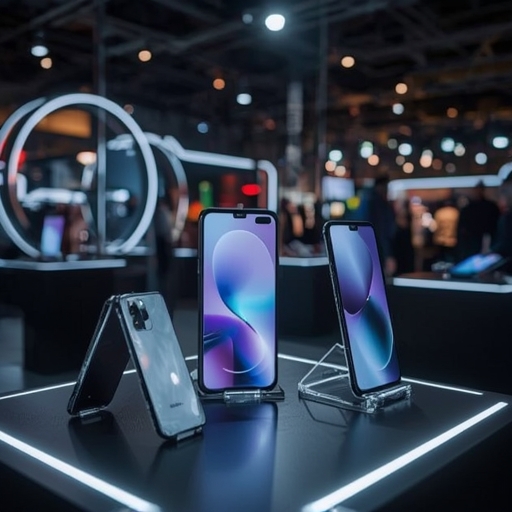
At CES 2026, the world’s largest technology showcase, innovation expanded far beyond conventional expectations, challenging long‑held assumptions about what a smartphone should look and feel like. Instead of the uniform rectangular slabs that have dominated the industry for years, this year’s exhibition unveiled a dazzling variety of creative reinterpretations—proof that imagination and engineering brilliance can coexist in forms as surprising as they are sophisticated.
From displays that gracefully bend and twist without compromising clarity, to modular systems allowing users to physically reconfigure their devices for specific tasks, every design reflected a deeper philosophy of flexibility and user‑centric creativity. Some concepts incorporated soft‑edge curvature for an ergonomic grip; others experimented with radical shapes, such as circular models optimized for wearable integration or minimalist foldables that collapse into pocket‑sized accessories. Collectively, these designs suggested that the future of mobile communication may not hinge solely on processing power or camera quality, but on rethinking the very geometry of interaction.
Observers noted how the atmosphere at the convention balanced the futuristic with the tangible. Amid sleek exhibition tables illuminated by dynamic lighting, prototype phones gleamed like pieces of functional art—each one demonstrating that aesthetic appeal can seamlessly merge with practical utility. Engineers, designers, and technology journalists mingled in animated discussion, contemplating not just how these devices work, but how they might redefine everyday habits: content creation through flexible displays, multitasking via detachable modules, and even fashion statements through personalized form factors.
This reinvention of shape also reflects an industry‑wide acknowledgment that technological progress thrives on daring experimentation. CES 2026 reminded attendees that creativity remains a vital current running through the heart of technological advancement. As product designers explore new materials and architectures—ranging from ultra‑thin polymer screens to transparent chassis and eco‑conscious composites—the smartphone continues its metamorphosis into something more intuitive, expressive, and adaptive.
Ultimately, the showcase served as both a glimpse into the coming decade and a celebration of boundary‑breaking design. While some prototypes may never reach mass production, their influence is undeniable: provoking thought, inspiring dialogue, and inviting the public to imagine mobile technology not as a static rectangle, but as a canvas of endless potential. The next generation of smartphones, as CES 2026 vividly demonstrated, will not simply evolve—it will transform into art in motion, where innovation, form, and human creativity intertwine.
Sourse: https://www.theverge.com/tech/859776/ces-2026-phones-clicks-communicator-ikko-samsung-trifold