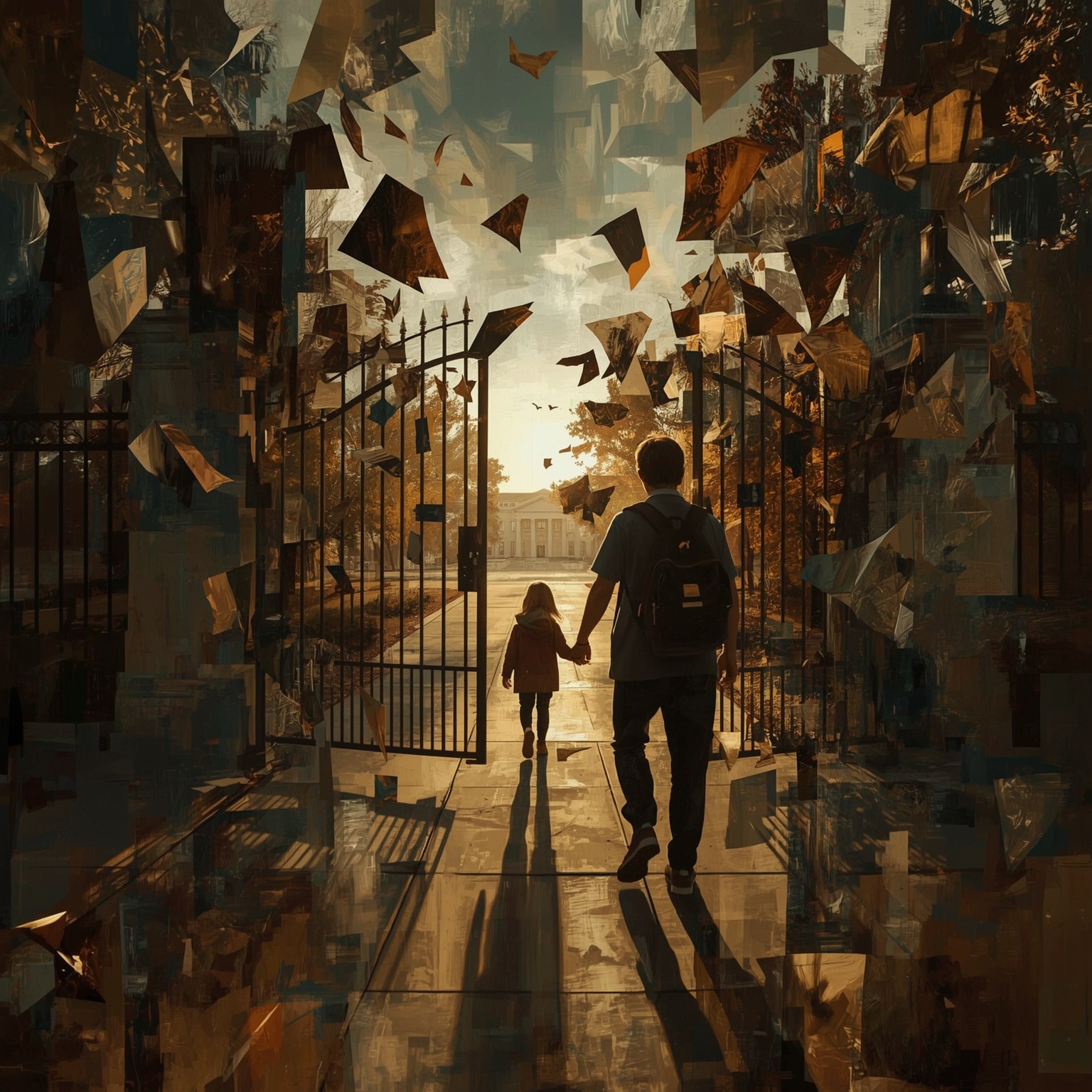
When the moment finally arrived to deliver my son to college for the beginning of his freshman year, I thought I was prepared for the inevitable mixture of pride and sadness. Yet as I drove away, leaving him behind to forge the first steps of his own independent life, an onslaught of questions consumed my mind. Would he manage to seek out meaningful friendships that would anchor him in this new environment? Could he sustain the discipline necessary to meet the unrelenting demands of academic deadlines? Or would he, like so many teenagers, be tempted to distract himself with his phone at exactly the wrong time, perhaps earning a reprimand for texting during class? These concerns, although ordinary for any parent, weighed heavily on me in that silent drive back home.
What awaited me there was the reality I had long known was coming yet had not anticipated with such intensity: the proverbial “empty nest.” Returning home, I entered a house that seemed both achingly familiar and curiously foreign, as though its very walls were echoing the absence of one of its essential inhabitants. The transition plunged me into a complicated mosaic of emotions: sadness that gnawed at the edges of my heart, pride in the young man my son was becoming, nervous anxiety about how both of us would adapt, and an undercurrent of excitement for the new opportunities awaiting him. Yet overriding all these feelings was the visceral awareness that the fabric of our family life had been irrevocably altered and would never return to what it once was.
However, the empty space left by my son’s departure was not simply about the practical realities of daily life. It jarred something far deeper, awakening within me emotions that reached across time. Taking Ethan—my 18‑year‑old—into that new chapter of his life pried open a Pandora’s box I had carried unknowingly for years. This container of long-buried pain had first taken root more than a decade earlier, when my other son, Jake, died thirteen years before. His absence had been a devastating blow, a wound I thought I had carefully learned to live with. Yet Ethan’s departure exposed that wound with startling clarity, demanding attention I had long avoided giving.
While my son busied himself with orientation, classes, and the first taste of collegiate freedom, I wrestled at home with emotions that felt simultaneously unfamiliar and hauntingly recognizable. Each time I walked past Ethan’s bedroom, its pristine neatness screamed louder than words: he no longer resided there. Cooking, once the domain of big family dinners, now left me confused; I gravitated toward preparing oversized meals for my husband and me because cooking for only two felt alien and empty. At the grocery store, my hand reached instinctively for Ethan’s favorite snacks, yet upon placing them back at home, they lingered unopened, mocking the void his absence had created. The longing was physical—I missed him in a way that made breathing uneven, as though grief had stolen the rhythm from my lungs.
In these moments, the grief of the present tangled itself with the grief of the past. Intellectually, my reasoning mind reminded me to see the contrast: one son had merely left for school, promising communication and eventual visits; the other had been taken permanently, beyond any earthly return. Yet the heart knows little of reason. It collapsed those experiences together, blurring the lines until one sorrow bled into the other. The fragile container of my pain split apart, scattering sharp fragments throughout my days, so that everywhere I looked I stumbled upon reminders.
What startled me most was that I had always considered myself adept at tending to the memory of Jake’s loss. I visited his grave often, replenishing bouquets of flowers and adding small tokens collected during our family travels. On his birthdays, I brought balloons and silly trinkets, imagining how he might have laughed at them. I even established a foundation in his memory, believing this gave me a healthy outlet to keep his presence alive in conversation and action. Yet it wasn’t until Ethan left for college that I recognized I had never truly completed—or perhaps even begun—the work of sitting with the full depths of that grief. When Jake first died, my tears were endless for weeks, but eventually, I assumed the rule of grief was to dry those tears, file the memories into a tolerable corner, and resume functioning. I mistook resumption of daily life for resolution.
Ethan’s departure revealed the flaw in that belief. The pain, once so tightly sealed, resurfaced with greater ferocity than I remembered, demanding acknowledgment. It took me time to trace that the ache I felt was not only the loneliness of an emptier home but also the resurgence of Jake’s absence. Slowly, I allowed myself to make room for grief once more, giving it the time and presence I had previously denied. From this surrender emerged a profound realization: grief does not adhere to a neat, linear progression. It refuses predictability. Instead, it ricochets unpredictably, like a pinball that careens across the board of our existence, touching pain, memory, and even joy at unexpected intervals throughout an entire lifetime.
This truth crystallized vividly on the thirteenth anniversary of Jake’s death. In a moment of clarity, I took pen to paper and wrote him a letter. In it, I poured the thoughts that were too complex to say aloud, the paradox that haunted me: that the absence of his younger brother—though temporary, explainable, and socially understandable—felt strikingly similar to his own permanent departure. I admitted the strange impossibility of explaining such feelings to others, acknowledging that most would either fail to comprehend or dismiss the comparison as inappropriate. Yet in my soul, the experiences resonated as alike—a gaping hollow in my chest that I needed to carefully distinguish to survive.
What has surprised me, however, is that grief, while merciless at times, is not inherently destructive. Alongside its shadows, it creates space for deeper connections, sharper gratitude, and a more profound capacity to love. The sadness that still washes over me unexpectedly teaches me to cherish the fleeting brightness of life all the more. Over time, I have come to regard my grief not as a burden to carry in silence but as a strange form of strength, almost a superpower. I no longer feel embarrassed when I catch myself speaking aloud to Jake’s memory, as though carrying on an invisible conversation. I even experience a peculiar sense of comfort when meeting someone who shares his name, a reminder—however subtle—that his essence still reverberates in the world around me.
Now, years later, I understand Jake’s absence as an integral part of my identity, shaping my perspective on parenting and on living. When I brought Ethan back to campus for his junior year, I noticed that I no longer carried Pandora’s box as a heavy, destructive presence. Instead, I held something transformed: not a container of shards, but a gift. That gift allows me to weave continual connections with both of my sons—the one thriving on his own journey and the one whose journey ended far too early. It reassures me that love survives absence, and that the relationships between parents and children possess the remarkable capacity to evolve long after circumstances change. For this enduring truth, I remain immeasurably and eternally grateful.
Sourse: https://www.businessinsider.com/empty-nester-hit-with-grief-2025-9