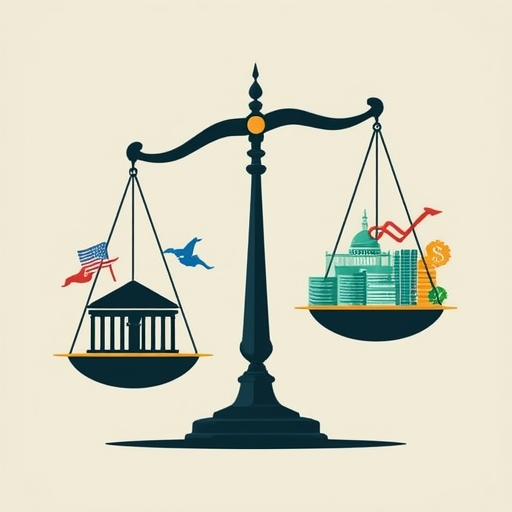
Throughout the long history of American economic governance, the Federal Reserve has frequently found itself at the intersection of politics and policy. However, the intensity of contemporary political scrutiny directed at the central bank represents a moment of unprecedented magnitude. This mounting pressure does not simply challenge the Fed’s daily decision-making processes; it provokes a broader national debate regarding the very principles that underlie its independence.
Traditionally, the Federal Reserve has operated with a carefully protected degree of autonomy — a safeguard designed to insulate monetary policy from the unpredictable tides of political maneuvering. The institution’s ability to set interest rates, regulate credit conditions, and stabilize inflation is guided by long-term economic analysis rather than by the short-term objectives that frequently shape political agendas. Yet today, with elected officials increasingly vocal about the Fed’s direction and timing of policy decisions, that delicate equilibrium between accountability and autonomy appears to be shifting.
Political leaders from across the spectrum, responding to public frustration over inflationary pressures, financial volatility, and widening inequality, have begun to voice strong opinions about how the central bank should act. This growing involvement, while reflective of democratic oversight, simultaneously raises concerns about the erosion of the bank’s capacity to make technically driven, evidence-based judgments free from external influence. Critics warn that excessive interference could transform monetary policy into an extension of partisan ambition rather than a stabilizing economic instrument.
At the same time, defenders of institutional independence argue that the legitimacy of the Federal Reserve — and, consequently, the credibility of U.S. financial markets — rests upon its ability to remain guided by data, discipline, and long-term vision. Once that autonomy is compromised, they contend, confidence in the central bank’s neutrality may weaken, potentially unsettling global markets and undermining public trust in the broader economic system.
In essence, the current debate is not solely about fiscal priorities or rate adjustments but about the underlying architecture of economic governance itself. As public and political attention intensifies, the Fed must navigate these uncertain currents with both caution and conviction, reaffirming its commitment to nonpartisan decision-making. The outcome of this tension could redefine how power and policy coalesce in the United States, shaping not only immediate financial outcomes but also the enduring stability of the nation’s economic foundation.
Sourse: https://www.businessinsider.com/trump-jerome-powell-threat-pattern-federal-reserve-fed-2026-1