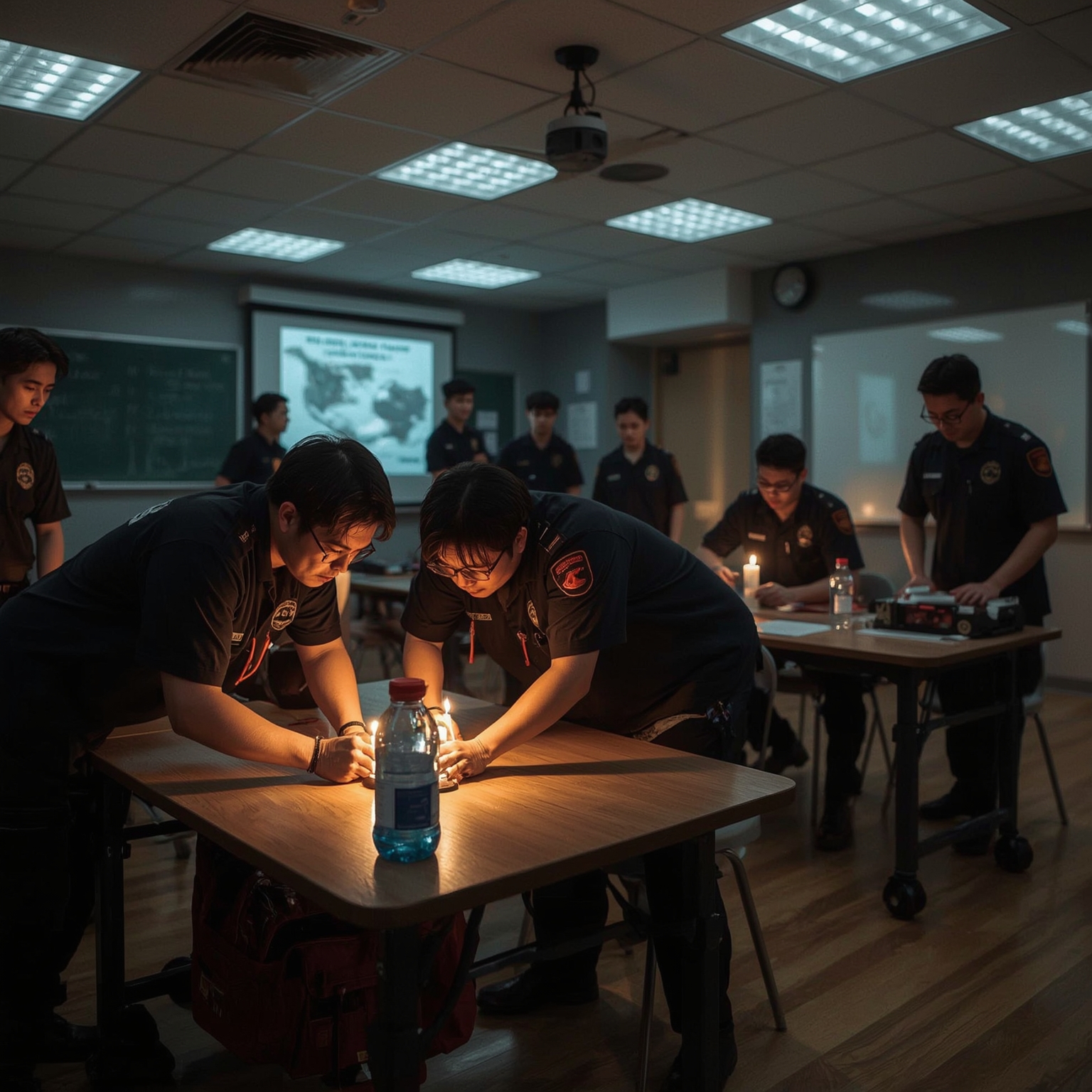
Securing permission to attend Kuma Academy, one of Taiwan’s most well-known civil defense organizations, does not feel like the simple registration process for an average public training session. Instead, the experience resembles what one might expect when involved in a covert or classified assignment. The steps are deliberate and thorough: credentials must be carefully submitted, followed by weeks of silence before approval is quietly, and somewhat mysteriously, granted. When I finally arrived on a Sunday in late May, the destination was not a grand military compound or live-fire training ground but an understated, unassuming office building tucked discreetly in the heart of downtown Taipei.
From the very first step into the lobby, the sense of heightened alertness was palpable. A security guard immediately questioned my reasons for entering the academy, a subtle but unmistakable reminder that even in this civilian-oriented institution, wariness and vigilance are constants. Once inside the facility itself, two staff members clothed entirely in black greeted me with an air of reserved seriousness. Their demeanor could be described as both professional and cautiously guarded. They politely refused to share personal details such as their names or the total number of staff members working at the academy. In addition, they firmly insisted that photographs of the instructors or trainees could only be taken with express consent in order to preserve participants’ privacy and security. The reasoning quickly became clear when one staffer disclosed, with visible concern, that the organization had endured a series of hostile incidents, including anonymous emails filled with vitriol, suspicious parcels delivered in the mail, and threats directed at its founder’s family. One particularly chilling message threatened to leave his daughter fatherless.
Despite the intimidating aura a newcomer might initially perceive, Kuma Academy is not a militarized boot camp where recruits are molded into soldiers. Rather, it operates as a nonprofit dedicated to equipping everyday civilians with the knowledge, skills, and psychological readiness to endure circumstances no one wishes to confront: a potential military invasion of Taiwan by China. The urgency of this mission has steadily grown as Beijing intensifies both its military exercises in the region and its political rhetoric across the strait. In response to such developments, thousands of Taiwanese citizens are taking proactive steps to prepare for a crisis that, while still hypothetical, looms large in national consciousness.
Founded in 2021, Kuma Academy quickly emerged as a central institution within Taiwan’s burgeoning grassroots preparedness and resilience movement. Its influence is reinforced by its role within a broader ecosystem of civil organizations that provide complementary training in areas such as misinformation resilience, emergency first aid, logistical evacuation planning, and cybersecurity. Since its inception, the academy reports having trained approximately 80,000 individuals, predominantly between their mid-twenties and mid-forties. Notably, around seventy percent of participants are women — reversing the demographic patterns of Taiwan’s older, government-linked civil defense organizations, which are often populated by aging, male participants who sometimes approach the sessions as more of a community social event than true preparation for national emergencies. A Kuma staff member observed bluntly that this discrepancy undermines the practical purpose of civil defense: citizens must be trained with genuine seriousness if they are to respond effectively in a crisis.
Yet for all its heavy subject matter, Kuma’s branding takes an intentionally striking — and surprisingly whimsical — form. Rather than symbols of dryness and intimidation, its identity rests on a black cartoon bear equipped with a rifle, surrounded by other playful, woodland-themed mascots. Workshops, merchandise, and promotional material carry this aesthetic forward, exhibiting a colorful lightheartedness that masks the gravity of the organization’s actual mission. This deliberate juxtaposition between outward cuteness and inward seriousness effectively lowers barriers of entry, making the training approachable while simultaneously signaling deeper resolve.
The course I attended was a one-day workshop priced around 1,200 New Taiwan dollars, roughly 40 US dollars. As a journalist attending under press credentials, I was permitted to observe without charge, though not to directly participate. Over the course of eight hours, the atmosphere inside the classroom proved thoughtful, focused, and instructional rather than authoritarian. While the subject of China underscored many parts of the sessions, it was rarely addressed with melodrama. For example, during a segment about the dissemination of false information across messaging platforms, instructors carefully explained how foreign adversaries might cultivate online trust with unsuspecting Taiwanese before spreading divisive disinformation and conspiracy theories intended to fracture social cohesion.
The program began with training on subtle “gray-zone” tactics — maneuvers deliberately designed to sow confusion, weaken social trust, and destabilize populations while avoiding the open aggression that might trigger immediate retaliation. A concrete example was provided: adversaries might add contacts on WeChat or Line, maintain friendly exchanges to build credibility, then introduce manipulative narratives designed to spread internal suspicion and discord. The aim here is less dramatic battlefield conquest than the gradual corroding of mutual trust among ordinary citizens.
In the afternoon, attention shifted to more tangible survival skill sets, particularly emergency medical response and basic self-defense strategies. I watched as an instructor guided participants through the specific actions necessary when confronted with a traumatic wound, demonstrating how to pack gauze deep into the injury before applying consistent pressure — an urgent measure far more effective than simple wrapping. Approximately forty attendees practiced tourniquet applications on their own arms, each intent on mastering a procedure that might one day save someone’s life. The seriousness of the group contrasted yet complemented the relatively relaxed classroom atmosphere; while conversations were calm, every participant focused sharply whenever a life-saving skill was being explained. In another exercise, an instructor corrected several participants as they struggled to lift and transport an adult male, eventually demonstrating the proper fireman’s drag technique as an effective method for moving casualties.
Kuma insists its mission is not to transform civilians into combatants but to empower them with resilience, practical readiness, and an awareness of the psychological and informational dimensions of modern conflict. Nevertheless, the academy’s rising visibility has incurred direct hostility from Beijing, which perceives its efforts as a challenge to its political narratives. The Chinese government has formally sanctioned Kuma Academy, its founder Puma Shen, and prominent donor Robert Tsao, alleging that their efforts encourage separatist sentiment. Shen dismissed these sanctions as pointedly antagonistic, while Tsao — a semiconductor magnate — responded with his own symbolic act of defiance, filing a lawsuit against China’s Taiwan Affairs Office in a Taiwanese court.
For ordinary Taiwanese citizens, this external hostility is not abstract. Several participants at the academy expressed genuine anxiety about the future. Celine Chen, a 44-year-old translator, admitted she felt heightened worry in light of the frequent military drills Beijing conducts near the island. She explained that she sought training not only for practical techniques but also to strengthen her psychological preparedness. Observing the regional context — Russia’s invasion of Ukraine, China’s increasingly forceful stance toward Hong Kong, and ongoing military exercises surrounding Taiwan — Chen concluded it was irresponsible not to be ready. Another attendee, a 44-year-old civil servant who requested anonymity, echoed the same motivations. She recounted friends warning her that the onset of war was inevitable, urging her to liquidate assets and convert them into gold or US dollars as financial protection. Rather than panic, she chose to invest time in preparedness so she would know exactly how to react if the worst ever transpired.
Despite these concerns, many experts caution that the likelihood of an imminent Chinese invasion remains low. Analysts at the Eurasia Group have highlighted that Chinese official statements continue to emphasize patience and confidence, frequently repeating the assertion that Taiwan’s political leadership cannot alter what Beijing characterizes as the long-term, undeniable trend toward eventual unification. Moreover, Taiwan itself has consistently communicated both to its allies and its adversaries its determination to defend sovereignty. According to Dale Buckner, a retired U.S. Army colonel and chief executive of security firm Global Guardian, civilian preparedness initiatives and systematic military drills together send an unmistakable signal: Taiwan is deeply serious about defending itself, and the international community should perceive it accordingly.
Indeed, public opinion surveys suggest a measured level of optimism. A March 2025 poll by a Taiwanese military think tank showed that nearly two-thirds, or 65 percent, of respondents believed a Chinese attack within the next five years was unlikely. In daily life across the island, this sentiment translates into a curious form of calm resilience: many Taiwanese go about their routines largely unshaken, even as fighter jets and warships make headlines abroad. For instance, performance artist Tseng Chih Wei described how his foreign friends often asked whether he felt endangered living in Taipei. His candid reply was that life seemed overwhelmingly normal — dominated more by fluctuations in rent, rising costs of living, and professional stress than by the specter of warplanes crossing the median line in the Taiwan Strait.
Yet, history ensures that the shadow of conflict never entirely disappears. Since 1949 — when the defeated Nationalist government retreated to the island following its civil war loss — Taiwan has existed in a state of unresolved ambiguity, with no peace treaty ever signed with the Communist leadership in Beijing. For seventy-five years, the island has learned to adapt within this tense equilibrium, recognizing at once its inherent fragility and the resilience of its people. Participants like Chen embody this paradox: while acknowledging the heavy psychological burden of preparation, she finds concrete relief in the academy’s practical guidance. The training demystifies daunting scenarios by teaching clear steps such as assembling an emergency “go-bag,” safeguarding essential documents, storing critical supplies, and coordinating family evacuation routes. Even so, she admitted, persuading family members to internalize the same urgency has proven difficult; many still dismiss such preparations as unnecessary.
Kuma Academy thus stands at the intersection of Taiwan’s daily normalcy and lingering uncertainty. It symbolizes an effort by ordinary people to take responsibility for their own resilience — a quiet but profound demonstration of courage of a society that has long lived in the shadow of geopolitical tension.
Sourse: https://www.businessinsider.com/taiwan-civilian-defense-kuma-training-china-invasion-risk-preparation-2025-9