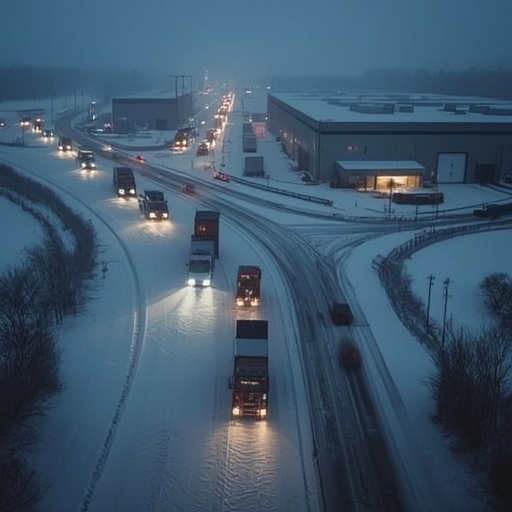
The moment has arrived. A vast portion of the United States—potentially encompassing as much as two-thirds of the nation—is bracing for an expansive winter storm system expected to deliver dangerous quantities of snow, ice, and freezing temperatures over the coming weekend. Meteorologists warn that the storm’s reach, extending from the southern plains of Texas all the way to the metropolitan sprawl of New York City, could bring widespread disruptions. Its effects are likely to ripple through major transportation arteries and significantly impact the flow of goods and services that rely on a steady, uninterrupted network of roads and highways. Such conditions could not only paralyze local traffic but also impede commercial operations and supply chains that depend on those routes for everyday deliveries.
Businesses across multiple sectors are taking the forecast seriously. In anticipation of these potentially debilitating conditions, operators of grocery stores, logistics firms, warehousing centers, and large-scale trucking companies have already been engaged in meticulous, days-long preparations. Stockpiling essential products, relocating critical inventory to regional hubs, and coordinating alternative delivery routes have all become part of the preemptive strategy. Yet, despite these concerted efforts, the exact magnitude of the storm’s eventual impact on the national supply chain—and, consequently, on the retail shelves that depend on its stability—remains uncertain. The full picture will only emerge once the storm has passed and the nation assesses both immediate disruptions and aftershocks in the flow of goods.
For many logistics professionals and retailers, however, this kind of challenge is nothing new. Winter storms are a seasonal inevitability, especially across Northern and Midwestern regions, and over time the freight and transportation industries have developed a sophisticated playbook to manage them. As Chris Caplice, chief scientist at the transportation management company DAT Freight & Analytics, notes, these events are often treated as business as usual. “If you’re a retailer, this happens all the time,” he observes. Within the supply chain world, a blinding snowstorm can simply represent yet another operational complication to be managed efficiently—another Tuesday, as Caplice puts it. This experienced pragmatism reflects an industry rooted in resilience, accustomed to recalibrating schedules and rerouting trucks at a moment’s notice.
Yet this particular storm presents unique complications that distinguish it from the ordinary seasonal squalls of the northern states. Its geographic breadth and the range of regions it threatens to encompass introduce considerable complexity. Chris Long, the executive vice president of operations at Capstone Logistics, emphasizes that the challenge lies not merely in the weather’s severity, but in its reach. “This one’s kinda tough,” Long explains, “because you don’t have a lot of snowstorms hitting the states that this one is hitting.” Southern states such as Texas, Oklahoma, and Arkansas rarely confront conditions of this kind. Historically, their emergency infrastructure has evolved around hurricane preparedness rather than snow resilience, prioritizing the storage and rapid distribution of materials like generators, plywood, and potable water—resources required to cope with flooding and high winds, not ice and subzero temperatures.
Consequently, if these states experience road systems freezing solid for several consecutive days—a situation Long describes as “the worst-case scenario”—the economic and logistical consequences could escalate quickly. Frozen highways and iced-over interstates would effectively immobilize the transportation network that sustains grocery stores, pharmacies, and manufacturing operations. The result could be temporary shortages in perishable items such as food, dairy products, and essential pharmaceuticals. Such interruptions would ripple outward from local communities to regional and national markets.
To mitigate that risk, retailers have spent the past several days executing a series of calculated maneuvers designed to anticipate consumer demand. They are strategically positioning high-priority items—including snow shovels, bottled water, canned goods, and de-icing agents—within local distribution hubs, ensuring that replenishment can happen swiftly if roads remain passable. Large trucking corporations have deployed fleets and personnel in strategic locations ahead of the storm’s advance, placing them where delivery and recovery operations are likely to be most critical. Independent truckers, meanwhile, have prudently vacated highways expected to become treacherous, adopting a wait-and-see approach until conditions improve.
In the week following the storm, as communities begin the arduous process of digging out and thawing from the deep freeze, the economic consequences will continue to unfold. Freight rates are expected to spike temporarily, explains Caplice, as trucking and logistics companies scramble to restore normal traffic flows and clear backlogs of delayed shipments. Nevertheless, such short-term fluctuations are anticipated and already factored into the cost structures of most major retailers. Brief weather-induced disruptions, while inconvenient, are a known business risk during winter; they rarely translate into long-term price increases for consumers at checkout counters. Caplice suggests that larger and more persistent uncertainties—such as evolving trade tariffs or shifts in immigration policy that affect labor supply—pose far greater strategic challenges for the freight industry than a single snowstorm does. “This will be a blip,” he concludes, underscoring the industry’s expectation that the system will swiftly rebound.
What remains particularly encouraging is that many companies confronting this meteorological test today are better equipped to handle it than they were in the recent past. Lessons learned during the COVID-19 pandemic fundamentally reshaped how logistics networks operate. The pandemic’s global lockdowns sent shockwaves through international supply chains, revealing the vulnerabilities of a system dependent on lean efficiencies and just-in-time delivery models. Reflecting on such transformations, Long, who previously spent years in the grocery sector, observes a distinct shift in philosophy: “When I first got into the industry it was all about ‘just-in-time.’” The pandemic, however, prompted a dramatic reevaluation. Retailers and freight companies alike recognized the importance of maintaining additional inventory, diversifying suppliers, and developing contingency plans to weather unforeseen disruptions. According to Long, these adaptations have left the industry more fortified and agile: “We’re in a way better place,” he affirms, encapsulating a cautious optimism shared across logistics circles. In essence, while this weekend’s snowstorm may test supply chains, it also provides evidence of an industry increasingly disciplined, data-driven, and resilient in the face of nature’s unpredictability.
Sourse: https://www.wired.com/story/here-comes-a-mega-snowstorm-shipping-logistics/