At Palantir’s highly orchestrated customer summit in early September—a carefully choreographed event befitting a defense technology and data analytics powerhouse—CEO Alex Karp placed himself at the narrative’s center by joining the increasingly popular online talk program “TBPN.” What unfolded was less a conventional business address and more a performative showcase of personality, in which Karp, dressed down in a modest white T-shirt but accessorized with the extravagant flourish of a six-figure Patek Philippe timepiece, leaned into contradiction. With dramatic irony, he declared, “We’re crushing it,” quickly following with the self-deprecating quip that he was at his “most humble ever.” The statement, dripping with paradox, mirrored his broader persona: simultaneously casual and ostentatiously elite.
Yet Karp’s twenty-minute dialogue was far from a straightforward update on Palantir’s operations or strategies. Instead, the discussion roamed promiscuously across personal revelations and idiosyncratic reflections. He confessed unease with his political alignment, admitting to being an “unhappy Democrat.” He traced the cultural commonalities between what he provocatively described as the “woke left” and the “woke right.” He also shared details of his personal athletic regimen, specifically emphasizing his investment in cross-country skiing as a discipline that cultivates resilience. Demonstrating a particular fondness for highlighting his personal edge, he boasted of laboring through holidays, extolled his ability to hang suspended from a bar for four and a half minutes, and indulged in anecdotes that were both self-aggrandizing and intentionally humorous. The hosts of “TBPN,” intent on punctuating the moment with levity, underscored the absurdity with birdlike sound effects, injecting parody into earnestness.
This blend of seriousness and spectacle is characteristic of “TBPN”—the Technology Business Programming Network—a show which, in less than twelve months, has transformed from an experimental livestream into what could credibly be described as both an emergent new media ecosystem and a gathering ritual for Silicon Valley’s deeply internet-oriented insiders. Produced from Los Angeles and helmed by two former startup founders, John Coogan, age thirty-six, and Jordi Hays, age twenty-nine, the show streams five days per week, typically stretching an ambitious three hours. The hosts orchestrate spirited exchanges on the latest technology news while simultaneously welcoming a rotating panel of three to ten guests, including investors, entrepreneurs, and the occasional reporter, most of whom dial in remotely. Despite broadcasting squarely during conventional working hours—11 a.m. to 2 p.m. Pacific Time—the show manages to attract some of the most notable actors in the tech world: luminaries such as Marc Andreessen and Mark Cuban have appeared for casual, friendly interviews. Around this format, a fiercely loyal and energetic listener community thrives, reinforcing the show’s position as more than noise: to many, it marks a cultural shift in which technology itself has become entertainment. As one founder succinctly captured on X, “Tech becoming entertainment is the best thing that could have happened for my archetype.”
The success of “TBPN” must also be situated within a broader media context, wherein insiders in Silicon Valley are increasingly eager to narrate their world on their own terms. Mike Solana of Founders Fund, for instance, established the digital publication Pirate Wires during the pandemic, deliberately positioning it in opposition to what he perceived as excessively skeptical mainstream coverage and to challenge restrictive forms of political censorship. Meanwhile, the podcast “All-In,” consistently topping Spotify’s technology charts, offers extended conversations where four venture capitalists share views on business and politics—with one panelist, David Sacks, even earning the moniker of “AI and crypto czar” from former President Donald Trump. Similarly, the well-known venture capital firm Andreessen Horowitz (A16z) has made several attempts—initially failing and then regrouping—to construct its own media arm in a bid to shape how startups are portrayed.
Stylistically, “TBPN” borrows heavily from the coded aesthetics of mainstream sports and business broadcasting. Its tone emulates ESPN’s high-energy entertainment framework, treating technology deals and product launches with the same exuberance sports commentators reserve for highlight reels. NASCAR-inspired merchandise, enthusiastic catchphrases reminiscent of “booyah!” during launch discussions, and baseball card–style graphics to announce key talent moves in artificial intelligence mirror this spectacle. The atmosphere also calls to mind CNBC, albeit reimagined by youthful founders energized by canned yerba mate rather than Wall Street conservatism. This convergence illustrates the show’s ambition: live on enough YouTube streams, then eventually permeate workplaces across the tech landscape—displayed on office televisions next to “Squawk Box” or “The Pat McAfee Show.”
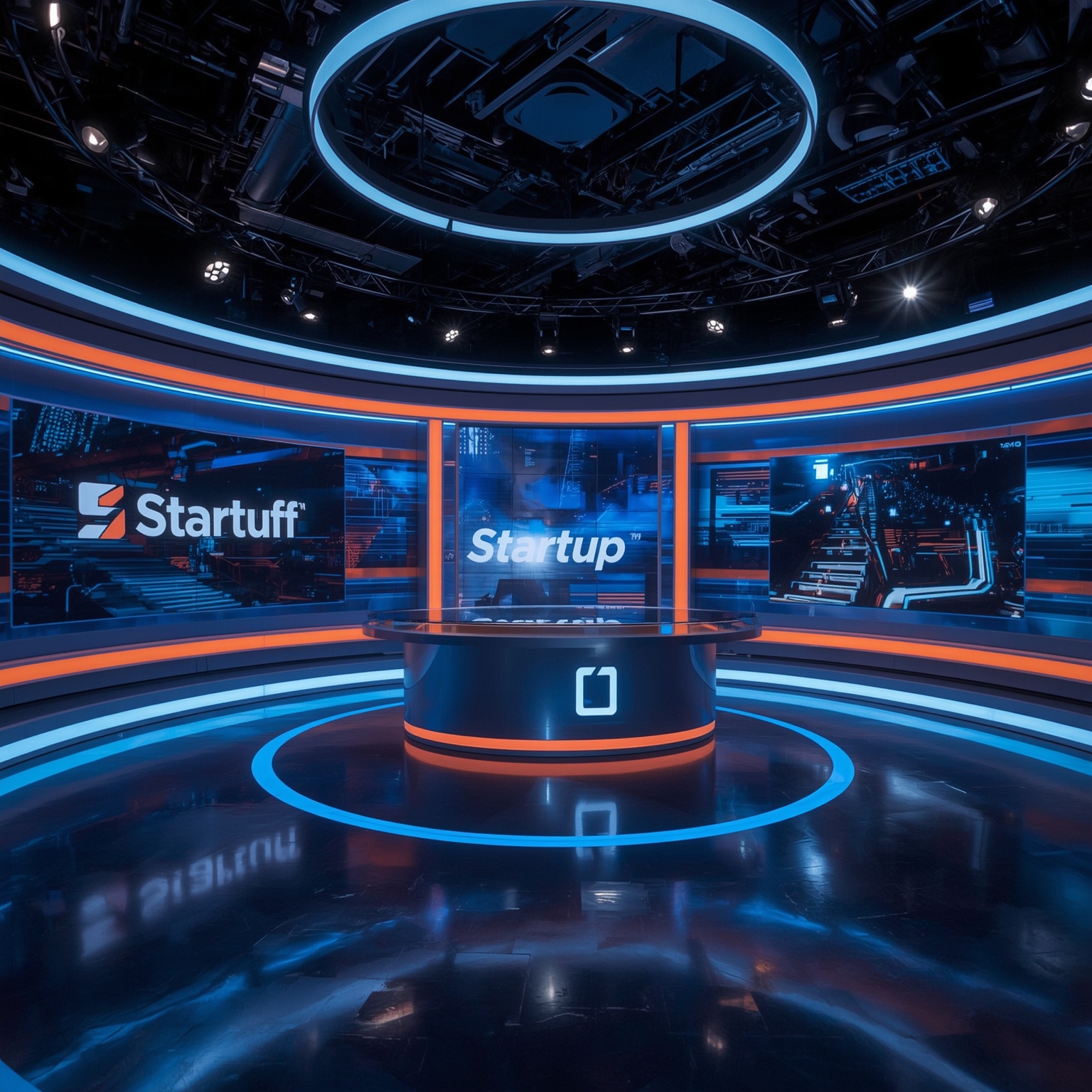
My own week immersed in “TBPN” revealed more than just an entertainment channel—it positioned the series as a cultural mirror through which Silicon Valley envisions itself. Operating out of a Hollywood soundstage, framed by a vivid green backdrop, Coogan and Hays flank a massive ceremonial gong, struck whenever a startup raises a funding round—a performative ritual that reflects the community’s evolving mode of announcement. Their table, cluttered with Diet Coke cans, newspapers, and branded memorabilia, reflects both a casual atmosphere and a subtle assertion of insider status. The roster of sponsors, ranging from Eight Sleep to Figma, resembles a curated portfolio of ambitious startups, all in alignment with the tech-forward identity. Their own pedigrees lend credibility: Coogan cofounded Soylent as well as Lucy, a Zyn competitor with aspirations to eliminate tobacco-related harm, and later worked as an entrepreneur in residence at Founders Fund. Hays meanwhile founded a venture-support startup, invested as an angel, and continues to advise early-stage entrepreneurs.
The pair frame “TBPN” self-consciously as pro-capitalist and unapologetically celebratory of technological progress. Their opening mantra lauds the program as the “temple of technology, the fortress of finance, the capital of capital.” Discussions about artificial intelligence are approached less carefully than in traditional journalism: Hays observed matter-of-factly, “Of course we’re in a bubble,” before concluding that profiting from such a bubble is nonetheless desirable. This ethos—candid, market-oriented, and tinged with humor—exemplifies a hybrid identity, both insider commentary and comedic banter, evidenced when Coogan asks guests profound geopolitical questions while Hays lightens the mood with lines like, “Explain it to me like I use TikTok for 12 hours a day.”
The linguistic ecosystem of “TBPN” also caters overtly to digitally native generations fluent in internet jargon. Terms like “oneshotted,” “nerfed,” “rugged,” and “aura farming” not only enter their banter but also reinforce their connection to a demographic accustomed to the linguistic churn of X and Discord channels. Taylor Lorenz, a journalist chronicling the culture of online creators, remarked that even without prior knowledge of Silicon Valley, exposure to “TBPN” instills a sense of belonging in its audience—as though one has stumbled into the inner sanctum of the tech elite.
The cultural influence stretches offline as well. In July, “TBPN” cohosted a party with Emily Sundberg of the Substack FeedMe at an exclusive New York social club. Attendees—tech-heavy financiers and New York media figures—mingled under the implicit shared expectation of being either investors, operators, or writers. The very hosting of such an event symbolized TBPN’s rise at a moment of flux for journalism itself: traditional news consumption is fragmenting, with surveys from Reuters and Pew indicating that growing numbers of Americans, particularly younger demographics, are turning to social media influencers and personalities as their primary sources of news.
Unlike other insider media endeavors that display open antagonism toward legacy outlets or produce ideologically charged narratives, “TBPN” situates itself differently. While openly asserting that it is not journalism, it nonetheless references mainstream reporting, often invites professional journalists to appear, and retains a porous boundary between entertainment and legitimate coverage. For example, its livestreaming presence at IPO events such as Figma’s debut at the New York Stock Exchange—and their subsequent return for Klarna’s offering—placed its hosts alongside Bloomberg and other established institutions. To its audience, the show thereby conveys unprecedented access while still preserving the informality and candid missteps associated with live, unedited broadcasting, which academics like David Schweidel argue enhances authenticity.
For loyal listeners, the program has evolved into more than habitual viewing; it forms a community. Fans like venture capitalist John Exley, who calls himself humorously a “VC without money,” arrange their daily schedules around the livestream. Others, primarily male founders and investors, carve out time afterward to listen, maintaining discussions in after-hours group chats. For some, the broadcast feels like a second home, a place of consistency in a volatile industry. “TBPN,” Exley suggested, becomes almost a secular church for techno-optimism, an “existence proof of heaven.”
From my own immersion, I emerged not emboldened to crush cans of energy drink or train my endurance on a pull-up bar in true tech-bro parody. Yet what did crystallize was the realization that, through their fusion of humor, irreverence, optimism, and online vernacular, the hosts embody and cultivate a new archetype: to tune into “TBPN” is not merely to consume tech media, but to inhabit, momentarily, the social climate of Silicon Valley itself.
Sourse: https://www.businessinsider.com/tbpn-dove-deep-sportscenter-silicon-valley-tech-bros-2025-9