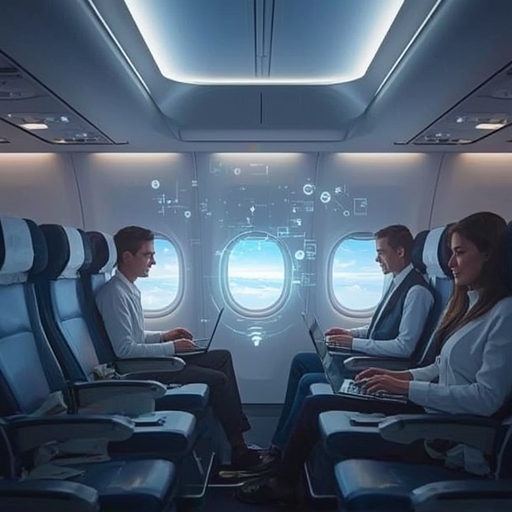
The prediction from Ryanair’s Chief Executive Officer introduces an intriguing and forward-looking perspective on the future of global air travel. He suggests that within an estimated time frame of approximately five years, free in-flight WiFi will likely become a widespread standard service across the aviation industry. This assertion, though ambitious, reflects a deep awareness of the rapidly evolving technological landscape and the increasing expectations of modern passengers, who now view connectivity as an indispensable element of their travel experience rather than an optional luxury. As onboard technology continues to improve—driven by advances in satellite infrastructure, data transmission efficiency, and cost optimization—airlines are progressively more capable of offering reliable connections at significantly reduced operational expenses.
This anticipated transformation would fundamentally redefine what it means to travel by air. Instead of viewing flight time as a disconnected interval between destinations, passengers might soon experience an uninterrupted digital continuum—working remotely from mid-air, streaming entertainment content, or communicating with friends and colleagues in real time. Such an innovation not only enhances convenience but also reshapes the economic and competitive dynamics of the airline market, where value-added digital amenities could become key differentiators for customer loyalty.
From a business standpoint, the implementation of universally free WiFi implies a strategic recalibration of airlines’ revenue structures. Rather than treating connectivity as a premium service generating ancillary fees, major carriers may integrate it into the overall fare or subsidize it through partnerships, advertising, or data-driven platforms. As connectivity costs decrease, what was once a privilege could evolve into a baseline expectation, similar to how in-flight entertainment screens or online check-in became near-essential over time.
For travelers, this shift heralds a more personalized, productive, and engaging experience. Imagine boarding any aircraft and effortlessly accessing a seamless network connection—allowing one to conduct business meetings over video calls, attend online classes, stream music or films, or simply stay in touch with loved ones throughout the journey. The airplane cabin, in essence, would transform into a moving hub of communication and information exchange, blurring distinctions between terrestrial and aerial connectivity.
On a broader scale, this evolution underscores the ongoing digital transformation of the entire aviation ecosystem. Airlines, airports, and technology providers continue to collaborate on making flight operations more efficient, sustainable, and user-focused. Free WiFi sits within that narrative as both a technological milestone and a symbol of customer-centered innovation. What began as a luxury feature offered only on select long-haul services is now poised to become as commonplace as a safety demonstration. Within the next half-decade, passengers may take to the skies with the expectation of being as connected above the clouds as they are on the ground—a testament to the rapid convergence of travel, technology, and everyday digital life.
Sourse: https://www.businessinsider.com/ryanair-ceo-says-every-airline-free-wifi-5-years-starlink-2026-1