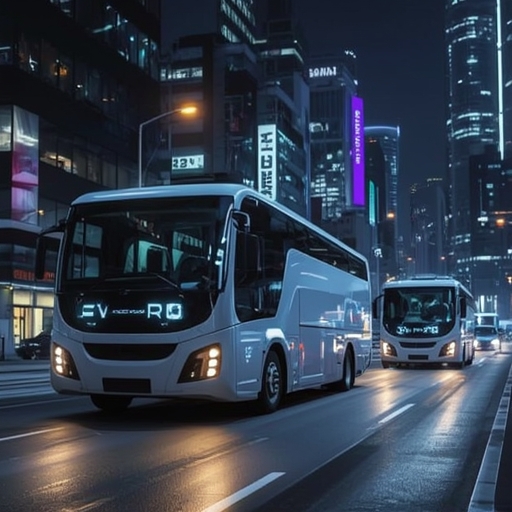
Waabi, a pioneering technology company headquartered in Toronto, has embarked on a transformative expansion that promises to reshape the trajectory of autonomous transportation. Originally celebrated for revolutionizing long-haul logistics through its intelligent self-driving trucks, Waabi is now venturing beyond the open highway and into the intricate fabric of urban streets. This bold transition introduces a fleet of highly advanced robotaxis—vehicles designed not merely to navigate cityscapes, but to redefine the very concept of mobility. What further elevates this milestone is a strategic partnership with Uber, one of the world’s most influential leaders in ride-hailing innovation, marking a dynamic collaboration where cutting-edge artificial intelligence meets large-scale mobility infrastructure.
Founded and led by Raquel Urtasun, a renowned computer vision and machine learning expert, Waabi has consistently demonstrated its commitment to an ‘AI-first’ philosophy. This approach leverages sophisticated simulation environments and deep learning frameworks that accelerate the process of refining autonomous systems safely and efficiently. Waabi’s expansion into robotaxis exemplifies both ambition and technological maturity: the company is evolving from managing controlled highway conditions to the unpredictable rhythm of urban life—where pedestrians, cyclists, and countless micro-interactions present complex challenges. Through this progression, Waabi is not only advancing its own capabilities but also contributing meaningfully to the broader vision of safer, scalable, and more accessible autonomous transport.
The partnership with Uber amplifies the impact of this development enormously. By integrating Waabi’s autonomous technology with Uber’s extensive mobility network, the collaboration creates a powerful synergy. Uber’s vast data ecosystem and its proven operational expertise in city environments provide an ideal platform for testing, deploying, and scaling Waabi’s self-driving systems. Conversely, Waabi’s research-driven innovations bring a level of intelligence and adaptability that aligns perfectly with Uber’s aspirations for an efficient, sustainable, and progressively automated transportation infrastructure. Together, they are setting the foundation for a future where commuting becomes more predictable, environmentally responsible, and seamlessly orchestrated by intelligent systems.
What makes this step particularly significant is its reflection of a global transition in mobility thinking. For decades, automation was viewed as an aspiration confined to industrial or logistical domains. Today, companies like Waabi are proving that autonomy can be democratized—making cities smarter, roads safer, and travel experiences more intuitive. Every autonomous truck that once symbolized efficiency on distant highways now gives way to robotaxis representing inclusivity and innovation on local streets. This metamorphosis symbolizes not merely technological progress but also a reimagination of how societies will move, connect, and interact with their environments.
Waabi’s endeavor underscores the convergence of advanced AI, robotics, and transportation infrastructure into a single narrative of transformation. By championing models that prioritize simulation training and safety-first deployment, the company ensures that its path toward autonomy is as responsible as it is ambitious. With Uber as a partner, that path broadens exponentially—linking state-of-the-art research with real-world implementation at a scale few startups achieve. Together, they are driving the dawn of a future where intelligent vehicles operate in harmony with human needs, and where the once distant dream of fully autonomous urban mobility edges ever closer to daily reality.
Sourse: https://www.theverge.com/news/868535/waabi-robotaxi-uber-fundraising-self-driving-truck