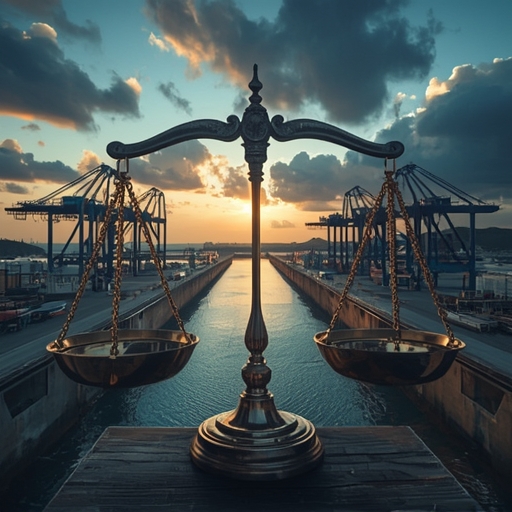
Panama’s Supreme Court has delivered a profoundly consequential judgment that reverberates far beyond its national borders, declaring that the contractual agreements granting operational control of two Panama Canal ports to a Hong Kong–based company are unconstitutional. This ruling, reached after extensive legal scrutiny and intense national debate, represents not merely a domestic legal correction but a transformation in the strategic calculus that underpins the governance of one of the world’s most vital maritime arteries. By asserting that such long-term port concessions breached the constitutional protections designed to safeguard Panama’s sovereignty, the Court has reaffirmed the nation’s authority over its canal infrastructure — a matter inseparable from its identity and economic security.
The implications of this decision are vast and complex. The Panama Canal, a global chokepoint linking the Atlantic and Pacific Oceans, serves as a cornerstone of international trade and a symbol of geopolitical leverage. By nullifying agreements with a company headquartered in Hong Kong, the Court not only reasserts Panama’s constitutional principles but also challenges the expanding sphere of Chinese economic influence in Latin America. Beijing’s involvement in critical infrastructure across the region has been viewed as part of a broader strategy to extend its global reach, and this ruling introduces a new and unexpected variable into that dynamic.
On a geopolitical level, the judgment signifies a rebalancing of regional power. Latin American nations, long navigating between external powers seeking economic footholds and internal demands for sovereignty, may see in Panama’s decision a precedent for reclaiming greater control over strategic assets. This move could inspire similar reassessments in countries where foreign concessions have prompted questions about dependency and national integrity.
Economically, the verdict invites both uncertainty and opportunity. For global shipping routes and trade logistics, any alteration in port administration around the Panama Canal carries immense ripple effects. Investors and international partners will be watching closely to assess how Panama manages the transition, how it ensures operational continuity, and how this episode reshapes its reputation as a hub of maritime commerce. Yet for Panamanians, the Court’s action is likely to be perceived as a reaffirmation of national dignity — a legal and symbolic stand signifying that critical infrastructure must remain under transparent and constitutionally compliant stewardship.
In essence, Panama’s Supreme Court has not merely rendered a constitutional judgment; it has illuminated the intersection of law, sovereignty, and global trade politics. The decision underscores how judicial independence can influence international economic paradigms and redefine the contours of foreign influence within a strategically indispensable nation. As governments, corporations, and analysts worldwide absorb the full ramifications of this outcome, what remains clear is that this landmark ruling will resonate throughout the Western Hemisphere’s political and economic landscape for years to come, marking a pivotal chapter in the modern story of the Panama Canal and its enduring role in shaping global commerce.
Sourse: https://www.wsj.com/business/logistics/panamas-high-court-rules-against-hong-kong-firm-running-canal-ports-714c23c8?mod=pls_whats_news_us_business_f