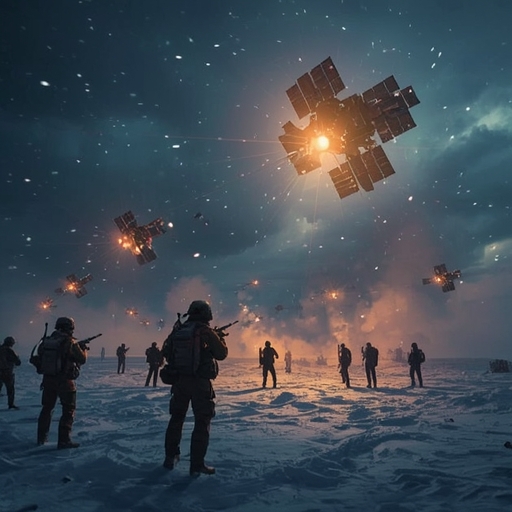
Recent reports emerging from Kyiv indicate a striking and somewhat unsettling development in the ongoing conflict: Russian military units, facing acute operational challenges due to disrupted communications, are reportedly resorting to desperate measures in their pursuit of Starlink connectivity. According to Ukrainian officials, these troops have allegedly been attempting to pressure, intimidate, or financially entice Ukrainian civilians into registering Starlink terminals on their behalf. Such actions underscore how access to reliable communication networks has evolved into an indispensable asset in twenty-first-century warfare.
What once constituted a mere tool of convenience—satellite-based internet access—has now become a decisive factor in both tactical coordination and strategic endurance. The competition for control over information channels reveals that the modern battlefield extends far beyond the trenches or urban front lines. Instead, it encompasses the digital sphere, where data transmission, encryption, and uninterrupted connectivity can determine the outcome of missions and influence military advantage. In this environment, Starlink’s constellation of satellites represents not just a technological marvel but a potent strategic lever—an invisible infrastructure of communication that can shape the tempo of conflict itself.
The allegations of Russian coercion and bribery therefore carry profound implications. They illustrate the immense value now attached to access points of digital infrastructure in contested areas. In regions where traditional signals are jammed or destroyed, the ability to transmit orders, relay reconnaissance, and maintain situational awareness through an independent satellite network may well define the capacity to operate effectively. Ukrainian officials’ statements highlight the growing recognition that cyberspace and physical warfare are no longer separate domains; rather, they function as two interconnected theatres in a single, unified struggle.
In essence, what is unfolding in Ukraine is not merely a battle over territory, but a contest for informational sovereignty—the control of the signals that sustain armies and shape narratives. As such, the confrontation surrounding Starlink terminals epitomizes a new era of technological warfare, where satellites orbiting silently above the Earth assume a central role in determining power on the ground. The incident serves as a stark reminder that in modern conflict, mastery of communication technologies is as critical as the mastery of weapons themselves, blending the tangible and digital dimensions of war into an inseparable, deeply strategic whole.
Sourse: https://www.businessinsider.com/ukraine-worries-people-register-starlink-terminals-russia-2026-2