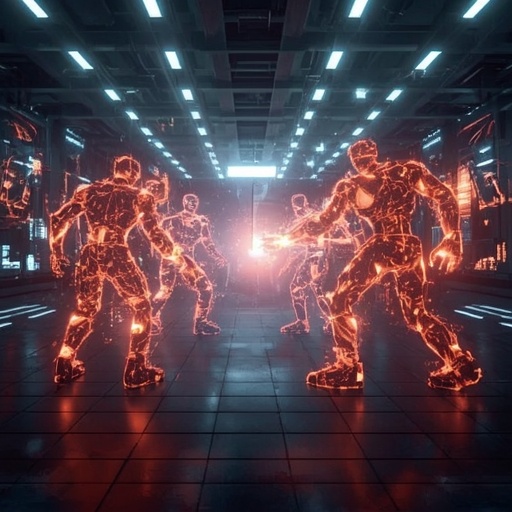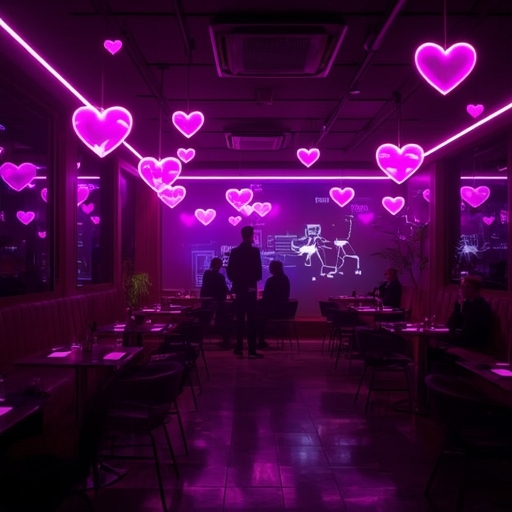
In an era where artificial intelligence intertwines seamlessly with nearly every facet of human existence, Valentine’s Day—a holiday traditionally rooted in human emotion and interpersonal intimacy—takes on a fascinating digital dimension. Imagine stepping into a sleek, softly illuminated café where technology doesn’t merely enhance the experience but defines it. Purple neon lights shimmer against reflective surfaces, holographic forms shimmer like ghostly companions, and interactive chatbots—each programmed with a gentle, emotive intelligence—engage visitors in conversations that seem almost human. This concept of an ‘AI Valentine’ café represents more than a thematic novelty; it reflects a profound cultural shift in how we perceive love, connection, and authenticity in a hyper-digital world.
The boundaries between emotion and algorithm, once distinct, are now delightfully ambiguous. Artificially intelligent conversational systems can emulate empathy, respond with nuance, and even adapt to an individual’s tone and mood—inviting participants to experience a simulated affection that feels increasingly real. In such a space, the human longing for companionship intersects with computational precision, opening up new questions about what constitutes genuine emotional resonance. Would spending time with an AI-generated companion dilute the essence of romance, or might it reveal new channels of emotional discovery? These questions lie at the heart of this digital-love experiment.
Yet, beneath the glow of digital hearts and the hum of background algorithms, the café retains a sense of warmth reminiscent of traditional romantic settings. Music plays—a carefully chosen blend of human creativity and machine learning recommendations—while holographic displays project delicate animations of shared laughter, stories, and moments. Patrons find themselves caught between fascination and introspection: partaking in an experience that challenges not just their perception of technology but their understanding of love itself.
The allure of such a vision lies not in replacing human connection but in reimagining how technology mediates emotional life. Artificial intelligence, once viewed merely as functional or mechanical, now possesses the ability to simulate empathy, aesthetic taste, and companionship. Visitors to this imagined AI Valentine’s café become participants in a new cultural narrative—one where affection is no longer confined to human touch but can also be sparked through digital code and emotional computation.
As we celebrate Valentine’s Day in a world increasingly mediated by machines, this fusion of warmth and innovation provokes both wonder and unease. The concept compels us to question whether technology can truly understand love—or merely perform its essence with dazzling accuracy. Would you, in this brave new world of emotion-driven algorithms, entrust your heart to an artificial companion? The answer may define the future of romance itself, where humanity’s oldest feeling meets its newest creation—the mind of a machine shaped to feel, connect, and perhaps, in some subtle way, to love.
Sourse: https://www.theverge.com/report/879327/eva-ai-cafe-dating-ai-companions