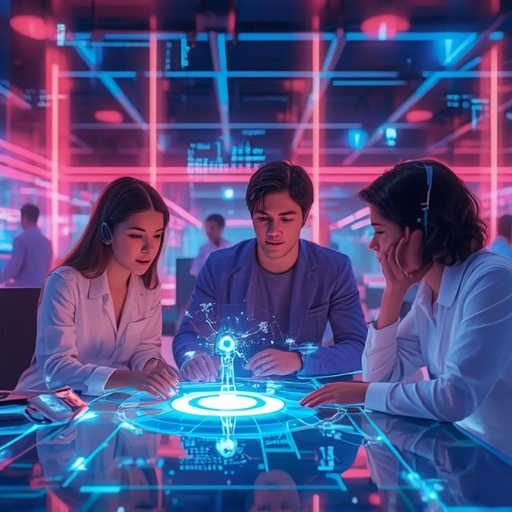
Mark Cuban’s foresight about the emergence of a new ‘AI army’ is no longer a far‑off prediction—it is rapidly unfolding before our eyes. Across industries, a dynamic generation of young innovators is rising to integrate artificial intelligence into nearly every facet of business and organizational life. What he anticipated as a growing movement of technologically fluent thinkers has evolved into a worldwide force, shaping enterprises, economies, and creative workflows in profound ways.
Today’s leading technologists and corporate visionaries unanimously recognize that artificial intelligence is not simply a fleeting trend but an essential catalyst redefining how work is imagined, executed, and expanded. The transformation is not centered on the replacement of human talent, but rather on amplifying human potential through intelligent collaboration between people and machines. In this new landscape, success belongs to those who can harmonize analytical logic with creativity and emotional insight—individuals who understand both emerging technologies and the timeless art of human problem‑solving.
For businesses, this evolution demands strategic adaptation. Organizations that once relied solely on conventional expertise are now building hybrid teams, where coders, data scientists, designers, and entrepreneurs work alongside automated systems that accelerate insight and efficiency. The companies embracing this model are discovering that innovation flourishes when humans serve as architects of AI‑driven ideas rather than passive observers of automation. Whether through AI‑enhanced customer experiences, data‑driven decision ecosystems, or generative creative tools, the promise lies in empowerment, not displacement.
Meanwhile, for young professionals navigating the early stages of their careers, artificial intelligence presents both an opportunity and a responsibility. It invites them to master new digital languages, explore novel ethical frameworks, and cultivate adaptive learning mindsets that will remain relevant in an era of perpetual change. The next generation’s competitive advantage will not be defined by memorized knowledge, but by the capacity to learn continuously, to collaborate intelligently with machines, and to think critically about technology’s role in shaping a better future.
Ultimately, the future of work envisioned by Cuban and echoed by countless experts today calls for courage and imagination. It challenges established institutions to rethink education, reskill their workforces, and design cultures where curiosity outweighs complacency. It encourages leaders to view AI not as a threat, but as a partner capable of expanding what humankind can achieve.
The revolution is no longer theoretical—it is already underway. Those who observe from the sidelines risk obsolescence, while those who engage boldly stand to become architects of the next economic and creative renaissance. The question is no longer when artificial intelligence will change the world—it is how we, as individuals and organizations, will choose to evolve with it. #AI #Innovation #FutureOfWork #Leadership
Sourse: https://www.businessinsider.com/mark-cuban-ai-skills-tech-young-people-jobs-implement-opportunity-2026-2