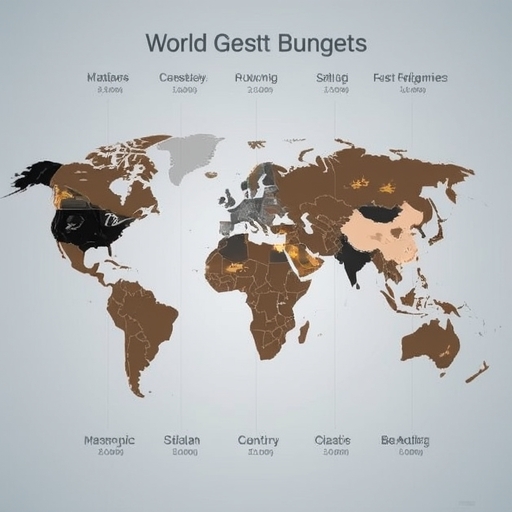
Global defense spending serves as a mirror reflecting not only a nation’s security concerns but also its political ambitions, economic capacity, and geopolitical strategies. At the forefront, the United States remains unmatched, maintaining an immense military budget that underscores its long‑standing role as a dominant global power. This colossal expenditure extends far beyond domestic security—it supports an intricate worldwide network of alliances, overseas bases, and advanced technological development, ensuring that the United States retains its global military reach.
However, an analysis of the 30 nations that invest the most in their armed forces reveals a complex portrait of how states allocate resources to defend their interests and define their standing on the global stage. Following the U.S., countries such as China, Russia, India, and members of the European Union have channeled substantial portions of their national budgets toward defense modernization. Each of these nations approaches spending from a distinct perspective: some focus on regional deterrence and territorial preservation, while others pursue global power projection or technological parity with their rivals.
These defense allocations expose how security priorities evolve in response to shifting global tensions. For instance, increased investments by nations within Asia and Eastern Europe reflect concerns about strategic competition and border security, while Western countries often emphasize innovation—spending heavily on cybersecurity, artificial intelligence, and next‑generation weapons systems. The disparity between budgets also highlights the uneven distribution of military influence, demonstrating how a small number of countries collectively account for the vast majority of worldwide defense outlays.
The implications of such concentrated spending extend beyond military hardware. Large defense budgets stimulate research, industrial development, and employment, yet they also raise questions about opportunity costs—resources devoted to weaponry could instead address education, infrastructure, or healthcare. Conversely, for nations perceiving imminent threats, robust defense funding becomes indispensable, a cornerstone of national sovereignty and deterrent credibility.
In assessing these figures, one perceives that military expenditure is not simply a numerical competition but a manifestation of ideology, aspiration, and perceived vulnerability. A comparative review of global spending patterns thus offers invaluable insight into the architecture of modern geopolitics: where conflicts may simmer, where alliances are strengthening, and how power, in its many forms, continues to be negotiated on the international stage.
Ultimately, tracking the thirty largest military spenders helps illuminate an underlying truth—that defense budgets are both a symptom and a driver of global dynamics. They shape not only how nations defend themselves but also how they influence and interact with one another, revealing the delicate balance between security, ambition, and responsibility that defines our contemporary world.
Sourse: https://www.businessinsider.com/biggest-military-budgets-countries-ranked