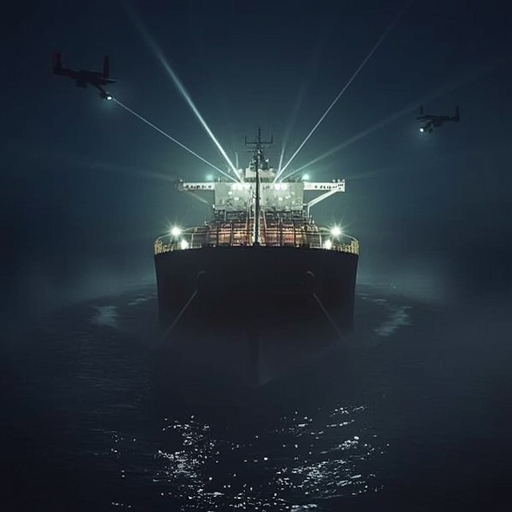
Across the vast expanse of the world’s oceans, an intricate and largely concealed operation is unfolding—one that has captured the focused attention of U.S. authorities. They are intensifying their determination to expose what is commonly referred to as the ‘shadow fleet,’ a loosely connected network of oil tankers engaged in clandestine activity, transporting petroleum outside the bounds of legal and regulatory scrutiny. These vessels, which often disguise their routes, ownership, and cargo origins, embody a new front in the ongoing struggle against illicit trade in the global energy market.
Driven by both geopolitical concerns and the goal of enforcing international sanctions, the United States has begun deploying increasingly sophisticated mechanisms for maritime surveillance. Advanced satellite monitoring, enhanced vessel-tracking algorithms, and data-driven analytical models are now being leveraged to dissect this hidden web of ships. As enforcement capabilities expand, those operating within the shadow fleet show remarkable adaptability—switching transponders off, altering digital identities mid-voyage, and transferring oil under the cover of darkness in remote waters. This constant tug-of-war between disclosure and deception illustrates a technological race evolving rapidly across the high seas.
Yet this conflict is about more than just digital cat-and-mouse tactics. It strikes at the very foundation of transparency in global energy commerce. Each new enforcement measure by regulators provokes inventive countermeasures by operators determined to remain invisible. As a result, the maritime industry finds itself at a crossroads, where the legacy systems of trade must now incorporate a culture of modern compliance bolstered by cutting-edge detection tools and multinational cooperation.
Observers predict that this mounting tension may trigger profound transformations in global shipping practices. Insurance frameworks, port inspections, and vessel registration protocols are all poised for reevaluation as authorities seek to close loopholes that have allowed illegal networks to thrive. At the same time, legitimate operators—those conducting lawful trade—are being urged to embrace transparency as both a defensive measure and a sign of trustworthiness in an increasingly monitored market.
In the end, the pursuit of the shadow fleet extends beyond the confines of maritime policy; it serves as a symbolic reflection of the broader struggle between secrecy and accountability in international commerce. The unfolding campaign, propelled by technological innovation and geopolitical necessity, promises to redefine what visibility on the world’s oceans truly means, setting the stage for a new era of maritime vigilance and energy security that no actor within the global trade ecosystem can afford to ignore.
Sourse: https://www.wsj.com/business/energy-oil/the-u-s-is-hunting-the-shadow-fleet-this-is-what-its-up-against-0feba9bb?mod=pls_whats_news_us_business_f