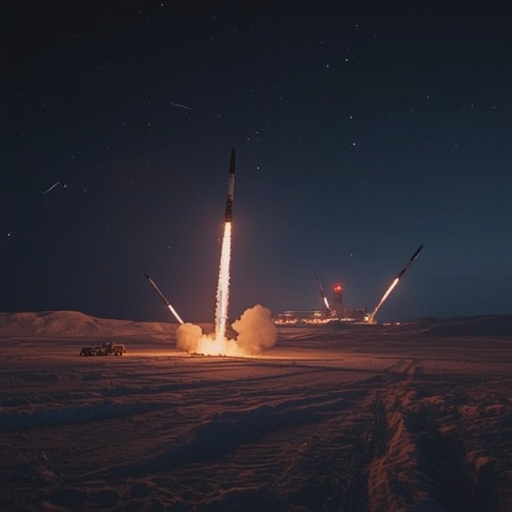
In a remarkable display of advancing military technology and strategic ambition, Ukraine has reportedly conducted a successful test of its newly developed, long‑range Flamingo missile system. According to multiple accounts, these domestically engineered weapons reached targets situated nearly nine hundred miles within Russian territory, allegedly including an Iskander missile production facility — a cornerstone of Moscow’s tactical missile infrastructure. This achievement, if accurately confirmed, underscores not only a striking leap in Ukraine’s indigenous defense capabilities but also the nation’s growing mastery of aerospace and precision‑strike innovation.
Such an operation represents more than a mere technical triumph; it embodies the culmination of years of accelerated research and adaptation conducted under the extraordinary pressures of wartime necessity. The development of the Flamingo missiles demonstrates Ukraine’s transition from dependence on foreign suppliers to a new paradigm of technological self‑sufficiency. In doing so, it reveals a broader narrative of resilience — a deliberate effort to engineer complex tools of deterrence and survival amid an evolving geopolitical struggle.
From a geopolitical perspective, the reported strike penetrates deeper into Russian territory than any earlier Ukrainian long‑range operation. This profound reach marks an inflection point, one that subtly redefines the operational balance between the nations. Each successful launch confirms that Ukraine’s defense sector has matured far beyond its pre‑war limitations, integrating advanced propulsion systems, guidance algorithms, and domestic manufacturing expertise to produce results once thought unattainable.
In a world where technological sovereignty is increasingly intertwined with national security, Ukraine’s progress highlights an essential truth: innovation is no longer a luxury but an existential imperative. The Flamingo missile program crystallizes this shift by illustrating how creative engineering, sustained commitment, and the urgency of conflict can converge to generate transformative results. As global observers analyze the implications of this test, it becomes clear that Ukraine’s evolution from a defense consumer to an innovation‑driven power is reshaping not only its battlefield posture but also its role in the broader architecture of modern warfare.
Ultimately, this event serves as both a symbol and a signal — a symbol of how necessity accelerates invention, and a signal that future conflicts will increasingly be determined not solely by numerical strength or imported weaponry, but by the capacity to design, refine, and command complex systems at home. The Flamingo’s reported flight deep into Russia, reaching almost nine hundred miles to its intended targets, stands as a testament to that new era of defense innovation and strategic autonomy.
Sourse: https://www.businessinsider.com/ukraine-zelenskyy-homegrown-missiles-900-miles-hit-russian-factory-2026-2