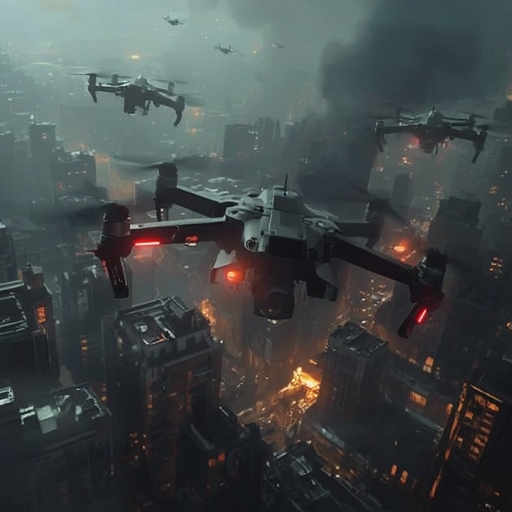
As the development and deployment of drones accelerate at an unprecedented pace, the fundamental nature of warfare itself is undergoing a profound transformation. Once confined primarily to reconnaissance and precision strikes, unmanned aerial vehicles have evolved into pivotal instruments that now influence every aspect of modern conflict — from intelligence gathering to direct combat engagement. Yet despite their strategic efficiency and technological sophistication, these airborne systems are steadily introducing a complex moral and humanitarian dilemma: civilians are increasingly exposed to danger even when they are not intended targets. The abstract buzz above is more than the sound of innovation; it is the echo of shifting doctrines and blurred battle lines.
Across regions such as Ukraine and the Middle East, the proliferation of drones has transformed the very structure of the sky into an active dimension of warfare. Traditional notions of safety behind the front lines are fading quickly as drones extend the battlefield deep into civilian territories. What was once a domain reserved for soldiers and strategic assets now encompasses markets, schools, and villages — turning ordinary life into a zone of perpetual vulnerability. For inhabitants of these regions, the sight of a small aircraft overhead can invoke not just curiosity but fear, reflecting a new psychological toll that parallels the physical destruction drones can unleash.
For policymakers, defense strategists, and humanitarian organizations, understanding this evolution is not merely an academic exercise but a moral imperative. Drone technology represents both possibility and peril: its precision can minimize collateral damage, yet its accessibility and autonomy can just as easily magnify harm. The challenge lies in reconciling efficiency with ethics, innovation with accountability. International norms and oversight mechanisms struggle to keep pace with the rapid adaptation of this technology, leaving a vacuum in which rules of engagement remain ambiguous and enforcement inconsistent.
In this emerging era of drone warfare, the boundaries between combatant and civilian, battlefield and homefront, have become increasingly blurred. As machines take to the skies with ever-greater autonomy and sophistication, the risks faced by noncombatants multiply in both scale and complexity. Technological progress, if left unchecked by humanitarian foresight, risks turning innovation into indiscriminate peril. The future of conflict, therefore, demands not only advanced engineering but also an equally advanced moral consciousness — one capable of ensuring that the power to reshape warfare does not come at the irreversible expense of human safety and dignity.
Sourse: https://www.businessinsider.com/new-level-drone-warfare-new-risk-civilians-ukraine-russia-iran-2026-3