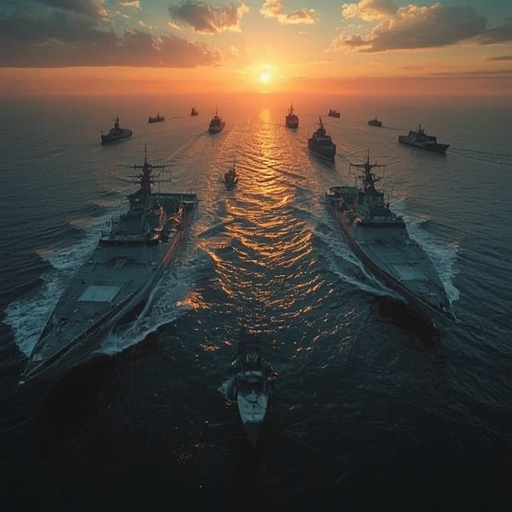
Tensions are escalating dramatically in the strategically vital Strait of Hormuz, a maritime corridor that serves as one of the world’s most critical arteries for the transportation of energy resources. According to recent reports from United States military officials, American forces have reportedly engaged and eliminated sixteen Iranian minelaying vessels that were allegedly operating in or near this narrow but geopolitically indispensable passage. This decisive action, undertaken in one of the most contested maritime regions on Earth, has immediately reverberated across the international community, igniting deep concerns about the security and stability of global oil supply chains.
The Strait of Hormuz, nestled between the Persian Gulf and the Gulf of Oman, acts as a gateway through which roughly one-fifth of the world’s petroleum consumption passes daily. Any disruption or perceived threat within this corridor carries the potential to send shockwaves through global markets, influencing energy prices, trade dynamics, and even diplomatic relations among major powers. With news of the destruction of these Iranian vessels, analysts are already warning of an intensified standoff between Washington and Tehran, as well as the elevated risk of further escalation in a region already burdened with layers of political and military tension.
Experts in energy infrastructure, maritime security, and international relations emphasize that the consequences of such actions extend far beyond the immediate theater of conflict. Tankers, shipping companies, and global trading consortiums rely on predictability and safe passage through this waterway. A single incident that hints at instability can provoke a surge in insurance premiums, rerouting of vessels, or speculative fluctuations in crude oil prices. The United States’ decision, therefore, marks not only a tactical maneuver but also a strategic signal—an assertion of its continued commitment to safeguarding open maritime routes against perceived aggression.
Simultaneously, global observers are watching closely to gauge Iran’s official response. Historically, Tehran has viewed the Strait as both a sovereign boundary and a lever of geopolitical influence—one that can be tightened or loosened to convey strategic pressure. The destruction of its minelaying boats could be interpreted domestically as an act of provocation, thus prompting renewed hostilities or retaliatory deployments. At the same time, diplomatic actors across Europe, Asia, and the Middle East are urging restraint, recognizing that a military miscalculation here could rapidly evolve into a larger regional confrontation with global economic ramifications.
Beyond the realm of defense and security, this event underscores the interconnectedness of modern energy and trade networks. Economists point out that the Strait of Hormuz functions as an irreplaceable junction in the map of international commerce. Any obstruction—whether caused by military confrontation, sabotage, or political brinkmanship—could disrupt the flow of oil and liquefied natural gas bound for Asia, Europe, and North America. Such a scenario would inevitably intensify inflationary pressures, strain supply chains already under stress, and test the resilience of international diplomatic frameworks meant to prevent escalation in high-stakes zones.
Professionals in the fields of logistics, energy management, and global policy are therefore watching this evolving situation with heightened vigilance. For maritime authorities, the challenge lies in balancing stringent security protocols with the maintenance of open trade flows. For investors and policymakers, the objective becomes assessing long-term exposure to volatility driven by geopolitical shocks. And for the general public, these developments serve as an urgent reminder that distant straits and contested waters—even thousands of miles away—possess the capacity to influence the price at the local fuel pump or shape the trajectory of broader economic recovery.
In the coming days, as further details emerge, the world’s attention will remain fixated on this narrow expanse of ocean. Every movement of a ship, every official statement, and every diplomatic overture will be scrutinized for signs of either de-escalation or confrontation. What transpires in the Strait of Hormuz may not merely define the tenor of U.S.–Iran relations but could also reaffirm the enduring truth that maritime freedom and energy stability remain inseparable pillars of the global order.
Sourse: https://www.businessinsider.com/us-attack-strait-hormuz-iran-war-oil-persianl-gulf-boats-2026-3