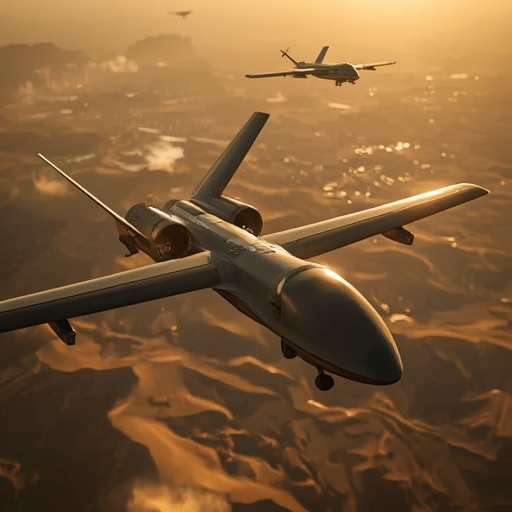
The rapid ascendance of Iran’s Shahed series of unmanned aerial systems has set in motion a dramatic transformation across the global defense and technology sectors. Once regarded primarily as a regional military novelty, these drones have now demonstrated substantial operational impact, prompting governments and private defense entities alike to rethink how airspace security and interception capabilities are approached. As a direct consequence of this heightened awareness, demand for advanced drone-interceptor technologies has surged to unprecedented levels.
Small and medium-sized drone manufacturers, many of which previously operated on the fringes of the aerospace industry, suddenly find themselves thrust into the spotlight. These companies, once focused on experimental or commercial-grade quadcopters and lightweight reconnaissance models, are now receiving large-scale procurement inquiries from defense contractors, national security agencies, and private defense investors—most notably concentrated in Middle Eastern markets where the threat perception is most immediate. For example, firms specializing in AI-assisted sensor systems, radar-guided interception algorithms, or autonomous flight coordination technologies are witnessing a dramatic escalation in both funding and production requests.
This ongoing evolution highlights a profound shift in how global defense industries operate. The development of cost-efficient, modular, and deployable drone interception systems has become not merely a strategic advantage but a necessity in the modern aerial warfare environment. The Shahed drones’ relatively affordable manufacturing process has exposed vulnerabilities in conventional defense frameworks that traditionally relied on costly missile systems or human-piloted aircraft. Consequently, military planners and private investors are accelerating innovation cycles to produce agile, responsive, and interoperable defense technologies capable of neutralizing fast-moving unmanned threats.
Furthermore, the ripple effect of this new defense race extends well beyond immediate military implications. The crossover between civilian drone technology and defense applications has fostered an unprecedented collaboration between aerospace startups, AI developers, and logistics innovators. These synergies have given rise to a new class of dual-purpose technologies—systems equally effective in safeguarding commercial air corridors and in defending critical national infrastructure.
In essence, the emergence of Iran’s Shahed drones has catalyzed an industry-wide recalibration of priorities. What began as a geopolitical development has evolved into a full-scale economic opportunity for small-scale drone innovators who can combine design agility, rapid prototyping, and advanced software integration. The global defense sector now stands at the threshold of a new era defined by accessibility, automation, and adaptive security responses—an era in which nimble engineering and visionary entrepreneurship redefine what air defense truly means in the twenty-first century.
Sourse: https://www.businessinsider.com/iran-shahed-drone-interceptor-booming-business-manufacturers-middle-east-t2026-3