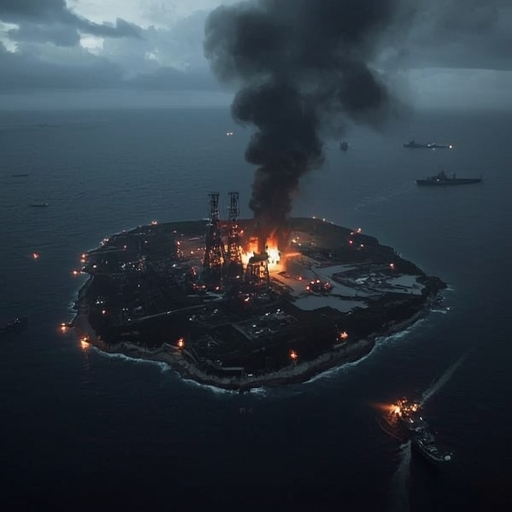
The United States has reportedly carried out a significant and highly coordinated military operation targeting major strategic installations on Kharg Island—one of the most critical nodes within Iran’s oil export infrastructure. This location, long regarded as the lifeline of the nation’s petroleum industry, functions not only as a pivotal logistical center but also as a symbol of Iran’s economic stability and energy sovereignty. By directing military force at such an essential facility, the U.S. appears to have made a tactical decision intended to communicate both operational capability and strategic intent.
Kharg Island’s relevance extends far beyond its geographical boundaries. Situated in the Persian Gulf, it has historically served as the principal terminal for Iran’s crude oil exports, making it a linchpin in the global energy supply chain. Any disruption there—whether temporary or prolonged—could reverberate across international energy markets, influencing oil prices, trade routes, and the delicate balance of power among energy-producing nations. For decades, analysts have viewed Kharg as a critical vulnerability within Iran’s industrial network, a site whose security directly correlates with the country’s fiscal resilience and global leverage.
The implications of this reported strike are multifaceted. On an immediate level, it introduces heightened uncertainty into the already volatile global oil market, discouraging investor confidence and potentially prompting rapid fluctuations in commodity prices. On a broader scale, the incident underscores how modern geopolitical tensions can swiftly extend into economic and environmental domains. A single military action in this region, where strategic waterways and energy corridors intersect, holds the capacity to reshape trade flows, alter diplomatic alignments, and intensify debates about maritime security and economic sanctions.
For experts in international relations, defense strategy, and energy policy, this event may signify a turning point in U.S.–Iran relations and in the broader geopolitical theater of the Middle East. It raises pressing questions: Was this operation a calculated act of deterrence, a demonstration of power projection, or a preemptive move responding to perceived threats? Equally pressing is the matter of consequences—how Iran and its allies might react, how global institutions will mediate the emerging crisis, and whether diplomatic channels can restrain escalation.
Ultimately, the strike on Kharg Island encapsulates the intertwined nature of energy infrastructure and national security in a globalized era. It reminds policymakers, corporations, and observers alike that stability in the energy sector is never merely an economic issue but rather an intricate reflection of international politics, regional rivalries, and strategic ambitions. The world now watches closely as governments gauge their responses, financial markets absorb the shock, and analysts reassess what this moment means for the fragile equilibrium of global power and resource dependency.
Sourse: https://www.businessinsider.com/trump-says-us-launched-strikes-iran-kharg-island-oil-reserves-2026-3