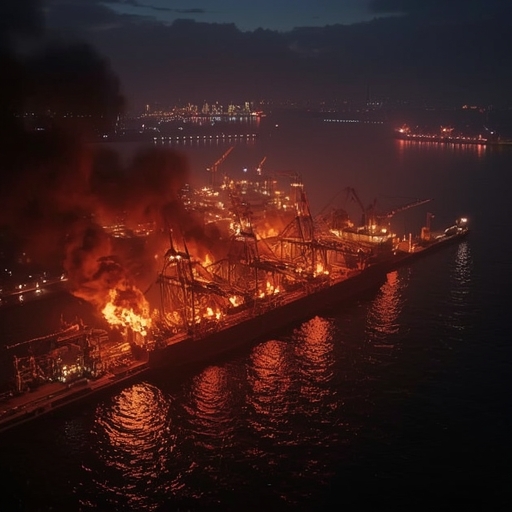
In a dramatic turn of global events, the Middle East has once again become the epicenter of escalating geopolitical and economic tension. A massive and highly destructive fire has devastated a crucial oil export terminal within the United Arab Emirates, an incident that occurred scarcely twenty‑four hours after United States military forces executed targeted airstrikes against a major Iranian oil storage facility. The timing of these two critical developments has raised widespread international concern, illustrating the acute vulnerability of energy supply chains and exposing how swiftly regional instability can ripple outward to affect the broader global economy.
The closure of the Strait of Hormuz—one of the most vital maritime arteries for the transport of petroleum and natural gas—has only intensified this precarious situation. This narrow waterway serves as the primary conduit through which a substantial portion of the world’s oil supply passes each day; its shutdown effectively throttles the lifeblood of international energy commerce. With shipping routes now suspended, analysts anticipate a steep and possibly sustained rise in oil prices, as global markets react to the sudden constriction in supply and to anxieties about further military confrontation.
Energy experts and policymakers alike warn that this convergence of military action and infrastructure disaster could precipitate a multifaceted crisis. Beyond the immediate rise in crude oil prices, secondary consequences are likely to emerge: heightened inflationary pressures, increased costs of transportation and production worldwide, and potential economic slowdowns across energy‑dependent regions. Traders have already begun recalibrating their projections, factoring in scenarios that include not only short‑term volatility but also the possibility of longer‑term geopolitical dislocation.
The fire at the UAE port underscores the fragility of industrial infrastructure in conflict‑prone zones. Although emergency response teams have reportedly contained part of the blaze, the visible plumes of dark smoke curling skyward serve as a stark reminder of the region’s combustible mix of resources, ambition, and geopolitical rivalry. For nations reliant on imported fuel, these events highlight an urgent need to diversify energy strategies—accelerating investment in renewables, reinforcing energy reserves, and re‑evaluating maritime trade dependencies.
Meanwhile, diplomatic tensions have escalated as world leaders call for restraint while simultaneously deploying naval assets to safeguard critical shipping lanes. Market observers are closely monitoring whether this incident will remain localized or if it will ignite a broader standoff involving major powers and their regional allies. The delicate balance of deterrence and diplomacy now hangs in the balance, with global energy security tethered to every decision made in the coming days.
In essence, the destruction at the UAE oil port, when coupled with the recent U.S. strikes on Iranian facilities and the consequential closure of the Strait of Hormuz, marks a pivotal moment in the ongoing story of global energy interdependence. It serves as a vivid testament to the intertwined nature of politics, economics, and the environment in shaping the modern world’s stability, reminding policymakers and citizens alike that in an era of unprecedented connectivity, the spark of conflict in one location can ignite consequences of truly international magnitude.
Sourse: https://www.businessinsider.com/photos-fire-key-uae-oil-hub-after-intercepted-drone-attack-2026-3