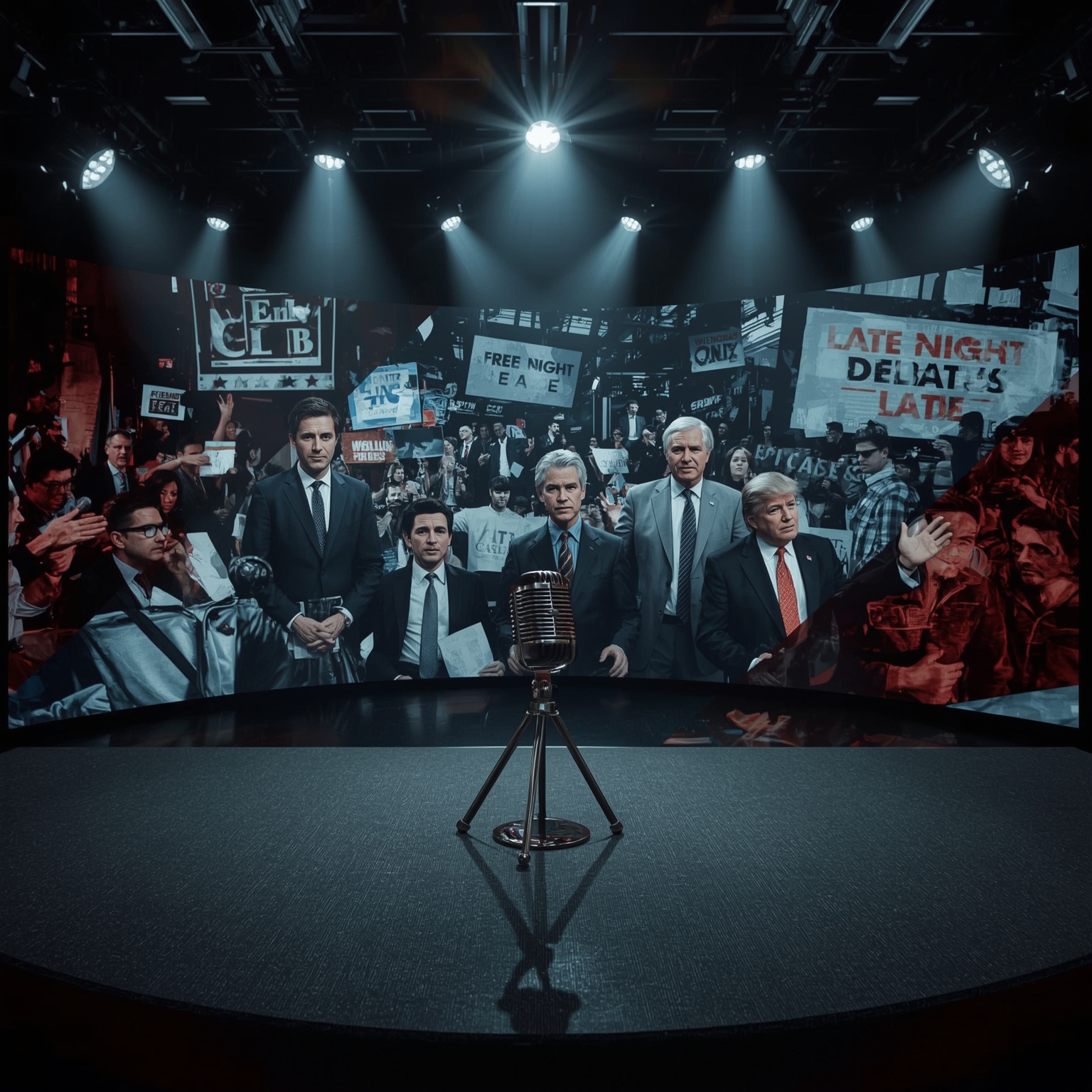
“Jimmy Kimmel Live!”—once a fixture of late-night entertainment and a recognizable part of American pop culture—might now be facing an uncertain future. Depending upon one’s perspective, this development could either be a welcome relief, signaling accountability in media, or a disastrous sign that comedy and free speech are under siege. What is undeniable, however, is that Jimmy Kimmel’s sudden suspension, prompted by comments he made concerning conservative activist Charlie Kirk, has sparked an immediate and polarizing debate, raising serious questions about the role and responsibilities of both entertainers and media institutions.
The controversy escalated quickly. Earlier this week, ABC made the consequential decision to remove Kimmel’s program from the airwaves indefinitely, following strong warnings from the Federal Communications Commission (FCC). The regulator reportedly threatened action unless the network addressed remarks Kimmel had made about the reaction within former President Donald Trump’s base to Charlie Kirk’s death. This intervention from a government body raised alarms for many observers, as it touches on the delicate line between regulatory authority and freedom of expression.
Predictably, ABC’s drastic move was met with passionate responses. Hollywood figures and fellow entertainers rallied behind Kimmel, criticizing the suspension as an attack on artistic autonomy and public discourse. Politicians, meanwhile, largely responded along party lines: Democrats voiced indignation, framing it as a threat to the First Amendment and a chilling precedent for journalism and comedy alike. By contrast, many Republicans welcomed the decision, framing Kimmel’s remarks as irresponsible and offensive. Unsurprisingly, Donald Trump expressed strong approval, even going so far as to suggest that rival networks such as NBC should punish their own late-night hosts, specifically naming Jimmy Fallon and Seth Meyers. The cultural divide was made crystal clear, while popular talk shows like *The View* declined to weigh in, leaving audiences to interpret the moment on their own.
Why, many asked, did ABC so readily yield to the FCC’s pressure? The answer may lie in corporate politics and business ambitions. A prominent local broadcaster, which carries ABC programming, is simultaneously pursuing approval for a multibillion-dollar merger deal valued at approximately $6.2 billion. That operator, keen on maintaining a favorable relationship with federal regulators, exerted pressure that forced ABC’s hand. It is worth remembering that, although ABC is a national network, many individual stations are not company-owned but instead affiliates—separately owned operators which carefully balance commercial interests with regulatory compliance.
The implications of this affair stretch far beyond a single host’s suspension. Media analysts emphasize that if American regulators can pressure media organizations into removing programming based on subjective objections, it erodes public confidence in the independence of the press and entertainment industries. As journalist Peter Kafka succinctly put it, the fact that U.S. regulators urged a private company to eliminate a program they found unpalatable sets a troubling precedent. This inevitably places questions of First Amendment protections at the center of the debate—questions about where to draw the line between accountability and censorship, between offensive commentary and legitimate discourse.
On the other side of this conversation are those who defend ABC’s decision by invoking the concept of what they call “consequence culture.” Unlike the much-derided term “cancel culture,” which implies silencing, proponents of consequence culture maintain that individuals must accept the repercussions of their own public statements, particularly when those statements carry social or political weight. At least one major ABC affiliate has even hinted at a willingness to put Kimmel’s show back on the air—though only if the comedian agrees to abide by their specific set of conditions, effectively tethering his return to a negotiated compromise.
This episode also fits into the broader narrative of late-night television’s struggles. Even before the political turbulence of the Trump era, the traditional late-night format was in decline, struggling to adapt to changing viewing habits in the streaming era. With Colbert preparing to exit and Kimmel’s future in doubt, the genre as a whole seems increasingly unstable. The combination of declining ratings, intensifying political scrutiny, and heightened cultural polarization has created an environment in which late-night hosts operate under extraordinary pressure.
Still, not all responses were grim. Almost immediately after Kimmel’s suspension, his peers in the industry—Stephen Colbert, Jimmy Fallon, Seth Meyers, and Jon Stewart of *The Daily Show*—took to their own platforms. Rather than retreat quietly, they chose to address the issue with their characteristic tools: satire, irony, and pointed humor, transforming outrage into material for social commentary. Their unified stance suggested that, while individual hosts may face scrutiny, the larger tradition of comedic resistance remains intact.
And if all that wasn’t enough, yet another institution found itself drawn into the Charlie Kirk discourse: Starbucks. In a seemingly smaller but still viral controversy, a barista declined to write “Kirk” on a customer’s cup, citing internal company guidelines about political references. The incident spiraled across social media, feeding outrage narratives until Starbucks publicly clarified its policy. From now on, staff may, in fact, write political or public figures’ names on beverage orders—a decision that, while trivial on the surface, underscores how sensitive and far-reaching these debates about cultural politics have become. One could easily imagine ordering a venti latte under the name of a founding father, or any controversial figure, with far less fuss than before.
Taken altogether, the Kimmel controversy encapsulates a turning point. The suspension is not merely about one comedian’s remarks, but about the evolving intersections of politics, entertainment, regulation, and free speech. Late-night television, once viewed chiefly as a vehicle for lighthearted escapism, is increasingly entangled with larger national conflicts over identity, ideology, and the proper role of media in a democracy. Whether this ultimately strengthens the genre’s relevance or accelerates its decline remains to be seen, but one fact is clear: the debate will continue, and its consequences will echo far beyond a single show.
—Dan DeFrancesco, Deputy Executive Editor and Anchor, New York; Hallam Bullock, Senior Editor, London; Akin Oyedele, Deputy Editor, New York; Grace Lett, Editor, New York; Amanda Yen, Associate Editor, New York.”
Sourse: https://www.businessinsider.com/jimmy-kimmel-live-suspended-charlie-kirk-trump-abc-colbert-drama-2025-9