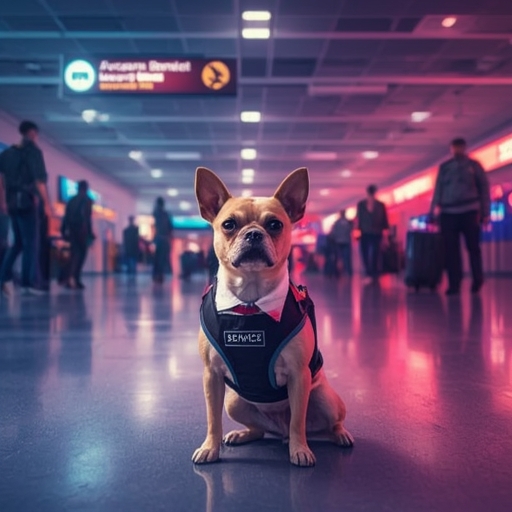
Across countless cities and towns, a troubling phenomenon has been gradually eroding one of society’s most valuable systems of trust and compassion: the proper use of service dogs. Increasingly, counterfeit service dog badges and vests are finding their way into public life—from bustling airports filled with hurried travelers to the aisles of local grocery stores where everyday interactions take place. This growing flood of fraudulent certifications does not merely inconvenience businesses; it damages the very foundation of respect and credibility upon which accessibility accommodations depend.
At its core, the problem arises from a lack of stringent regulation and awareness. Because it is remarkably easy to purchase a convincing service dog badge or vest online, individuals with no legitimate need for such identification can deceive staff or gate agents without fear of consequence. This ease of access, while seemingly harmless to some, inflicts lasting harm. Each instance in which a fake service dog disrupts a space—by barking aggressively, soiling public areas, or displaying disobedience—feeds public skepticism toward genuine service dogs and their handlers. Over time, it becomes increasingly difficult for those who legitimately depend on trained assistance animals to be treated with the trust and dignity they deserve.
For businesses and employees, this creates a persistent ethical and operational dilemma. Store owners and airline personnel are placed in the unenviable position of balancing compliance with disability accommodation laws against the need to maintain safety and order. Too often, fear of legal backlash or public criticism prevents staff from questioning the authenticity of a service dog vest, leading to situations where policy is exploited rather than upheld. The resulting erosion of standards does not reflect a lack of empathy, but rather a lack of clear guidance and enforcement mechanisms.
Real service dogs represent more than companionship—they are highly trained extensions of their handlers, responsible for vital tasks such as detecting medical conditions, assisting with mobility, or providing emotional stability. Their rigorous training ensures that they behave predictably and safely in public settings. When an untrained pet is passed off as a service animal, it not only jeopardizes this delicate trust but also places genuine teams at risk: a poorly behaved impostor can provoke confrontations, trigger anxiety, or distract a working service dog in the midst of performing essential duties.
Addressing this escalating issue requires both accountability and empathy. Public awareness campaigns can help distinguish legitimate service dogs from fraudulent representations, educating people on appropriate behavior when encountering service animals. Additionally, policymakers should consider implementing verification frameworks—perhaps standardized registration systems or digital credentials—that respect privacy while deterring misuse. Businesses, too, can play a role by training employees to approach inquiries with sensitivity, ensuring that enforcement efforts protect dignity rather than infringe upon it.
Ultimately, solving the crisis of fake service dog badges is not just about enforcing rules; it is about restoring the culture of trust and compassion that underpins accessibility. Encouraging honesty in how accommodations are claimed helps protect those who rely on them to live independently. By combining stronger regulation, informed empathy, and a collective sense of responsibility, society can reaffirm that accessibility is a right—never a loophole. 🐾
Sourse: https://www.businessinsider.com/cavapoo-fake-service-dog-badge-offices-restaurants-2026-3