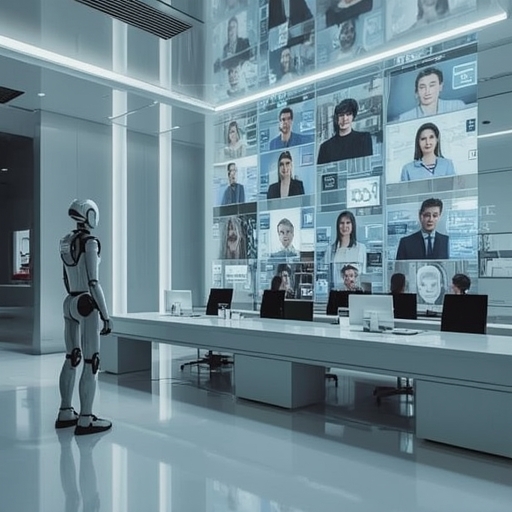
A growing number of people are beginning to accept the possibility of being managed not by a human supervisor, but by an artificial intelligence system designed to lead, evaluate, and guide their work. Recent research reveals that approximately 15% of Americans are open to the idea of having an AI as their direct manager. This statistic, while seemingly modest, reflects a profound cultural and organizational transformation that is gradually reshaping the structure of modern workplaces.
For decades, management hierarchies have defined how power, decision-making, and accountability flow within companies. Traditional corporate models relied heavily on tiered systems of human oversight — each level responsible for interpreting data, issuing commands, and ensuring performance. However, the rapid integration of automation and machine learning into business processes is now compressing these layered structures. In this emerging scenario, algorithms can analyze performance metrics, allocate tasks, and even make objective managerial assessments more efficiently than their human counterparts.
This development contributes to what futurists are labeling “The Great Flattening,” a term describing how organizations are reducing intermediate levels of supervision in favor of direct coordination between teams and intelligent systems. As a result, titles and hierarchies that once defined corporate identity may become less relevant. Employees could find themselves reporting to AI-powered dashboards or decision-assistance platforms capable of providing real-time feedback, personalized coaching, and strategic recommendations grounded in vast data analytics.
Such a shift opens both opportunities and challenges. On one hand, AI-led management could enhance fairness, consistency, and efficiency by eliminating certain human biases and delays inherent in traditional decision-making. On the other hand, it raises questions about trust, accountability, job satisfaction, and the evolving role of human empathy in leadership. For many professionals, adjusting to a non-human authority figure may test their adaptability and redefine what it means to be managed.
Ultimately, this transformation in organizational design compels companies to rethink leadership, redefine employee engagement, and establish clear ethical boundaries around algorithmic authority. If 15% of the workforce is already prepared to accept AI in a managerial capacity, the conversation is no longer speculative — it is an early glimpse into a not-so-distant reality where technology assumes roles once considered exclusively human. The fundamental question now becomes not merely whether we would work for an AI, but how we can coexist with it in a way that advances productivity while preserving the distinctly human qualities of creativity, judgment, and emotional understanding.
Sourse: https://techcrunch.com/2026/03/30/ai-boss-supervisor-us-quinnipiac-poll/