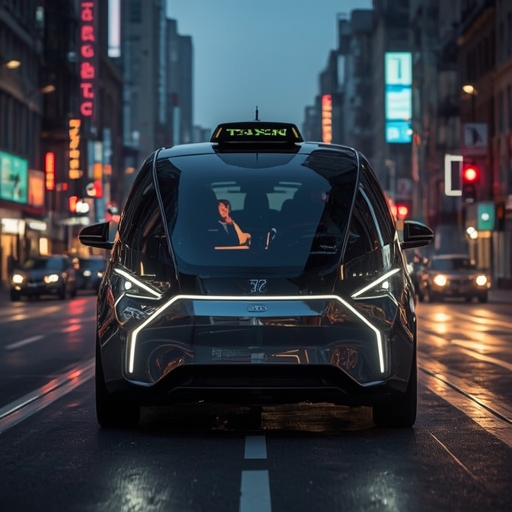
In a surprising yet revealing disclosure, Tesla has confirmed that certain vehicles within its developing fleet of so-called ‘robotaxis’ are at times being driven entirely by human operators rather than functioning under full autonomous control. This admission, while straightforward in tone, carries complex implications for how society perceives technological progress within the field of self-driving transportation. It signals a candid acknowledgment that the journey toward complete autonomy remains fraught with intricate challenges — technical, ethical, and regulatory — which even a pioneering company like Tesla cannot completely transcend at present.
Tesla’s forthrightness contrasts sharply with the image carefully cultivated by other players in the autonomous vehicle sector—particularly Waymo—who consistently emphasize the stability and maturity of their fully driverless technologies. By openly disclosing that humans sometimes take the wheel, Tesla disrupts the tidy narrative of seamless automation and invites a broader consideration of what ‘autonomous driving’ genuinely means. This transparency provokes a nuanced discussion about the interface between algorithmic decision-making and human oversight, highlighting that automation is seldom an absolute condition but rather a continuum of control shared between person and machine.
The acknowledgment also raises vital questions for regulators, policymakers, and consumers alike. How much human input is compatible with labeling a vehicle ‘autonomous’? Should temporary human intervention be viewed as a safeguard that enhances safety, or as evidence of a technology not yet mature enough for unsupervised operation? Each interpretation influences public trust, legal accountability, and the future trajectory of innovation in this sphere.
Moreover, Tesla’s openness could paradoxically reinforce its credibility. In an industry often tempted to exaggerate its advancements, admitting human participation may signify integrity and realism rather than weakness. Such honesty could foster trust among investors, engineers, and customers, who may prefer a measured pace of innovation to grandiose claims of perfection. Simultaneously, it challenges society’s impatient expectations—perhaps reminding us that progress toward true autonomy involves iterative refinement, not abrupt transformation.
Ultimately, this revelation encapsulates the tension inherent in twenty-first-century technological evolution: the aspiration for effortless, self-directed machinery opposed by the persistent necessity of human judgment. As Tesla navigates that narrow boundary between invention and limitation, the company compels us to reconsider what autonomy actually represents—a total replacement of human contribution, or a sophisticated partnership between intelligence natural and artificial. Either way, the debate over automation’s meaning has just grown deeper, more intricate, and decidedly more human.
Sourse: https://gizmodo.com/tesla-goes-ahead-and-admits-its-robotaxis-are-sometimes-fully-human-controlled-2000740641