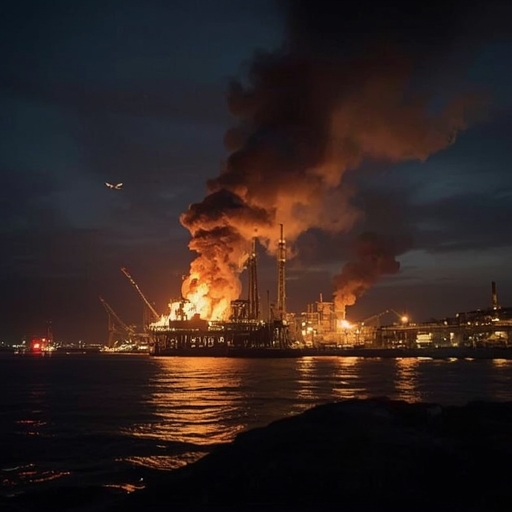
NASA’s latest satellite observations have identified and documented an extensive and intense fire raging at one of Russia’s most strategically important oil export facilities located on the Black Sea coast. According to initial reports, this destructive blaze appears to have been triggered by a drone strike that occurred during the night, an event which has rapidly drawn international attention and concern. High-resolution imagery captured from orbit vividly shows large sections of the terminal engulfed in flames, the dark smoke plumes rising dramatically into the atmosphere and drifting across nearby coastal regions. This visual evidence not only provides a striking record of the incident itself but also serves as a vivid demonstration of how modern space-based monitoring systems can deliver valuable real-time intelligence during unfolding global crises.
The event has profound implications that extend far beyond the immediate scene of destruction. Russia’s Black Sea oil infrastructure is a vital node in the country’s vast energy network, facilitating exports that are critical to both regional and global supply chains. A disruption of such magnitude introduces significant uncertainty into global energy markets, already strained by geopolitical instability and fluctuating demand. Analysts warn that even temporary interruptions can lead to rising oil prices, logistical bottlenecks, and renewed debate over energy security in Europe and beyond.
From a technological perspective, the episode underscores the indispensable role of NASA’s Earth observation satellites in capturing verifiable, near real-time data that can inform both governmental and private-sector assessments. Through advanced sensors capable of detecting thermal anomalies, atmospheric disturbances, and changes in surface conditions, these systems allow researchers and policymakers to evaluate incidents with remarkable speed and precision. The Black Sea terminal fire thus becomes more than just a localized event; it exemplifies the intersection of environmental observation, geopolitical risk, and technological innovation.
Furthermore, the broader context—marked by ongoing conflict, cyber tensions, and energy dependence—heightens the relevance of this discovery. In an age when remote sensing provides the world’s eyes in orbit, the ability to monitor such incidents from space reinforces transparency and accountability within the international community. This particular episode serves as a reminder that data gathered from above can illuminate not only the flames consuming industrial infrastructure but also the complex web of political and economic forces that those flames symbolize. In essence, the NASA-documented fire at the Russian Black Sea oil terminal stands as a compelling testament to how space-based science continues to transform our understanding of global events and their far-reaching consequences for energy security, geopolitical stability, and technological progress.
Sourse: https://www.bloomberg.com/news/articles/2026-04-06/russia-s-key-black-sea-oil-terminal-on-fire-nasa-data-show


