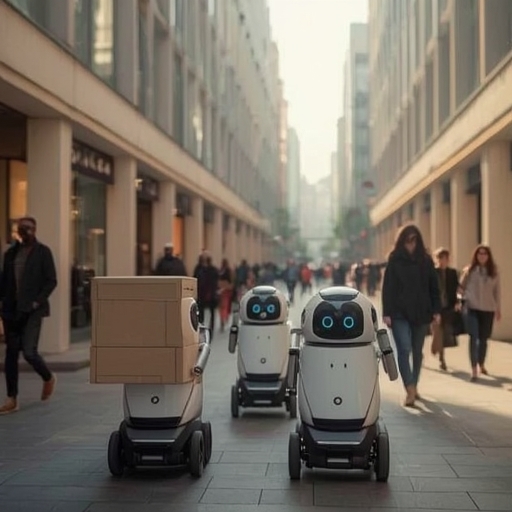
For centuries, humanity has speculated about a future where mechanical beings would move among us — partners, helpers, and sometimes rivals in our shared environment. That vision, once confined to the realms of science fiction, is now materializing on our very streets. Delivery robots, equipped with advanced sensors, mapping technology, and adaptive AI, are quietly becoming part of urban life. They navigate crosswalks, wait patiently at intersections, and deliver packages to doorsteps with near-human precision. Yet the most striking revelation does not stem from the technology itself, but from the human reaction to it.
Executives behind major delivery robot enterprises have observed something both unexpected and profoundly encouraging. Contrary to early fears that humans might vandalize, mistreat, or reject these autonomous couriers, evidence shows that people tend instead to treat them with a mix of curiosity, respect, and even affection. Children wave as they pass, pedestrians step aside to give them space, and communities have begun to embrace their presence as an emblem of progress rather than a disruption. The phenomenon reveals that empathy — one of the defining traits of humanity — extends even to artificial creations, suggesting a future where coexistence is not merely tolerated but genuinely harmonious.
This unfolding relationship between society and technology hints at a broader transformation. As automation becomes more visible and accessible, the boundary between the human and the mechanical grows increasingly porous. Rather than provoking alienation, the presence of these modest machines invites reflection on collaboration, design ethics, and shared wellbeing. The positive human response to delivery bots demonstrates that innovation need not erode compassion; instead, it can serve as a canvas upon which empathy and ingenuity coexist. It signals a cultural shift in which trust and technological sophistication evolve hand in hand.
If these early interactions are any indication, they paint a portrait of an optimistic tomorrow — a world where robots do not simply perform tasks for us but exist within our communities as respectful participants in the flow of daily life. Sidewalks once designed solely for human passage now host a quiet partnership between person and processor, between emotion and algorithm. The delicate balance of this emerging coexistence underscores a single truth: the future of robotics will be shaped not only by what machines can do, but by how we choose to welcome them. Humanity’s kindness, it seems, is becoming the most powerful form of technology of all.
Sourse: https://www.businessinsider.com/delivery-robot-mishaps-screw-ups-videos-coco-serve-starship-2026-4


