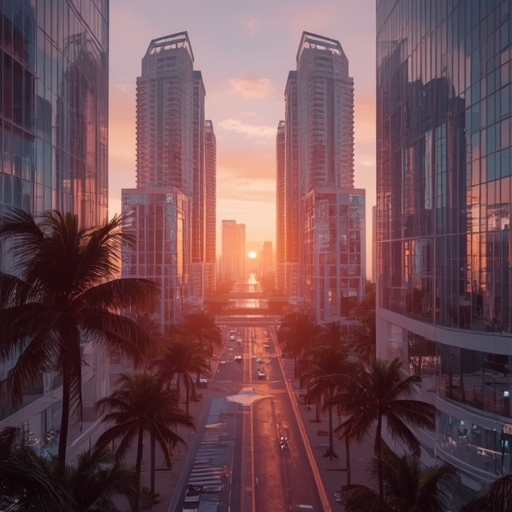
Miami was once envisioned as the glittering epicenter of a new financial era—a radiant symbol of prosperity where palm trees would stand alongside towering skyscrapers representing global wealth and investment. For years, the city was relentlessly branded as ‘Wall Street South,’ a place where ambitious portfolio managers, hedge fund titans, and high‑net‑worth investors would supposedly converge to build an empire of capital under the sun. Yet as time has unfolded, the enthusiasm has quietly softened, giving way to a sobering realization: the anticipated migration of financial powerhouses has not fully materialized.
This disconnect between aspiration and outcome reveals a complex interplay of factors. While Miami’s allure lies in its tropical climate, cultural vibrancy, and reputation as an international crossroads, the foundational infrastructure required for a sustained financial ecosystem remains underdeveloped compared to traditional finance centers. The city’s appeal to wealthy individuals and executives is undeniable—they are drawn by the absence of state income taxes, the growing luxury real estate market, and a lifestyle that seamlessly merges business with leisure. Nevertheless, convenience and livability alone do not guarantee a thriving institutional presence.
To transform into a true financial hub, a city needs more than attractive amenities. It demands a deep bench of financial professionals, regulatory stability, efficient transportation networks, and the intellectual infrastructure found in schools, universities, and professional associations that foster talent exchange and innovation. Many hedge funds and portfolio management firms that initially considered relocating discovered that the logistical and operational challenges of uprooting from established ecosystems like New York, Chicago, or Boston were far greater than anticipated. These older centers offer immediate access to analysts, legal experts, compliance officers, and technology infrastructure built over decades.
In addition, the cultural rhythm of Miami—dynamic, diverse, and often leisure‑oriented—does not always harmonize with the relentless pace of global finance. Some firms that experimented with satellite offices or temporary operations found that maintaining client relationships and recruiting specialized professionals proved cumbersome. The novelty of working beside turquoise waters soon met the realism of distance from major exchanges, investors, and institutional counterparts.
Despite these obstacles, Miami’s journey toward financial relevance is not a failure but a work in progress. The city has successfully attracted a new generation of entrepreneurs, venture capitalists, and crypto investors who view finance through a digital and decentralized lens. This emergent ecosystem differs from the traditional ‘Wall Street’ mindset—it values innovation and flexibility over legacy structures. Consequently, Miami’s financial identity may not mirror Manhattan’s but could evolve into its own unique hybrid of lifestyle, investment culture, and technological ingenuity.
Ultimately, the question of what became of the portfolio managers who were expected to flood Miami is less about their physical absence and more about the evolution of the city’s ambitions. ‘Wall Street South’ remains a compelling narrative, a symbol of Miami’s determination to transcend its image as simply a playground for the wealthy. Yet the myth reminds us that building a global financial nucleus requires more than branding—it demands time, consistency, and an economic ecosystem as resilient as the city’s enduring sunshine.
Sourse: https://www.businessinsider.com/miami-wall-street-hedge-funds-investments-2026-4


