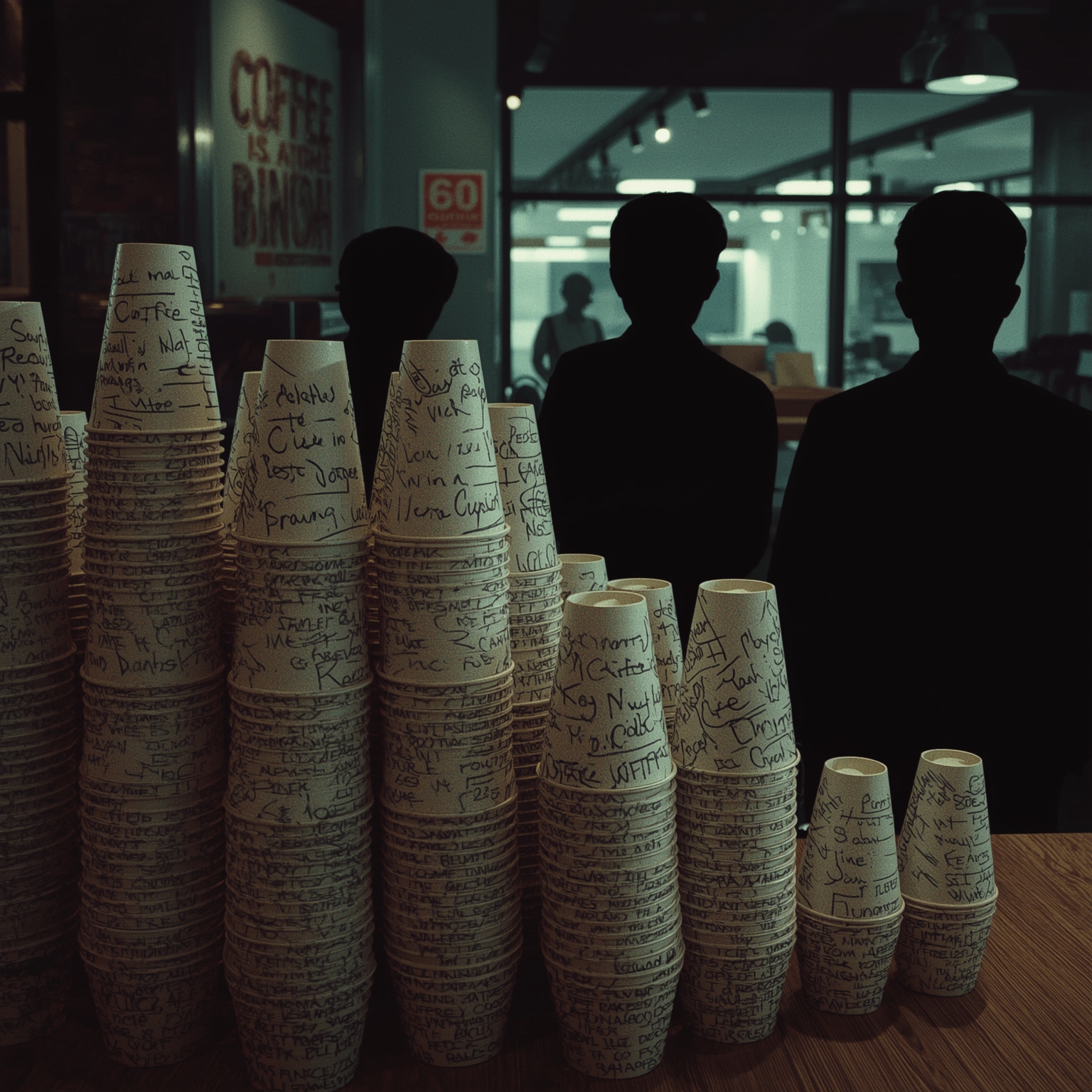
The circulation of a viral video featuring a Starbucks barista refusing to inscribe the name “Charlie Kirk” on a customer’s coffee cup, citing compliance with internal corporate rules, has reignited public scrutiny of the company’s controversial requirement that every beverage container bear some form of handwriting. Originally designed as a strategy to foster a warmer and more personalized interaction between employees and guests, this mandate has paradoxically introduced a great deal of anxiety for baristas, since either neglecting to write on a cup or inscribing something deemed impermissible may result in disciplinary consequences, potentially escalating as far as job termination.
Documents obtained by Business Insider, specifically internal operating guidelines, reveal that Starbucks enforces an elaborate system of directives that governs what employees are permitted to write, as well as the disciplinary structures for deviations from these standards. For example, the guidelines emphasize that employees, known within the company as “partners,” are categorically prohibited from writing or printing any content that is judged profane, offensive, or inconsistent with Starbucks’ stated Mission and Values. Equally, even if explicitly requested by customers, partners are not permitted to include political slogans, religious messaging, or content advocating personal causes. Violations considered serious—such as offensive remarks, repeated failure to follow the writing directive, or messages that could insult a reasonable customer—can serve as direct grounds for dismissal.
When Business Insider spoke to fourteen Starbucks baristas from different regions across the United States, it became evident that interpretation of the company’s rules was far from uniform. Some saw permissible latitude for lighthearted notes or small doodles, while others felt any form of creativity was unwelcome under the tightened enforcement observed in recent months. One barista, based in Minnesota and with seven years of experience at the company, described personally being verbally corrected multiple times simply for failing to notice that another worker had neglected to write on two cups. Other employees confirmed that repercussions for such omissions have become noticeably harsher.
The disciplinary framework, reviewed by Business Insider, outlines three tiers of offenses: minor, medium, and serious. Seemingly trivial missteps, such as forgetting to mark every cup, referencing pre-written notes by preparing cups in advance, or even using a writing instrument other than the designated Sharpie, qualify as minor violations. More conspicuous but less egregious misjudgments—such as scribbling generational slang, drawing pop culture references, or engaging in playful sketches like animals—are classified as medium infractions. Even these have drawn frustration among staff; for example, one California-based partner expressed regret that they can no longer sketch the simple cat or dog faces that young customers used to delight in, since doing so now risks a formal write-up. By contrast, severe breaches involve any message that could reasonably provoke offense, including disparaging or sarcastic remarks regarding a customer’s order.
The public controversy intensified further when the video of the refusal to write “Charlie Kirk” gained traction, coinciding ironically with news of the conservative commentator’s death. Starbucks clarified thereafter that requesting one’s actual name—even if belonging to a polarizing public figure—should not be prohibited under the policy, differentiating between names which remain permissible and political slogans or advocacy statements, which do not. In an official clarification, the company reaffirmed its vision of operating as a “community coffeehouse” where all guests should feel welcomed. It encouraged staff to tactfully redirect customers if slogans were substituted for names but conceded that legitimate given names are acceptable.
The enforcement protocol distinguishes between levels of violation severity. For minor errors, the progression usually begins with verbal guidance, moves to a formal write-up if the mistake recurs, and escalates toward final warnings before eventual termination. Medium-level missteps bypass verbal coaching and result in immediate documented warnings, while serious infractions can precipitate near-automatic disciplinary termination. According to the documents, an employee who already has a final warning within the prior year may be terminated even for a relatively minor mistake. Particularly offensive content, such as vulgar or sexually inappropriate wording, leads directly to dismissal on the grounds of its obvious capacity to deeply offend customers.
Notably, the consistency of enforcement often depends on managerial discretion. Six baristas noted that their outcomes varied dramatically based not solely on what they wrote but on how sympathetic or inflexible their immediate supervisors were. A California employee contrasted one understanding manager, who actively supported staff, with others who, in previous stores, appeared to take a punitive stance, remaining aloof until errors could be penalized. Several workers reported observing either terminations or voluntary resignations precipitated by the rigidity of this cup-writing mandate.
The origin of the policy lies in Starbucks’ “Back to Starbucks” campaign, a broader customer service initiative intended to reemphasize human connection. CEO Brian Niccol explained in a quarterly earnings report that such measures have corresponded with a measurable improvement in employee engagement and in the company’s customer satisfaction indexes. Internal memos elaborated that the return of handwritten notes—once common before Starbucks introduced printed order labels nearly a decade ago—was meant to provide what executives saw as “meaningful” touchpoints in the guest experience.
Nevertheless, not all stakeholders share this optimism. Michelle Eisen, a veteran barista and spokesperson for Starbucks Workers United, noted that in earlier years cup-writing served a primarily functional purpose: ensuring accuracy in fulfilling beverage orders. With the universal adoption of order stickers, she believes the authentic personal connection has already diminished, and requiring obligatory messages on every single cup now simply creates pressure. She further explained that during peak rushes—times when the company expects baristas to prepare and hand over completed drinks in under four minutes—taking the additional time to write notes becomes a counterproductive distraction. In her view, since the handwriting is now performed under compulsion and with the looming threat of reprimand, whatever personal charm the practice once had has transformed into an insincere and stressful requirement, ultimately slowing service times and fraying the workplace atmosphere.
Business experts reinforce this concern. Michael Goldberg, a professor of entrepreneurship and finance at Case Western Reserve University, characterized the Starbucks notebook policy as emblematic of well-intentioned corporate rules engineered to solidify brand distinctiveness but often difficult to execute faithfully in a decentralized retail environment. The more viral attention such small missteps attract, he argued, the more the central leadership must confront whether strict adherence to this rule truly aligns with Starbucks’ broader goals or simply exacerbates ongoing tensions between management, employees, and customers.
The unfolding debate illustrates the delicate balance between creating memorable customer interactions and imposing corporate requirements that inadvertently compromise employee morale. At stake for Starbucks is whether what was envisioned as a lighthearted, personal flourish can survive under strict enforcement without eroding the very sense of community it aims to cultivate.
Sourse: https://www.businessinsider.com/starbucks-policy-crack-down-barista-notes-cups-coaching-termination-2025-9