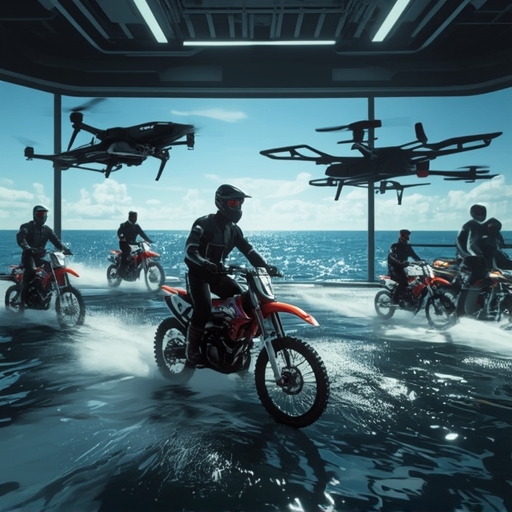
In a revelation that challenges conventional assumptions about technology and training, the United States Marine Corps has uncovered an unexpected truth about what it takes to become a truly exceptional attack drone pilot. Contrary to earlier expectations that avid gamers—individuals deeply familiar with joystick controls, fast-paced visuals, and virtual environments—would dominate this arena, the Marines have discovered that the most effective operators often come from a completely different background: dirt bikers and boaters.
This fascinating finding underscores a critical and nuanced point about human performance that transcends traditional metrics of technological aptitude. The Marines anticipated that video game enthusiasts, accustomed to simulated flight and reflex-driven control systems, would naturally excel at drone piloting. However, real-world evidence has proven the opposite. Those who navigate physical environments, balancing themselves amid unpredictable terrain or guiding a vessel through the changing dynamics of water currents, possess an instinctive form of spatial awareness and mechanical adaptability that translates directly into superior control of aerial systems.
In the world of dirt biking, riders cultivate a sophisticated sense of equilibrium, reflexive decision-making, and an intuitive understanding of how subtle shifts in motion influence trajectory and stability. Similarly, boaters learn to compensate for fluid forces and environmental variables—wind direction, water resistance, and momentum—all of which parallel the real-time adjustments required in the precise handling of unmanned aerial vehicles. These seemingly unrelated experiences in the physical world have granted these individuals an edge that cannot easily be replicated in a digital simulator.
The Marines’ discovery highlights a broader, thought-provoking lesson about the interplay between human intuition and technological innovation. It demonstrates that mastery of advanced equipment is not defined solely by technical proficiency or virtual experience but also by embodied knowledge—the ingrained coordination and instinctive reactions honed through years of real-world physical practice. This insight reminds us that while machines and simulations can teach precision, it is the human capacity for balance, perception, and adaptability that ultimately determines excellence.
As military technology continues to evolve, this revelation invites a reexamination of how training programs identify and cultivate talent. Perhaps the next generation of elite drone pilots will not rise from virtual battlefields but from motocross tracks, marinas, and open landscapes where the senses are tested and reflexes are sharpened against the unpredictability of reality. In recognizing the intrinsic value of these lived skills, the Marines are not merely discovering better pilots—they are redefining the relationship between human instinct and technological mastery, ushering in a new era where innovation begins with an understanding of motion, environment, and intuition.
Sourse: https://www.businessinsider.com/marines-say-best-attack-drone-pilots-might-be-dirt-bikers-2026-4


