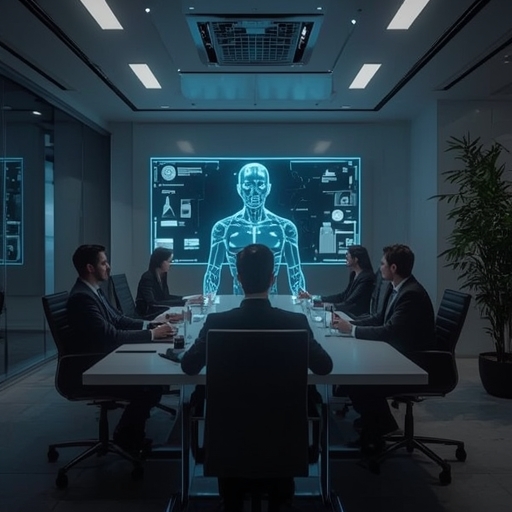
The modern workplace stands on the precipice of a revolutionary transformation, one guided not by new management theories, but by the increasingly tangible presence of artificial intelligence within the very fabric of professional interaction. Recent reports indicate that a prominent technology executive is pioneering the creation of an AI-based replica of himself—an artificial counterpart designed to attend meetings, communicate with teams, and perhaps one day represent him entirely in the digital realm. This endeavor not only reflects the ever-advancing frontier of machine learning and language modeling but also provokes profound questions about authenticity, leadership, and the evolving definition of human presence in business environments.
Imagine a scenario in which an executive’s virtual likeness, capable of imitating vocal nuances, mental frameworks, and behavioral tendencies, participates in boardroom discussions, makes routine decisions, and even empathizes—albeit algorithmically—with staff members. On one hand, this innovation presents a remarkable leap in efficiency: an AI delegate could process information at superhuman speed, maintain perfect recall of conversations, and manage overlapping obligations without fatigue or error. For leaders burdened by incessant schedules, this type of delegation might extend productivity beyond the constraints of time and physical presence.
However, such a development invites deeper contemplation regarding human connection and trust within organizational culture. Leadership has historically relied not only on intellect and decision-making prowess but also on emotional intuition, empathy, and moral judgment—qualities inherently human and difficult to replicate, no matter how sophisticated the technology. Employees may eventually find themselves interacting daily with synthetic personalities, guided by their leader’s data but devoid of genuine spontaneity or emotion. Would the flattening of such interactions erode corporate cohesion, or might it instead standardize communication in ways that eliminate bias and inconsistency?
This initiative also symbolizes a broader societal shift toward digital bifurcation: individuals maintaining both a physical and an artificial version of themselves. In many ways, the AI clone functions as an upgraded avatar, one through which the modern professional might extend influence, preserve mental bandwidth, and sustain presence across multiple arenas simultaneously. Yet, with such capability come pressing ethical considerations. How should accountability be distributed when mistakes occur through algorithmic extensions of human will? Can authenticity persist when leadership itself becomes mediated by digital proxies?
The implications go far beyond convenience. If executives begin routinely delegating their presence to AI versions of themselves, the concept of leadership may evolve into something abstract—a function performed jointly by human and machine intelligence. It suggests a future in which the boundary between biological consciousness and digital cognition blurs to the point of indistinction. Today’s innovation, therefore, is less about skipping a meeting and more about redefining what it means to be present, to lead, and ultimately, to exist in professional society.
In essence, the creation of CEO-level AI clones signals a pivotal moment in the history of work. It demonstrates both the technical magnificence of artificial intelligence and the philosophical dilemma underpinning its use. Will this herald a renaissance of freedom and focus for decision-makers, or will it detach leadership from the inherently human qualities that ground it? As industries race toward automation of everything from scheduling to strategic foresight, the emergence of a digital self may soon become the hallmark of the next industrial revolution—one powered not by machines that serve us, but by machines that increasingly become us.
Sourse: https://www.theverge.com/tech/910990/meta-ceo-mark-zuckerberg-ai-clone