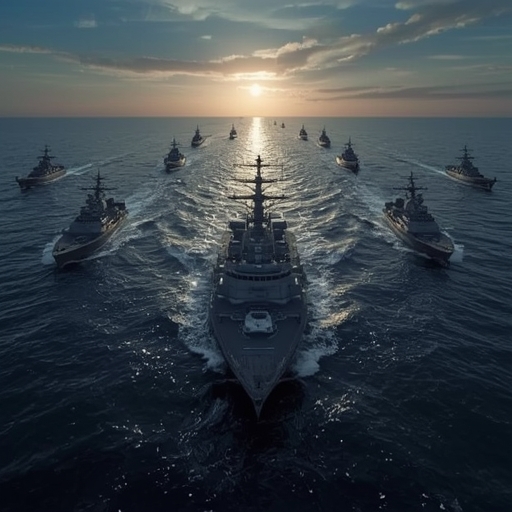
In a dramatic escalation of maritime operations, the United States Navy has initiated a full-scale blockade around Iran’s key port regions, deploying an impressive flotilla composed of more than a dozen advanced warships accompanied by thousands of well-trained service members. This formidable concentration of naval power is not merely a demonstration of military capability—it is a message, both a strategic deterrent and an assertion of authority in one of the world’s most geopolitically critical waterways.
The decision to enforce the blockade underscores a complex interplay of factors, including regional tensions, global trade dependencies, and strategic alliances that make this area one of the most heavily scrutinized maritime zones on the planet. Each vessel involved in the operation contributes to a layered defense and enforcement network designed to monitor, intercept, and, if necessary, restrict maritime traffic connected to Iranian ports. This level of coordination requires not just logistical strength but precise communication between multiple command structures, ensuring that the blockade remains firm yet compliant with international laws governing naval conduct.
For industries reliant on the safe and predictable movement of goods through the Persian Gulf—such as global shipping, oil production, and energy distribution—the ramifications are significant. Even the mere perception of instability can lead to fluctuations in oil prices, insurance rates, and international shipping schedules. While the immediate intent is to compel diplomatic compliance and limit certain economic activities, the secondary effects ripple outward across oceans and continents, affecting markets and energy consumers worldwide.
Strategic analysts view this mobilization as a demonstration of hard power meant to reinforce broader policy objectives. The presence of these warships, equipped with cutting-edge radar systems, aerial support capabilities, and advanced defensive technologies, gives the United States and its allies substantial leverage in maritime negotiations. Yet, behind this strength lies the risk of escalation, as any miscalculation or unauthorized encounter at sea could transform political posturing into direct confrontation.
Observers from organizations concerned with international maritime law and global security have already begun evaluating the long-term implications of such an extensive military presence. The mission’s success hinges not only on naval dominance but also on the ability to maintain stability across the broader region. While the world watches closely, this blockade stands as both a warning and an opportunity—a vivid reminder of how control over the world’s seas continues to define power, influence, and the fragile balance of global order.
Sourse: https://www.businessinsider.com/how-the-us-navy-is-enforcing-the-blockade-on-iran-2026-4