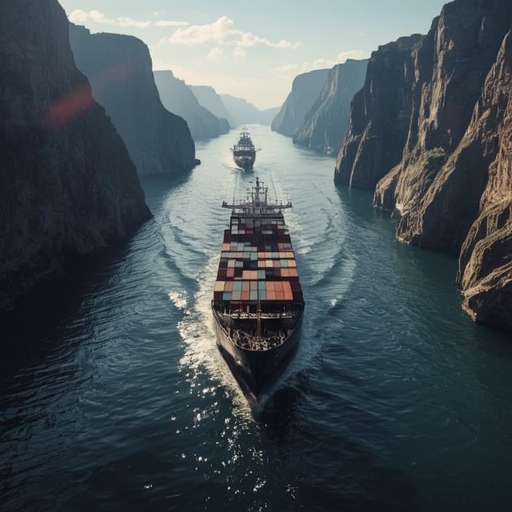
Shipping lanes throughout the vital Strait of Hormuz remain consistently active and vibrant, illustrating an uninterrupted pulse of global trade even amidst heightened geopolitical attention. Following Iran’s emphatic declaration that the maritime passage is now ‘completely open,’ comprehensive ship‑tracking analyses continue to display a persistent pattern of commercial movement through these waters. Tankers, cargo carriers, and logistics vessels appear to maintain their steady routes, underscoring both the resilience and the dependency of the world’s energy corridors on this strategic strait.
This bustling continuity serves not only as a demonstration of navigational accessibility but also as a reflection of international maritime confidence in operational safety for now. The current traffic patterns could be interpreted in two ways: either as evidence of genuine stability and cooperation fostering open seaways, or as a deceptively calm moment preceding potential shifts in regional tension and control. The dual possibilities leave analysts and economists alike watchful, aware that a single political decision could transform open waters into a contested zone overnight.
The Strait of Hormuz, situated between the Persian Gulf and the Gulf of Oman, essentially functions as a maritime lifeline for the global energy supply chain—handling an immense fraction of the world’s petroleum exports each day. Therefore, every official statement regarding its openness reverberates far beyond the immediate region. It influences crude‑oil pricing benchmarks, shipping insurance rates, and the logistics strategies of major trading nations. When Iran confirmed that the channel is ‘completely open,’ stakeholders in both government and industry sectors immediately cross‑verified these claims through real‑time ship‑tracking platforms and satellite data, confirming active vessel pathways and minimal signs of obstruction.
For maritime observers and economic strategists, this development emphasizes how global stability can hinge on a single strait a few kilometers wide. Geopolitical decisions made on distant shores ripple outward—affecting freight schedules in Asia, refinery operations in Europe, and even fuel prices at consumer pumps across the Americas. The verified continuation of movement through Hormuz, in this sense, provides temporary reassurance to markets and policymakers. Yet, it also reinforces a reminder of enduring fragility: that the world’s commerce literally floats on narrow passages whose openness depends on diplomacy, deterrence, and maritime security vigilance.
In essence, what the sustained flow of vessels conveys is a momentary equilibrium—a demonstration of coordination and restraint across nations that rely upon these waterways. Whether this balance endures or collapses will determine more than the fate of regional transport; it will influence the rhythm of the entire global economy. For now, as satellite imagery reveals silhouettes of tankers gliding calmly through sparkling blue horizons, the Strait of Hormuz represents both continuity and caution: an emblem of trade’s persistence and a potential flashpoint kept momentarily at peace by mutual necessity and global interdependence.
Sourse: https://www.businessinsider.com/traffic-data-shows-ships-moving-through-the-strait-of-hormuz-2026-4