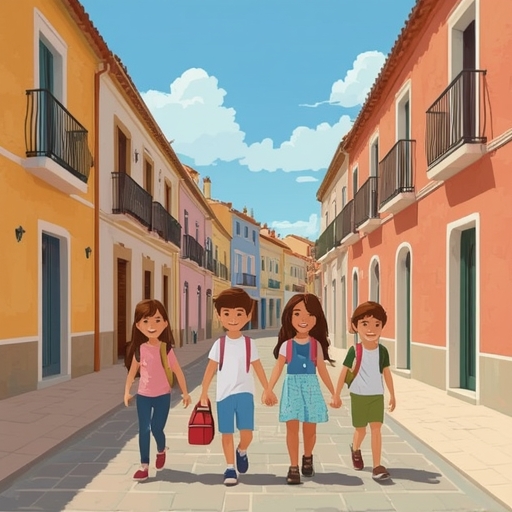
When we first decided to leave the United States and start a completely new chapter of life in Spain, I knew it would be a transformative experience—but what I didn’t anticipate was that my children would become the true teachers in this story. Moving abroad, in itself, is an act of courage: you dismantle the familiar support systems you’ve relied on, say goodbye to the language of your daily life, and step into a rhythm that feels uncertain and exhilarating all at once. As adults, we often brace for impact, planning for every detail—the paperwork, the schools, the housing, the costs—because that’s how we manage fear. But children, as I found, have an entirely different approach. They adapt through immersion, through openness, and through a willingness to learn by doing rather than worrying.
When we arrived in Spain, my boys didn’t understand a single word of Spanish. They stood in their new classroom surrounded by sounds and expressions that, at first, felt indecipherable. I prepared myself for weeks of struggle, for frustration and tears. Instead, something remarkable happened: they began to listen differently, to observe, to mimic tone and gesture long before they discovered vocabulary. Within days, they were sharing words I had never heard them say before, trying out phrases with confidence, sometimes even correcting my pronunciation. Their adaptation wasn’t forced; it was fluid. In that openness to new experiences lay a lesson that I, as an adult, had long forgotten—the courage to embrace discomfort not as a threat but as the natural backdrop of growth.
What surprised me most was not simply their ability to learn quickly, but the joy they found in the process. They approached each day with curiosity—tasting new foods without hesitation, joining games at school even when they only half‑understood the rules, finding humor in misunderstanding rather than embarrassment. For them, the unknown wasn’t a roadblock but an invitation. I watched them integrate into the community slowly at first—through playdates, shared laughter, and simple acts of communication that transcended words. Over time, they began to think, dream, and joke in Spanish. The shift was astonishing: their world had expanded, and with it, their confidence.
As parents, we sometimes assume our role is to lead, to provide a model of resilience and preparedness. Yet living abroad has shown me that leadership also means learning—especially from those with beginner’s hearts. Children embody adaptability because they do not yet build walls of assumption or fear; they meet life with raw perception and an eagerness to connect. Moving abroad stripped away layers of my own adult defenses and made me reconsider what flexibility truly means. It’s not about tolerating change but about finding comfort within transformation itself.
Now, nearly a year later, I see that my sons did not just adapt to Spain—they became part of it. They move through the streets with confidence, chatting with friends and teachers, savoring churros on weekend mornings, and navigating their surroundings as if they’ve always belonged here. Watching them thrive has humbled me more than any career milestone or personal accomplishment ever could. Their courage has reminded me that resilience isn’t born from control but from trust—from believing that we are capable of belonging wherever life invites us.
This experience has deepened my understanding of what it means to grow as a family. Growth does not always come from grand achievements or meticulously planned goals; sometimes it emerges quietly, in the humility of learning to say new words, in the patience of listening, and in the grace of letting others teach you. Children rarely fear transformation because they live close to it every day. In their example, I found not only admiration but also renewal. They showed me that home is not a permanent place but rather a mindset—a choice to root ourselves in curiosity, kindness, and openness to whatever landscape surrounds us.
So, if you ever find yourself on the edge of change, remember this: adaptability is less about skill and more about spirit. If you can approach life as a child does—open‑hearted, unguarded, and curious—you’ll discover that transitions can be not only survivable but deeply enriching. My children didn’t just adjust to living in Spain; they transformed what this journey meant for all of us. They reminded me that bravery often appears most effortlessly in the smallest voices, whispering the simplest truth: growth begins the moment you stop resisting change and start living inside it.
Sourse: https://www.businessinsider.com/moved-american-kids-to-spain-benefits-surprises-2026-4