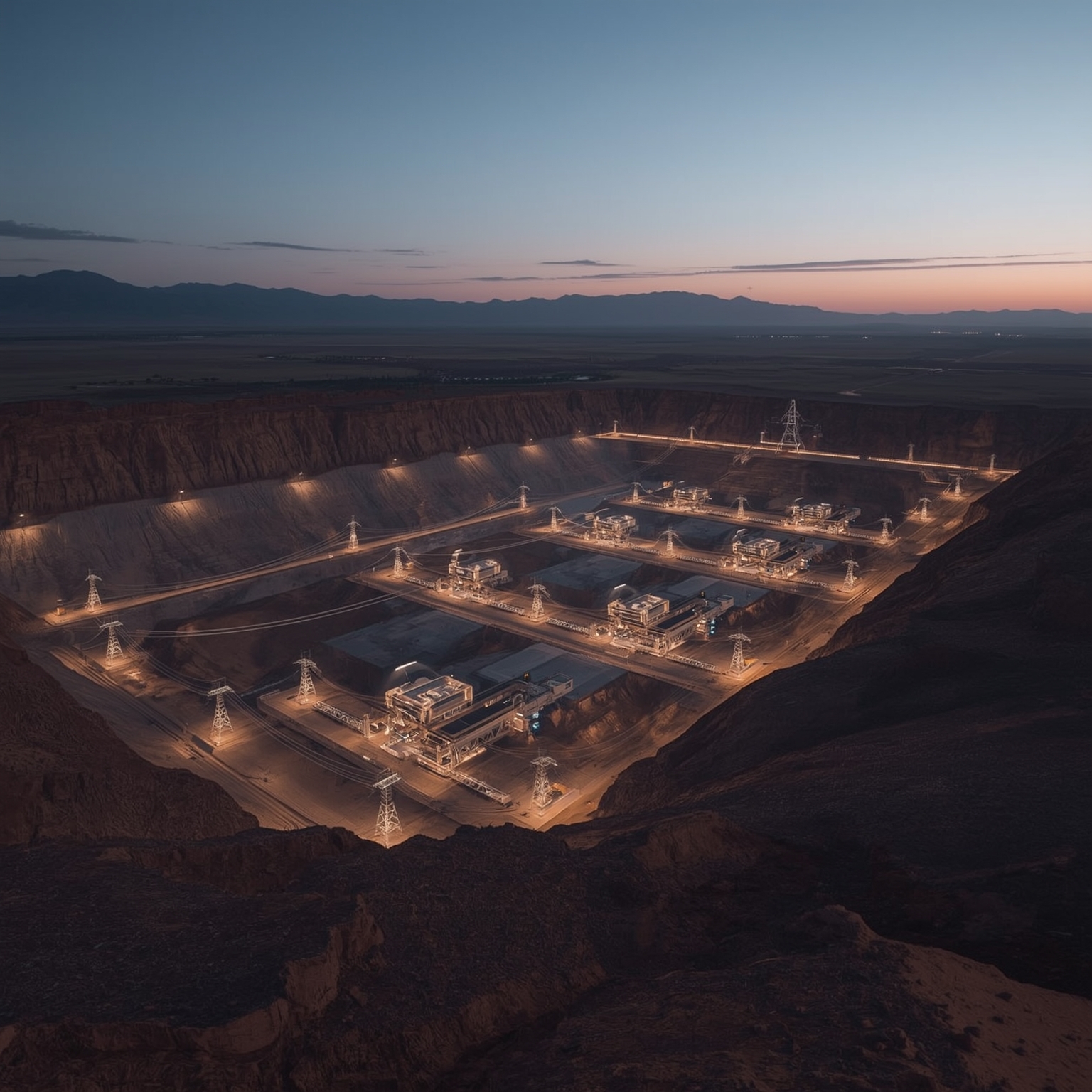
The Trump administration revealed through the Department of Energy that it has acquired a five percent equity interest in Lithium Americas, while also taking an additional five percent ownership stake in the company’s joint lithium mining venture with General Motors situated in Nevada. This announcement signifies not merely a financial transaction but a larger strategic maneuver designed to solidify federal involvement in the domestic energy supply chain. The planned centerpiece of this endeavor is the Thacker Pass lithium project, which, once operational in 2028, is projected to attain the position of the leading source of lithium production across the entire western hemisphere.
Lithium itself occupies a uniquely critical role in the modern technological and industrial landscape. It forms the essential building block for high-capacity rechargeable batteries, which power a sweeping range of innovations: from the rapidly expanding sector of electric vehicles to large-scale storage systems for wind and solar power, and even the countless smaller electronics indispensable in daily life. Successive U.S. administrations—both President Biden’s and President Trump’s—have declared achieving independence from foreign lithium imports as a crucial national priority. Thus, the latest equity acquisition represents a continuation of broader efforts to reinforce domestic security in the supply of strategically important minerals.
On a quantitative scale, the ambitions surrounding Thacker Pass are striking. Once the mine reaches full operational capacity, it is expected to yield approximately 40,000 metric tons of lithium carbonate annually, all destined for conversion into battery-grade materials. To understand the magnitude of this development, one must consider that current U.S. production of lithium lingers below 5,000 metric tons, a fraction of anticipated output. In striking contrast, China—ranked as the third-largest global producer after Australia and Chile—already produces lithium at a level comparable to Thacker Pass’s projected yield, roughly 40,000 metric tons per year. The expansion represented by this Nevada project would therefore catapult U.S. production into the international forefront virtually overnight.
Nevertheless, the mine has stirred significant controversy since construction commenced in 2023. A central source of opposition has come from Native American tribes residing in the immediate region, who argue that the project imperils sacred lands and cultural heritage sites. Their concerns were validated in part by a February 2025 report released jointly by Human Rights Watch and the American Civil Liberties Union, which concluded that the federal licensing process had overlooked fundamental obligations by failing to secure “free, prior, and informed consent” from the tribes directly affected. Beyond Indigenous voices, local ranchers have expressed apprehension about diminished water resources, and environmental organizations have publicly warned of the risks posed to fragile ecosystems and to species already considered endangered.
Financially, the enterprise has also evolved dramatically through successive administrations. During President Biden’s tenure in October 2024, Lithium Americas obtained a substantial loan package valued at $2.26 billion, meant to accelerate construction and ensure project viability in the face of high capital costs. In its recent restructuring of this agreement, the Department of Energy emphasized that more than $100 million in fresh equity had been incorporated into the revised deal. In a televised interview, Energy Secretary Chris Wright made the administration’s reasoning transparent: with a volatile global market in which lithium values have recently dropped, direct government participation as a shareholder is seen as essential to lend stability and foster investor confidence.
The outreach toward securing equity positions is not occurring in isolation. It reflects a broader trend pursued by the Trump administration across multiple strategic industries tied to national security and technological competitiveness. Earlier in the year, the federal government purchased a ten percent interest in the semiconductor giant Intel, signaling concern about safeguarding America’s technological leadership. Similarly, in July, MP Materials—the sole U.S.-based producer of rare earth minerals, which are indispensable for defense applications and renewable technologies—announced that the Department of Defense would become its single largest shareholder by acquiring a fifteen percent stake. Taken together, these measures underscore a deliberate shift: the federal government is positioning itself not merely as a regulator or lender but increasingly as an investor and participant, thereby exercising more direct influence over the infrastructure that underpins the twenty-first-century economy.
Sourse: https://www.theverge.com/news/790057/lithium-mine-us-trump-us-government-stake-thacker-pass