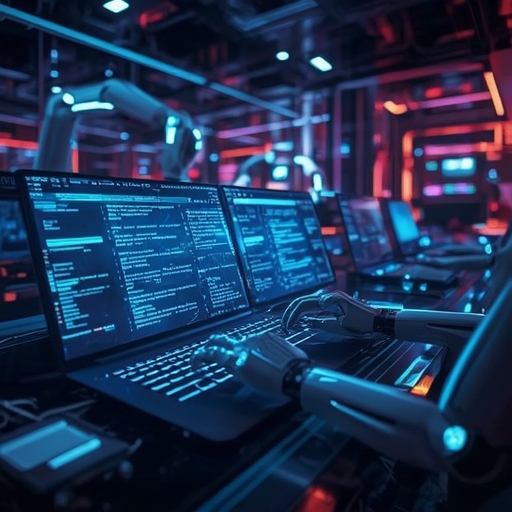
In a groundbreaking revelation, Google has disclosed that roughly seventy-five percent of its newly developed code is now produced through artificial intelligence systems. This remarkable milestone signifies not merely a technological advancement but a transformative evolution in the very nature of software development. Where lines of code were once solely the product of human ingenuity, they are now increasingly co-authored by machines capable of reasoning, pattern recognition, and creative synthesis.
This shift marks the dawn of a new epoch in engineering—one in which human intellect collaborates symbiotically with algorithmic intelligence to generate solutions of unprecedented speed and precision. Developers, rather than being replaced, are now elevated to strategic architects and mentors who guide AI models, refine their outputs, and ensure that machine-generated code aligns with complex business goals and ethical standards.
By allowing AI to undertake repetitive or highly logical programming tasks, engineers can focus attention on higher-level innovation—designing architectures, improving user experiences, and solving multidimensional problems that still require a distinctly human touch. This partnership between coder and algorithm not only accelerates productivity but also redefines creativity in the digital realm.
Google’s announcement underscores a broader industrial trend sweeping across global technology sectors. Organizations everywhere are beginning to integrate AI-driven automation into their development pipelines, discovering that AI can dramatically reduce production time, identify bugs before deployment, and even predict potential security vulnerabilities. The implications are profound: software delivery could soon become nearly continuous, with AI-driven systems learning and improving autonomously.
However, this shift also invites important questions. As machine-produced code becomes the norm, how can we ensure transparency, security, and accountability within systems that increasingly write themselves? The challenge lies in maintaining human oversight without stifling innovation—a balance that will define the next decade of digital progress.
Ultimately, Google’s revelation is not simply a numeric statistic; it is a vision of the near future, where the boundaries between human creativity and machine intelligence blur into a seamless continuum. The age of AI-driven software development has arrived, propelling technology toward a future once imagined only in science fiction, now realized in the very algorithms that power our everyday digital world.
Sourse: https://www.businessinsider.com/google-ai-generated-code-75-gemini-agents-software-2026-4


