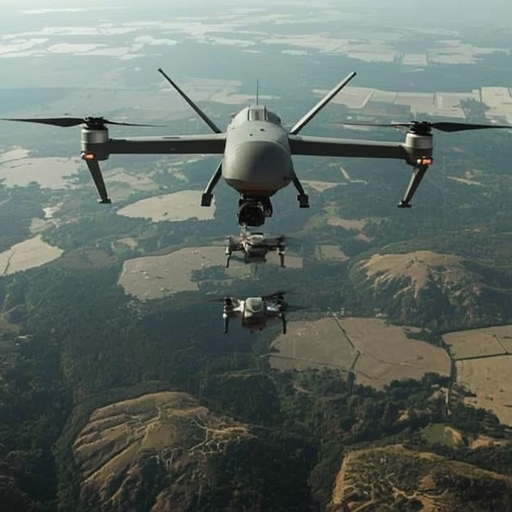
In a significant technological development that reflects the accelerating evolution of modern warfare, Russia has reportedly repurposed its Orlan-10 reconnaissance drone into a high-endurance aerial command platform capable of launching and controlling FPV quadcopters over vast distances. Originally designed as a surveillance asset, the Orlan-10 was primarily used to gather intelligence, provide battlefield imagery, and coordinate operations from medium altitudes. However, through this transformation, the aircraft has taken on a new dual role — not only functioning as an advanced scout but also serving as a strategic mothership that extends the range, coordination, and tactical flexibility of smaller drones.
This modification marks a substantial leap forward in the integration of reconnaissance and strike capabilities. By equipping the Orlan-10 with systems that support the deployment of multiple FPV units, military engineers have effectively created a mobile hub from which fast, maneuverable quadcopters can be guided to precise targets while maintaining real-time communication links. Such a configuration eliminates many limitations associated with standard FPV operations, which are typically constrained by the short range of radio transmissions and the need for the pilot to remain in close proximity to the battlefield.
With this new adaptation, the Orlan-10 becomes a force-multiplying asset, capable of overseeing swarm operations far beyond the horizon, supporting ground troops, and executing complex missions that merge reconnaissance, electronic warfare, and precision strike methods. The implications of this are profound: future conflicts may increasingly rely on interconnected drone ecosystems where larger, endurance-oriented platforms act as command relays for smaller, expendable attack units.
Beyond its immediate tactical advantages, this innovation demonstrates how quickly military drone technology is advancing. The reconversion of an existing airframe into a multi-role control node minimizes production costs while exponentially increasing battlefield efficiency. In doing so, it underscores a broader strategic shift toward modular, scalable systems — where a single platform can be continuously updated and repurposed to respond to new operational challenges.
Ultimately, the Orlan-10 mothership concept blurs traditional distinctions between surveillance and combat. It exemplifies the trend toward decentralized, network-based warfare, where unmanned systems communicate and cooperate seamlessly to achieve coordinated effects. As nations continue to experiment with autonomous and semi-autonomous drone hierarchies, such conversions foreshadow a battlefield increasingly dominated by machines that think, sense, and strike far beyond the constraints once imposed by human operators.
Sourse: https://www.businessinsider.com/russians-turn-recon-drone-orlan-mothership-fpv-quadcopters-flash-2026-4


