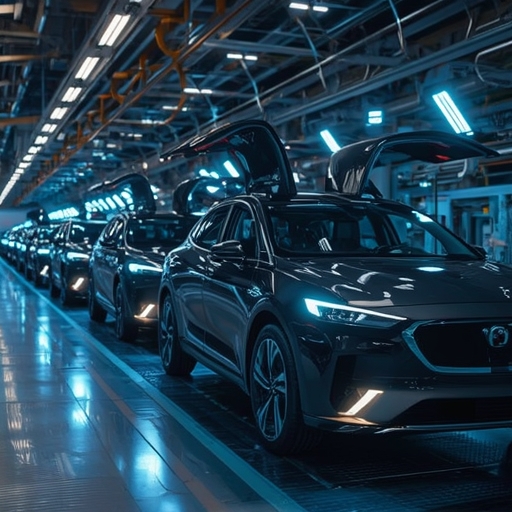
Tesla made an unambiguous statement this week: the long-anticipated Cybercab has officially entered production, signaling the company’s latest and perhaps boldest stride toward a fully autonomous transportation ecosystem. Yet, alongside this milestone announcement, an inevitable question arises—how swiftly will these self-driving taxis emerge from the assembly lines, and in what quantity can Tesla realistically meet its ambitious targets?
On Thursday, the company confirmed this breakthrough via a post on CEO Elon Musk’s social platform, X. The message announced, in striking simplicity, that the “Cybercab [is] in production now at Giga Texas,” alluding to the colossal Tesla manufacturing hub located just outside Austin, Texas. Accompanying this declaration was a vivid image of a gleaming, futuristic Cybercab rolling confidently from the factory floor onto the open road, a symbol of the transition from concept to tangible reality. Shortly thereafter, the official Tesla Robotaxi account shared yet another visual update—a video sequence depicting an entire line of uniform Cybercabs gracefully merging onto a highway, their synchronized motion serving as both a demonstration of production progress and an emblem of Tesla’s grand vision for autonomous mobility.
This new stage comes roughly two months after the very first Cybercab unit was completed and marks more than eighteen months since Tesla originally unveiled its self-driving Robotaxi initiative in October 2024. When that program was introduced, Elon Musk spoke with characteristic boldness, setting an impressive target of producing two million Cybercabs annually, which translates to approximately 38,000 vehicles every week. Such figures underscored Tesla’s audacious confidence in its capacity to industrialize autonomy at an unprecedented scale.
However, during Tesla’s most recent quarterly earnings call, the world’s wealthiest individual adopted a noticeably more measured tone. Musk acknowledged that the initial pace of production would be “very slow,” attributing the deliberate rollout to the complexities of establishing a reliable supply chain and ensuring that manufacturing systems achieve full optimization. He reassured investors and enthusiasts alike that, over time, production would progressively accelerate—or, in his words, “ramp up” before eventually reaching an “exponential” rate of growth. Still, Musk tempered this optimism with a characteristic caveat: such acceleration would occur only “to the best of our ability,” a phrase suggesting both awareness of operational constraints and an insistence on quality over speed.
Safety, Musk emphasized, remains the foremost consideration. He stated unequivocally that the true limiting factor in expanding the Cybercab and Robotaxi programs lies in the “rigorous validation” necessary to guarantee complete safety. The goal, he said, is to ensure zero incidents—“not a single accidental injury”—as Tesla scales its fleet across cities and states. This cautious yet principled stance reveals Tesla’s attempt to balance visionary ambition with technical prudence, especially within an industry where public trust and regulatory approval are pivotal.
A Tesla representative, when contacted, did not provide an immediate comment for clarification or additional detail. Meanwhile, scrutiny from regulators continues to hover over the company. The U.S. National Highway Traffic Safety Administration (NHTSA) is currently investigating approximately 3.2 million Tesla vehicles equipped with the company’s Full Self-Driving (FSD) driver-assistance system. The agency’s inquiry stems from allegations that Tesla’s camera-dependent approach to perception may have failed to adequately detect certain common roadway scenarios, contributing to multiple collisions. Tesla maintains that its FSD software enables vehicles to steer, accelerate, and brake autonomously while still requiring a human driver present and ready to take control in the event of any irregularity.
Presently, Tesla’s operational Robotaxi service functions on a limited scale within three major Texas metropolitan areas—Dallas, Houston, and Austin—using its Model Y vehicles. These cars are fitted with autonomous capabilities but retain traditional controls such as a steering wheel and pedals, ensuring compatibility with both human and automated operation. In the future, Tesla anticipates populating its fleet, not only in Texas but across the United States, exclusively with Cybercabs. Intriguingly, early reports suggest that the dedicated Cybercab model may ultimately forgo conventional driving controls entirely, creating a cabin designed exclusively for passenger comfort and machine navigation.
Beyond Tesla, the broader autonomous transportation industry is undergoing rapid transformation. According to research from Grand View Research, the global driverless taxi market is projected to expand by an extraordinary annual rate of 99%, reaching an estimated total value of $147 billion by 2033. Within the U.S., Alphabet-owned Waymo currently holds the dominant position, operating autonomous services in ten major cities, including Los Angeles, San Francisco, and Phoenix. Amazon’s Zoox, another prominent contender, runs similar services in Las Vegas and San Francisco, with ambitions to extend its footprint to Austin and Miami.
By comparison, Tesla’s Robotaxi program remains in a catch-up phase. As CNET senior writer Abrar Al-Heeti observed—recounting her firsthand experience in a retrofitted self-driving Tesla ride in Las Vegas—Tesla faces a formidable challenge. “It’s a highly competitive market that moves fast,” Al-Heeti noted, identifying both uncertainty and hesitation surrounding Musk’s technology strategy, particularly his insistence on using solely camera-based vision systems rather than employing a combination of cameras, lidar, and radar, as competitors such as Waymo and Cruise do.
These three core sensing technologies—cameras, lidar (light detection and ranging), and radar—constitute the technological foundation of most autonomous vehicles today. Lidar produces intricate three-dimensional maps of a vehicle’s environment using laser light, while radar, a system developed during World War II, employs radio waves that reflect off surrounding objects to establish their distance and velocity. Tesla’s decision to rely exclusively on cameras diverges from this industry norm, reflecting both a minimalist engineering philosophy and a calculated bet on the continual advancement of neural networks and visual processing algorithms.
Although driverless ride-hailing services are still relatively niche, Al-Heeti and other industry watchers anticipate they may one day become the dominant form of urban transit. Nevertheless, that transformation remains years away, impeded by a range of logistical, technological, and regulatory obstacles. Additionally, consumer sentiment remains mixed; both riders and traditional drivers express understandable hesitation, questioning whether fully autonomous rides can yet be considered the safest, most trustworthy, or most convenient mode of transportation. For Tesla, the introduction of the Cybercab represents both a bold leap forward and a cautious experiment—an attempt to steer the future of mobility while navigating the challenging road between innovation and public confidence.
Sourse: https://www.cnet.com/roadshow/news/tesla-cybercab-begins-production/


