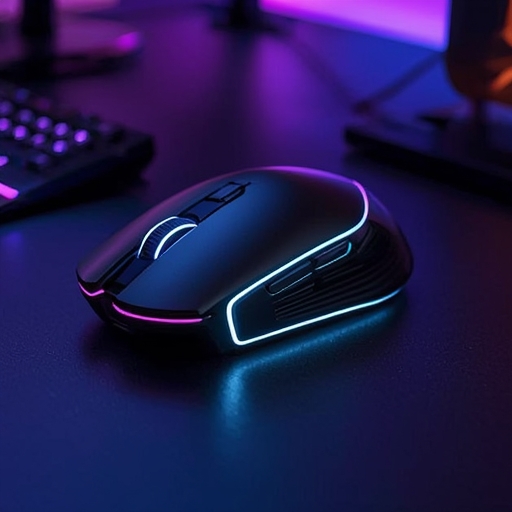
Turtle Beach has recently unveiled the Command Series MC7, an audacious addition to the modern landscape of gaming peripherals. At first glance, it presents itself as an ambitious reinvention of an everyday tool: a wireless gaming mouse enhanced by the striking inclusion of a 2.25-inch touchscreen display. Priced at $160, the device positions itself at the intersection of luxury aesthetics, cutting-edge innovation, and technical experimentation — a move that has quickly ignited debate among gamers and design enthusiasts alike.
This unconventional approach to a traditionally straightforward accessory raises an essential question within the realm of technology: when does forward-thinking innovation begin to verge on excess? The Command Series MC7 challenges our very perception of ergonomic design by introducing an interactive interface into a space previously dominated by tactile control and quick precision. While for some, this could signify an exciting leap toward intuitive customization, others might interpret it as an unnecessary complication — an over-engineering of an already refined piece of hardware.
From a functional perspective, Turtle Beach’s touchscreen-equipped mouse aims to reimagine both speed and convenience. Through the display, users can theoretically access configuration options, adjust sensitivity, monitor battery levels, or even switch gaming profiles without relying on external software. Such versatility evokes the kind of seamless control typically reserved for high-end keyboards or complex control panels. Yet, this very advantage underscores a paradox: integrating a miniature smart interface into a device meant to remain lightweight and easily maneuverable might ultimately challenge the balance between comfort and complexity.
The product’s unveiling has stirred reverberations throughout the gaming community and beyond. Some applaud Turtle Beach for its willingness to disrupt an otherwise standardized market, commending the bold pursuit of creative risk-taking. Indeed, in an industry often inundated with incremental upgrades, the MC7’s design dares to redefine what a mouse can be. However, skeptics maintain that the inclusion of a touchscreen, however sophisticated, risks overshadowing its fundamental purpose — delivering precise, responsive gameplay. In their view, this experiment might serve more as a conversation piece than as a practical enhancement for competitive use.
Ultimately, the Command Series MC7 stands as a fascinating commentary on the tension between innovation and functionality. It embodies both the promise and the peril of modern product design — a symbol of progress that simultaneously provokes reconsideration of what users truly need. Whether the MC7 emerges as a meaningful step forward or as an elegant exercise in technological extravagance will depend less on its specifications and more on how gamers respond to this fusion of novelty and necessity. For now, it remains an emblem of our era’s unrelenting enthusiasm to transform even the most familiar tools into symbols of futuristic aspiration.
Sourse: https://www.theverge.com/gadgets/918919/turtle-beach-mc7-gaming-mouse-touchscreen-command-series


