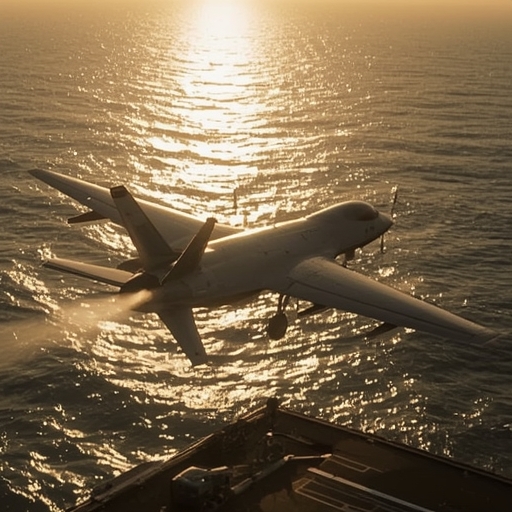
The United States Navy has officially reached a transformative milestone in the evolution of its aerial capabilities with the successful completion of the MQ-25A Stingray’s very first test flight. This achievement represents far more than a routine technological test—it heralds the dawn of a new era in carrier-based aviation and unmanned aerial innovation. The Stingray, engineered as the Navy’s pioneering unmanned aerial refueling aircraft, stands as a symbol of modern ingenuity, combining autonomous systems with mission-critical functionality to extend the horizon of naval operations.
During its trial flight, the MQ-25A demonstrated not only stable flight autonomy but also the enormous potential to revolutionize how aircraft carriers project power across vast distances. Traditionally, the reach of carrier-based aircraft has been constrained by the limits of onboard fuel capacity and the logistical demands of sending crewed refueling aircraft into the skies. The Stingray, by contrast, provides a strategic solution through its ability to autonomously perform mid-air refueling. With this new capability, U.S. Navy fighter jets such as the F/A-18 Super Hornet, F-35C Lightning II, and EA-18G Growler will soon be able to fly longer, strike farther, and remain on mission with greater efficiency than ever before.
Beyond its practical function, the MQ-25A represents a paradigm shift in how the Navy envisions the integration of unmanned systems into its operations. This aircraft seamlessly merges cutting-edge artificial intelligence and system reliability with aerodynamic refinement and mission adaptability. The data gathered from its inaugural flight will pave the way for further testing phases aimed at achieving full operational readiness—an essential prelude to mass deployment on U.S. aircraft carriers. Once operational, the Stingray will effectively serve as a force multiplier, enabling carriers to support a wider array of missions, decrease operational strain on human pilots, and elevate the overall effectiveness of carrier strike groups.
The implications of this event extend beyond the Navy alone. Defense analysts and aerospace engineers view the MQ-25A as a technological harbinger, signaling the future convergence of autonomy, endurance, and real-time decision-making in aerial warfare. More broadly, it underscores the continuing commitment of the U.S. defense sector to innovation, efficiency, and forward-thinking design. Just as previous generations once marveled at the first carrier-launched jets, today’s aviation community now witnesses the evolution of autonomy taking flight from the same decks.
The first test flight of the MQ-25A Stingray serves as both a scientific and symbolic triumph—a clear reminder that progress in aerospace technology remains deeply interwoven with national strategy and human ingenuity. As additional trials unfold, the data will inform refinements in performance, safety, and integration protocols, ensuring that the drone operates seamlessly within the complex ecosystem of carrier aviation. With this unprecedented achievement, the Navy reaffirms its role at the forefront of global maritime modernization and sets in motion a vision of skyborne operations defined by intelligence, precision, and endurance. #NavalInnovation #AerospaceEngineering #FutureOfFlight #USNavy #MQ25A #StingrayDrone
Sourse: https://www.businessinsider.com/us-navys-new-stingray-refueling-drone-test-flight-2026-4


