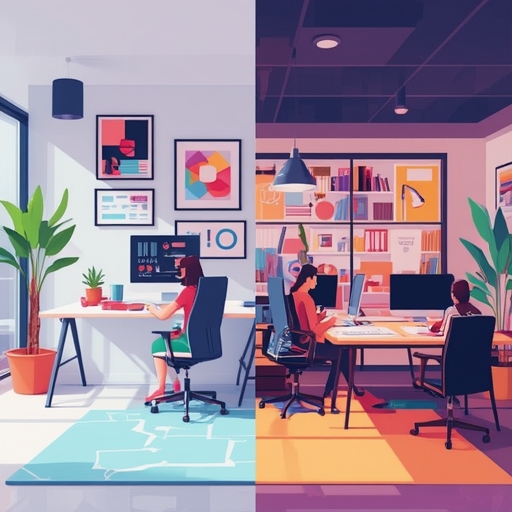
A powerful debate has reignited across business communities and professional networks following a provocative statement by a prominent fashion entrepreneur, who recently declared that working from home could amount to a form of ‘career suicide.’ Her declaration has swiftly polarized opinions, with some professionals acknowledging a certain truth in her claim, while others interpret her perspective as outdated and misaligned with the evolving realities of contemporary employment.
At the core of her argument lies the idea that close physical proximity within the workplace—those unplanned hallway exchanges, spontaneous brainstorming sessions, and the subtle mentorship that occurs when ambitious people occupy the same physical environment—serves as an irreplaceable catalyst for skill development and professional visibility. According to this viewpoint, young professionals benefit not simply from performing their tasks but from witnessing how leaders handle negotiations, resolve conflict, and seize opportunities in real time. Remote work, while convenient and efficient in some respects, can limit access to these nuanced experiences that often shape a person’s professional maturation.
However, the opposing camp contends that labeling remote work as ‘career suicide’ demonstrates a narrow interpretation of success. They emphasize how technological advancement has bridged physical divides, enabling virtual collaboration on a global scale. In their view, productivity, creativity, and ambition are no longer confined to the walls of an office building. Remote professionals, for instance, have leveraged digital tools to deliver innovation, maintain personal well-being, and achieve career milestones without being bound by geographical or temporal constraints.
The fashion executive’s insistence on the virtues of in-person work also touches on a broader philosophical question about what defines career progress in the twenty-first century. Does career advancement hinge on constant visibility to management and face-to-face engagement, or can dedication, output quality, and digital fluency be equally compelling indicators of leadership potential? The debate extends beyond the fashion industry, resonating throughout technology firms, creative agencies, and corporate offices worldwide.
This discussion inevitably intersects with generational differences in workplace expectations. Many younger employees prize flexibility, autonomy, and the capacity to integrate personal aspirations with professional responsibilities. In contrast, some veterans of traditionally structured industries continue to champion the discipline, focus, and sense of collective identity derived from sharing a physical working environment. Both parties, perhaps, seek the same goal—sustained growth and recognition—but differ in their methods of achieving it.
Ultimately, the controversy sparked by the entrepreneur’s statement underscores the complexity of our evolving relationship with work itself. Whether one perceives the home office as a realm of empowerment or isolation, the essential challenge remains finding a balance that honors both personal well-being and professional advancement. The future of work may not lie exclusively in the remote or the physical realm, but rather in a thoughtful integration that allows talent, regardless of location, to flourish.
Sourse: https://www.businessinsider.com/skims-cofounder-emma-grede-wfh-remote-work-downsides-social-issues-2026-4


