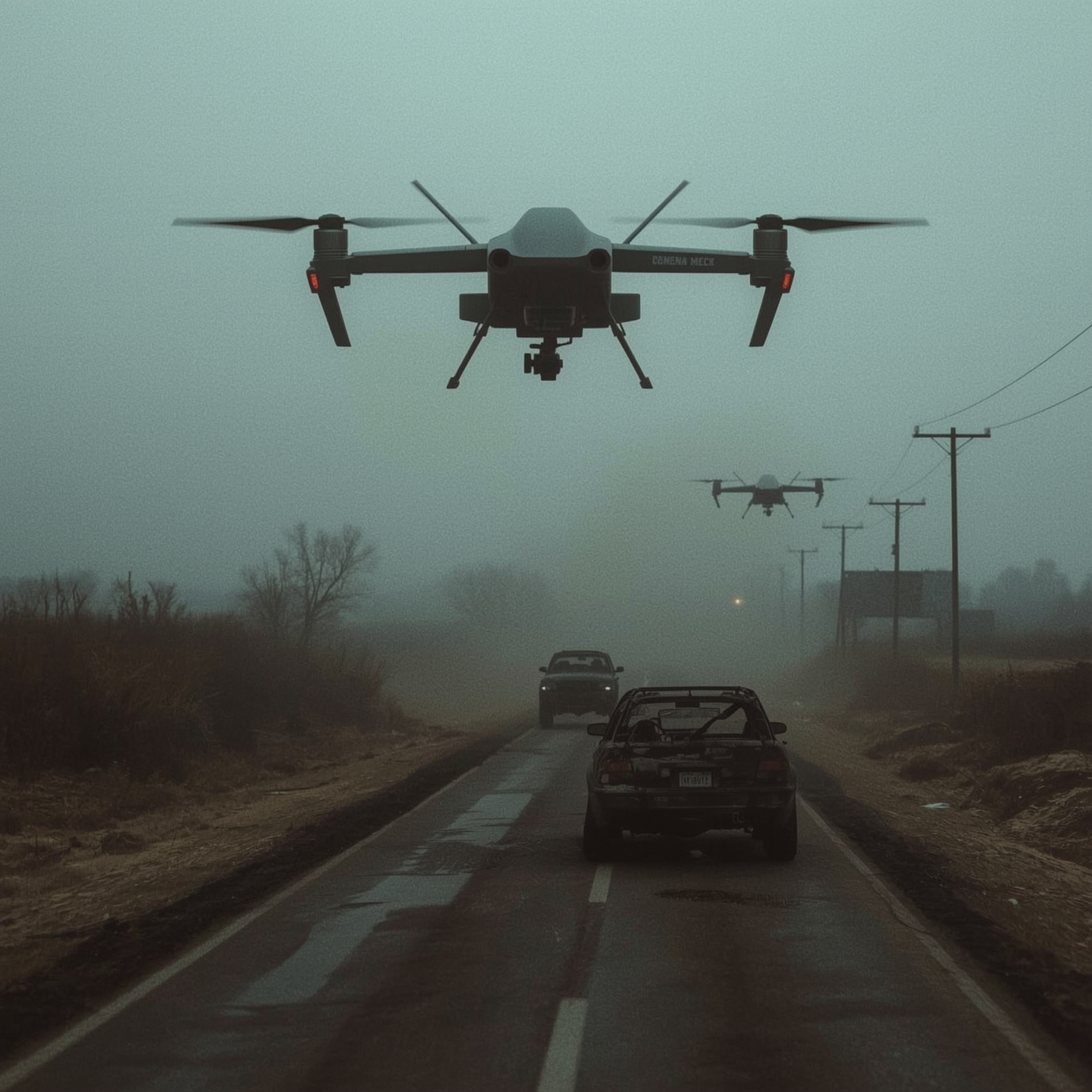
Russian unmanned aerial systems are increasingly being deployed in a highly calculated and insidious manner, with operators positioning them along key Ukrainian roadways to lie in wait before ambushing military vehicles as they pass. What were once considered relatively secure transport corridors have in many cases been transformed into lethal zones where each movement carries the risk of sudden destruction. This evolving battlefield tactic signifies a profound shift in the operational environment, eroding the ability of Ukrainian forces to move freely and safely within contested areas.
Ukrainian officers who spoke with *Business Insider* emphasized that Russian drone pilots are now concentrating their efforts on vital supply routes, particularly those close to the front lines. They are employing specialized fiber‑optic drones that remain impervious to the types of electronic interference and jamming techniques which traditionally blunt conventional drones. Because these drones maintain a stable connection to their operators through physical cables rather than relying on vulnerable radio frequencies, Ukrainian defenders face immense difficulty in countering them. As a result, the continuing series of ambushes has created serious disruptions for logistics operations, obstructing the transport of munitions, equipment, and personnel precisely where such resources are most critical.
The nature of this drone warfare recalls the improvised explosive device (IED) campaigns encountered by US and coalition forces in the Middle East, where roadside bombs posed continuous threats to patrols and convoys. Yet there is a significant and alarming difference in the Ukrainian context: unlike static IEDs planted in the ground, Russian drones possess the capacity to maneuver in the air, reposition themselves, and actively pursue vehicles. In this respect, they represent a synthesis of traditional guerrilla tactics with advanced unmanned technologies, making them even more challenging to predict or defend against. This underscores how uncrewed systems are redefining the dimensions of danger on the battlefield, heightening risks far beyond conventional scenarios.
One Ukrainian officer, identified only as Artem for security reasons, explained that Russian forces increasingly dispatch fiber‑optic drones to logistics corridors where they land unobtrusively near the roadside. The drones then lie dormant until an armored vehicle, such as a tank or infantry fighting vehicle, approaches. At that moment, the operator directs the drone to strike, executing an ambush that often proves catastrophic. According to Artem, such incidents now occur on a weekly basis, cumulatively exacting a heavy toll in both soldiers’ lives and valuable armored assets.
These drones are, on the surface, relatively inexpensive and deceptively simple. Fiber‑optic models fall into the category known as first‑person‑view (FPV) drones and can cost only a few hundred dollars, yet they carry small but deadly explosive payloads weighing several pounds. In contrast to standard FPV drones, which are guided by radio communication and therefore susceptible to jamming or interference, fiber‑optic drones are tethered by extremely thin cables that shield them from such countermeasures. This technological distinction renders them particularly perilous on the battlefield, since most electronic warfare defenses are unable to neutralize them.
While their effective range is somewhat constrained by the physical limitations of the cable and the complexity of terrain navigation, fiber‑optic drones are still able to traverse contested front lines and penetrate deeply enough into Ukrainian territory to set up lethal ambushes. Artem, who formerly served as deputy commander of Ukraine’s 3rd Assault Brigade and now directs military partnerships at the independent Snake Island Institute, stressed that routes once regarded as sufficiently secure have turned into treacherous gauntlets. The persistently looming threat of ambush has forced troops to reconsider their movements, often compelling them to remain in one location longer than planned rather than conduct routine rotations between positions.
The Ukrainian armed forces are now contending with the broader reality that drones in all forms have emerged as the single most dangerous menace to armored platforms across the theater of war. Assets such as tanks, infantry fighting vehicles, and armored personnel carriers are routinely singled out for attack by unmanned systems. To counteract these hazards, Ukrainian vehicles have been outfitted with improvised armor enhancements and equipped with sophisticated electronic warfare equipment. Nevertheless, as fiber‑optic drones cannot be disrupted via conventional jamming approaches, the options for defense are limited; physical barriers remain among the few practical measures.
Acknowledging this, Ukrainian engineers and combat units have taken proactive steps to mitigate the threat. Many prominent roads close to the front are now covered with improvised overhead netting, creating makeshift protective tunnels that hinder drones from swooping directly onto convoys. These alterations improve survivability but offer only partial security, as there are always openings through which drones can intrude. Alex Eine, section commander with Ukraine’s Separate Presidential Brigade, noted that adept Russian operators regularly maneuver drones through gaps in the netting, then land them in ambush positions, poised to strike when a vehicle enters their kill zone. He himself has personally witnessed Ukrainian vehicles being destroyed through such ambushes.
The mounting losses caused by drone operations have sparked broader debates concerning the continued effectiveness of armored vehicles in modern and future conflicts. Ukraine has effectively become a graveyard for armored systems, with thousands of tanks and troop carriers lost on both sides according to open‑source trackers. Nevertheless, Artem insists that despite substantial attrition, armored vehicles remain indispensable on the battlefield. In his view, offensive operations still rely fundamentally on the mobility, firepower, and protection that such platforms provide. Thus, although drones have exacerbated their vulnerabilities, armored vehicles cannot be considered obsolete, at least for the foreseeable future, within the context of high‑intensity warfare.
Overall, the adaptation of fiber‑optic drones as airborne ambush devices starkly illustrates how swiftly evolving technologies are reshaping combat dynamics. What was once primarily ground‑based guerrilla threat has now taken flight, merging low‑cost accessibility with lethality, and imposing new dangers that transform even the simplest act of driving down a road into a potentially fatal gamble.
Sourse: https://www.businessinsider.com/russia-turns-unjammable-drones-into-flying-bombs-ambush-ukrainian-vehicles-2025-10