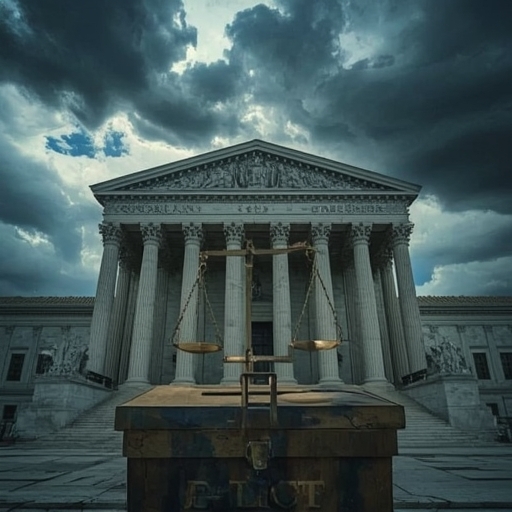
The Supreme Court’s most recent decision represents far more than a mere judicial adjustment or a technical reinterpretation of electoral regulations—it signifies a fundamental upheaval of one of the nation’s most vital safeguards for democratic participation. By effectively dismantling key elements of the Voting Rights Act, the Court has not only narrowed the legal definition of fairness but also redefined justice in terms that primarily preserve institutional and political power rather than the rights of individual citizens. This ruling transforms the very concept of equality at the ballot box into an abstraction, erasing decades of progress built through collective struggle and civic perseverance.
The broader implication of this development reaches far beyond the borders of Louisiana or the specific litigation in question. At its core, the decision reframes systemic inequity as impartiality, suggesting that efforts to rectify historical and ongoing discrimination somehow constitute unfair advantages. Through this inversion, the Court subtly shifts the moral balance of democracy—from a framework meant to amplify underrepresented voices to one that fortifies entrenched hierarchies and privileges. This is not simply a legal reconfiguration; it is a philosophical reorientation that turns the language of justice inward upon itself, using it to defend structures that perpetuate inequity.
For advocates of democratic integrity, the challenge arising from this ruling is both immediate and long-term. The erosion of voting protections undermines confidence in the electoral process, enabling subtle yet pervasive forms of suppression to reemerge under the guise of administrative neutrality. Without vigilant civic engagement and sustained public discourse, these measures risk evolving into silent barriers that disproportionately affect minority communities and marginalized constituencies. If unchecked, such developments threaten to normalize exclusion as an accepted political reality.
Now more than ever, it becomes imperative for informed citizens, policymakers, and community leaders to reaffirm their commitment to the foundational principle that every vote and every voice possesses equal worth. Constructive engagement—through education, advocacy, and participation in local and national discourse—constitutes the most effective response to judicial decisions that seek to dilute representation. Only by maintaining a collective focus on fairness, transparency, and inclusion can the democratic experiment endure against encroaching cynicism and manipulation.
Ultimately, democracy cannot survive when justice is reduced to a rhetorical instrument wielded in defense of inequality. The Supreme Court’s decision marks a pivotal moment that calls for renewed awareness, dialogue, and action. The preservation of voting rights transcends partisan interest; it defines the moral and constitutional essence of the United States itself. Citizens must therefore not only witness this transformation but actively resist it—insisting, through participation and conscience, that the republic remain accountable to those whose freedoms it was designed to protect.
Sourse: https://www.theverge.com/policy/921597/callais-louisiana-voting-rights-act


