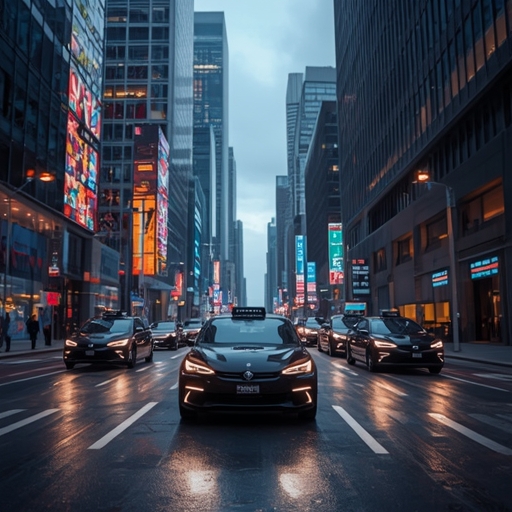
Waymo, a pioneering division within Alphabet focused on autonomous transportation technology, stands at the forefront of a revolution that is redefining personal mobility. The company’s robotaxi service, originally viewed as a futuristic experiment, has now matured into a complex and far‑reaching network that operates across eleven major U.S. cities. This expansion signifies not just operational growth but also a fundamental shift in how society conceptualizes safety, efficiency, and convenience in urban travel.\n\nWaymo’s vehicles—engineered through years of artificial intelligence, sensor fusion, and real‑world data refinement—are now completing millions of rides entirely without human drivers. Each ride represents a sophisticated orchestration of machine learning algorithms, high‑definition mapping, and real‑time environmental awareness. The technology continuously scans road conditions, interprets traffic behavior, and predicts the actions of nearby vehicles and pedestrians with remarkable precision. In practical terms, what once required a vigilant human behind the wheel is now achieved through a finely tuned digital intelligence that reacts faster than human reflexes could allow.\n\nThe company’s rapid progress illustrates both scalability and reliability. Operating in diverse metropolitan environments—from the dense traffic systems of Los Angeles to the unique layout of Phoenix—demonstrates Waymo’s ability to adapt to varied infrastructures and local regulations. Each deployment also functions as a large‑scale data generator, informing iterative improvements that enhance navigation algorithms, safety protocols, and passenger comfort.\n\nBeyond technology, the social implications are profound. Millions of completed rides mean millions of opportunities to evaluate trust, accessibility, and sustainability in automated mobility. For many first‑time passengers, stepping into a driverless car evokes curiosity and initial hesitation, soon replaced by astonishment at its smooth precision. With Waymo’s continued expansion, this experience is no longer exclusive to a handful of test users; it is becoming a shared, everyday reality for communities across the United States.\n\nAlphabet’s investment positions Waymo as a key architect of the transit systems of tomorrow. As urban populations grow and demand for efficient, low‑emission travel intensifies, fully autonomous fleets could alleviate congestion, reduce accident rates, and introduce new models of shared, on‑demand transport. While questions remain about policy, infrastructure, and societal adaptation, the trajectory is unmistakable: the self‑driving future has moved from the pages of science fiction into tangible modern life. Across eleven cities and counting, Waymo’s robotaxis embody the seamless fusion of artificial intelligence, engineering mastery, and human ambition—ushering in a safer, smarter, and fundamentally transformed way to move through our world.
Sourse: https://www.businessinsider.com/waymo


