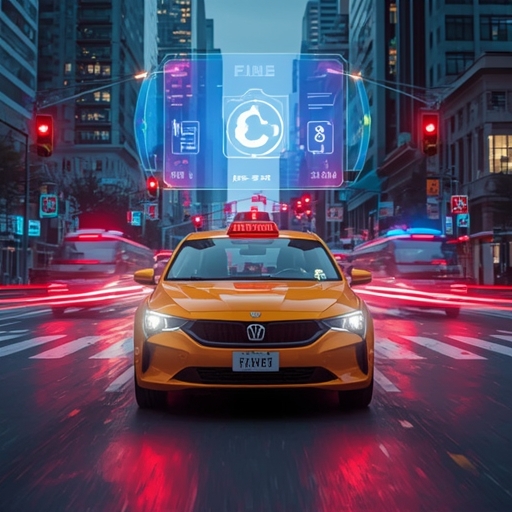
In the ever-evolving landscape of intelligent transportation, an intriguing and somewhat paradoxical question has emerged: can a self-driving vehicle, often referred to as a robotaxi, actually be issued a traffic ticket? This inquiry delves much deeper than mere curiosity—it touches on the intersection of technology, ethics, and law as society adapts to a future increasingly shaped by autonomous mobility. As artificial intelligence systems assume more control over our roads, the distinction between human accountability and algorithmic decision-making grows increasingly blurred.
The concept of a robotaxi—an autonomous vehicle engineered to transport passengers without human intervention—embodies both technological triumph and regulatory complexity. Traditionally, when a driver commits a traffic violation, law enforcement identifies the individual responsible and assigns a penalty accordingly. Yet in the case of a vehicle without a human operator, this model no longer applies. The automated driving system cannot be served with a citation in the conventional sense, and attributing responsibility becomes a nuanced issue involving designers, software developers, fleet operators, and even municipal or state regulators.
Consider a practical scenario: a fully autonomous taxi operating within a bustling metropolitan environment misinterprets a stop signal due to ambiguous road markings or environmental interference. Who, in this instance, bears culpability? Is it the corporation overseeing the fleet, the developers responsible for the decision-making code, or the end passenger merely riding inside? Such questions are not hypothetical abstractions—they are already challenging policymakers, insurers, and manufacturers worldwide. The very infrastructure of traffic law, built upon the presumption of human agency, must now reconcile itself with entities that act through logic rather than intuition.
TechCrunch Mobility’s latest analysis delves into these dilemmas, bringing together perspectives from automotive innovators, legal theorists, and government agencies to explore how enforcement mechanisms may evolve in tandem with automation. Some jurisdictions are beginning to experiment with accountability frameworks that treat autonomous systems as extensions of their parent companies, ensuring that civil responsibility remains traceable—albeit indirectly—to human decision-makers. Others propose entirely new regulatory paradigms, where artificial intelligence behavior is audited and certified much like the mechanical safety inspections of older vehicles.
Beyond legality, the philosophical implications are profound. A traffic ticket issued to a robotaxi may seem absurd, yet the act symbolizes society’s effort to preserve order amid sweeping technological disruption. In redefining mobility, we must also redefine responsibility. As cities adopt smarter infrastructure—digital signals, cloud-connected intersections, adaptive road surveillance—the dialogue between technology and governance intensifies. Ensuring fairness, transparency, and public safety in this emerging environment demands not only innovative algorithms but also thoughtful human oversight.
Ultimately, the question of whether a robotaxi can receive a ticket extends far beyond fines and enforcement; it encapsulates our collective negotiation with autonomy itself. The future of transportation hinges not solely on the vehicles we build, but on the values and regulations we choose to embed within them.
Sourse: https://techcrunch.com/2026/05/03/techcrunch-mobility-how-do-you-issue-a-ticket-to-a-robotaxi/


