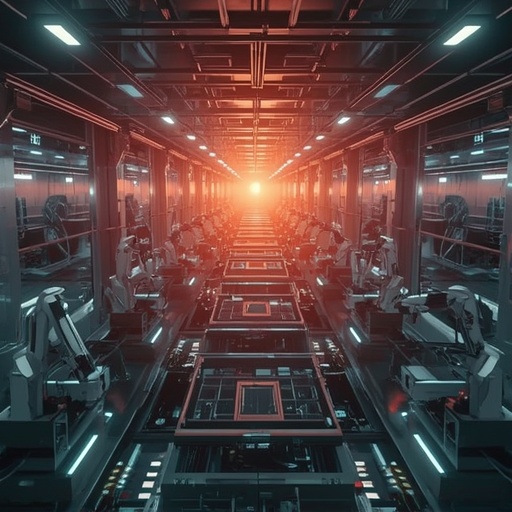
SpaceX has unveiled one of its most ambitious undertakings to date: a staggering $55 billion investment directed toward the establishment of a monumental AI chip manufacturing complex, aptly named ‘Terafab,’ to be located in Austin, Texas. This strategic initiative is far more than a mere expansion of production capacity; it represents a transformative leap toward redefining how advanced computational hardware will be conceived, built, and scaled in the coming decades. By choosing to anchor this facility in Texas—a burgeoning hub for technological innovation and industrial energy—SpaceX is signaling its intention to merge the frontiers of space technology with the rapidly expanding world of artificial intelligence research and infrastructure.
The ‘Terafab’ facility is expected to place SpaceX at the vanguard of a technological revolution where chip manufacturing independence and advanced processing power are no longer just competitive edges, but foundational pillars of the AI-driven future. As artificial intelligence increasingly permeates every sector—from autonomous navigation systems and interplanetary communications to robotics and real-time data analysis—the need for custom-designed, robust, and energy-efficient hardware becomes indispensable. SpaceX’s foray into this field suggests not only a desire to support its own mission architectures but also to contribute materially to global technological ecosystems that depend on resilient, scalable semiconductor supply chains.
This extraordinary investment underscores the company’s unrelenting commitment to technological sovereignty and innovation leadership within the United States. At a time when microchip shortages and supply bottlenecks have revealed vulnerabilities in global technology networks, SpaceX’s initiative can be viewed as both visionary and pragmatic—a decisive effort to reinforce domestic capability in a domain that serves as the backbone of digital and scientific progress. The ‘Terafab’ project, therefore, is poised to catalyze advancements not only in AI development but also in aerospace applications, data processing infrastructure, and beyond.
Ultimately, SpaceX’s move illuminates a broader narrative about the converging horizons of artificial intelligence, advanced manufacturing, and interstellar ambition. By integrating its expertise in automation, sustainable energy, and large-scale engineering, the company is creating an ecosystem where AI innovation can thrive at unprecedented speeds. The ‘Terafab’ plant in Texas is more than a construction project—it is a declaration of intent, a powerful statement that the next era of technological evolution will be built on foundations designed intentionally for the intelligent systems shaping humanity’s future.
Sourse: https://www.theverge.com/ai-artificial-intelligence/926356/spacex-terafab-plant-cost-ai-chips


