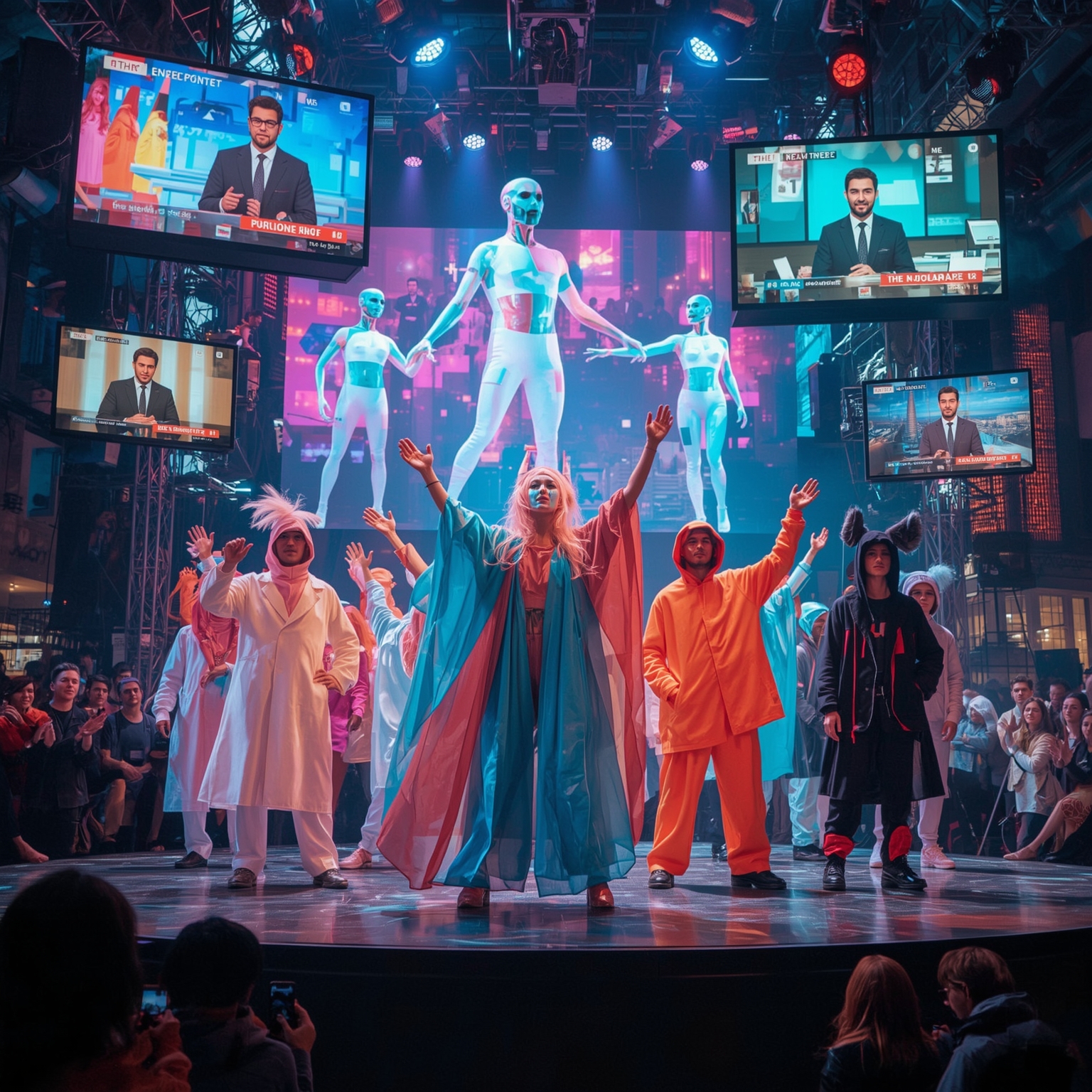
Picture a digital feed in which the boundaries between sacred imagery, Broadway theatrics, celebrity parody, and internet meme culture collapse into one continuous stream of AI-generated spectacle. On one scroll you might encounter a stylized anime reimagining of Jesus Christ dramatically overturning tables; on the next, OpenAI employees energetically performing musical numbers while dressed in elaborate Hamilton-inspired stage costumes. Interspersed are simulated television anchors solemnly narrating fabricated news segments, a young man orchestrating a TikTok-style dance performance aimed at projecting allure, and surreal renderings of OpenAI’s chief executive, Sam Altman. In these clips, he alternates between absurd scenarios such as being caught on CCTV seemingly stealing GPUs, listening gravely to business pitches, and even dissolving into tears. This kaleidoscope of scenes illustrates the unpredictable nature of my initial experience exploring Sora — OpenAI’s newly released social platform for AI-generated video creation.
The app, launched publicly on iOS earlier in the week, enables users to produce videos of up to ten seconds that can depict virtually any concept, no matter how whimsical, strange, or personal. Among its central features is the so‑called “cameo” function, where users can generate videos not only of themselves but also of friends or colleagues who explicitly grant permission for their likeness to be used. Within briefings to journalists, OpenAI employees emphasized that they see Sora as possibly occupying the same cultural tipping point for video generation that ChatGPT represented for text-based AI. And the rapid adoption metrics seem to support that optimism: by Friday, the application had already risen to occupy the number-one spot on Apple’s App Store ranking of free apps.
Yet beneath this popularity lies pronounced ambivalence. Critics quickly juxtaposed OpenAI’s often lofty ambitions — framed around cutting-edge research and advancing safe artificial intelligence — with the reality of Sora’s output, which primarily consists of deliberately comical or surrealist video snippets. Posts mocking this disconnect spread widely enough that Sam Altman personally addressed the issue. Alongside satire, thoughtful concern has circulated as well. Analysts, technologists, and everyday users alike worry about the consequences of AI-driven video tools capable of creating ultra-realistic depictions of individuals without sufficient safeguards. Problematically, these tools could lower the barrier for spreading misinformation or generating manipulative deepfakes. While some observers dismiss the platform as nothing more than a frivolous meme engine, others view it as a harbinger of acute societal challenges.
Even within OpenAI, opinions are not monolithic. Certain employees have expressed unease at the implications of their employer’s creation. John Hallman, who works in pre-training research, acknowledged in a public post that he personally felt concerned when he first learned of Sora’s release, though he carefully noted that the team implemented design measures aimed at cultivating a safe and constructive experience. Boaz Barak, part of OpenAI’s technical staff, articulated a nuanced reaction: he declared himself simultaneously impressed and worried. He praised the technical achievement, yet cautioned that it is premature to assume the company can completely avoid the toxic patterns established by other social platforms, particularly those involving manipulation and deepfakes. While optimistic about certain safeguards that have been put in place, he warned that no team can fully anticipate how a product of this magnitude will be used once it enters the unpredictable landscape of the real world.
Compared to similar experiments by competitors — such as Meta’s experimental app Vibes — Sora may hold a temporary but potent advantage: its ability to let users humorously transform themselves, essentially memeing their own identity into entirely new narrative contexts. OpenAI appears to have recognized the viral energy behind AI trends that invite people to recast themselves as animated characters, stylized figures, or fantastical versions of their digital avatars. Sora builds directly upon this impulse by positioning self-transformation as its core structure. Thus far, this approach has resonated; users are reportedly consuming its feed in a manner strikingly reminiscent of TikTok, endlessly scrolling through snippets of absurd and surreal entertainment. The long-term question, however, is whether such synthetic trends can ever fully substitute the authenticity of real individuals sharing genuine emotions, opinions, and voices once the novelty of gimmicks — such as Altman appearing as a full-bodied cat — inevitably wanes.
Upon joining Sora myself, I was immediately greeted with warnings and disclosures. The platform informed me I was “about to enter a creative world of AI-generated content.” It also stated that my activity might be used for training purposes and that personalizations might draw upon ChatGPT’s memory feature — though users retain controls within settings to moderate these practices. My personal feed primarily consisted of OpenAI employees playfully satirizing themselves, tutorial-style demonstrations explaining how best to exploit Sora’s features, and a smattering of animal videos. This dominance of employee-created material was unsurprising, as staff had privileged access prior to public rollout and general invitations remain limited; nevertheless, encountering so little organic user content outside that circle underscored the platform’s still-nascent stage.
Despite this immaturity, Sora already confronts pressing ethical questions about reality perception. The sign-up process required me to consent to likeness generation by recording myself moving my head side to side while reciting numbers. When I attempted my first personal video prompt, the system failed under heavy demand, advising me to “try again later.” A subsequent attempt involving a whimsical request for a clip of myself “running through a meadow” was surprisingly flagged as potentially suggestive or inappropriate. Yet when I substituted the word “frolicking” for “running,” the request was accepted without issue — a small but illustrative example of the unpredictable nature of content moderation rules. A reminder of caution quickly followed: those considering account creation should know that deleting one’s Sora account is currently impossible without simultaneously canceling their ChatGPT account, after which re-registration with the same credentials remains impossible. OpenAI confirmed work on a solution but no immediate timeline has been given.
The videos Sora generated of me were startling in their realism: my AI avatar’s voice sounded slightly distorted and the facial rendering showed some unnatural warping at the beginning, but overall the likeness proved eerily convincing. My friends’ reactions conveyed dissonance between technological awe and existential discomfort. One marveled at how closely the avatar resembled me, another openly questioned the product’s necessity with blunt skepticism, and a third reacted with visceral rejection, describing the video as deeply unsettling and triggering. These divergent responses encapsulate a broader ambivalence running throughout public discussion of the platform.
One intriguing feature is the cameo mechanism. Setting permissions allows users to control whether their likeness may be used solely by themselves, only by approved friends, by mutuals, or universally by the public. Many OpenAI staff members, including Altman, opted for the most permissive setting, enabling anyone to freely generate content featuring their digital doubles. Company officials outlined to the press that likeness generation of public figures is heavily restricted except when explicit consent has been granted — but early tests reveal inconsistencies. While attempts to generate a “young firebrand congresswoman” were blocked unless rephrased as a generic “politician,” prompts describing figures reminiscent of iconic tech leaders, such as a “successful tech executive in glasses and a black turtleneck,” were successful. These examples suggest that establishing definitive safeguards against misuse remains a daunting technical and cultural challenge.
Within just twenty-four hours, two of OpenAI’s most prominent launch promises appeared precarious: the company’s assertion that it could reliably stay ahead of copyright infractions and its assurance that it could effectively contain misinformation. Already, users reported generating videos featuring copyrighted fictional characters, from SpongeBob and Pikachu to Batman and Baby Yoda. Reports surfaced of grotesque outputs like Nazi-themed SpongeBobs and criminalized versions of beloved children’s icons. While some prompts were rejected as content violations, determination and creativity allowed users to bypass restrictions in many cases. This demonstrates how easily copyright boundaries can be breached once technology like this enters the public domain.
Another challenge lies in discerning fabricated content from authentic recordings. Even for this AI reporter, hyper-realistic videos of Sam Altman and fellow employees proved genuinely difficult to separate from actual footage. OpenAI assured that every Sora-generated video carries unmistakable markers — such as metadata and visible watermarks — to signal artificial origin. However, users discovered workarounds, including recording content via browser playback, where watermarks were faint, easily overlooked, or absent. Instructions on removing watermarks with external AI tools proliferated across the internet with alarming speed, reinforcing suspicions that the emergence of highly convincing deceptive content is an inevitability. Similar historic examples exist: Microsoft’s earlier image generator proved able to bypass filters for violent and sexual material, and xAI’s Grok recently produced scandalous deepfake celebrity imagery.
In the final analysis, Sora’s attraction, at least in its early life, seems rooted in novelty and amusement. The joy of producing humorous videos starring your friends, or exaggerating well-known figures such as Sam Altman, drives engagement far more than promises of revolutionary productivity applications. But this essential question remains: can a platform sparked by amusement and irreverence endure as more than a TikTok imitator? And should it? As our culture wrestles with the merging of entertainment, identity, and realism in the age of AI, OpenAI’s Sora may well mark the beginning of a paradigm shift in how we perceive online creativity — and possibly, how we distinguish fact from fiction entirely.
Sourse: https://www.theverge.com/ai-artificial-intelligence/791290/openai-sora-ai-generated-video-hands-on